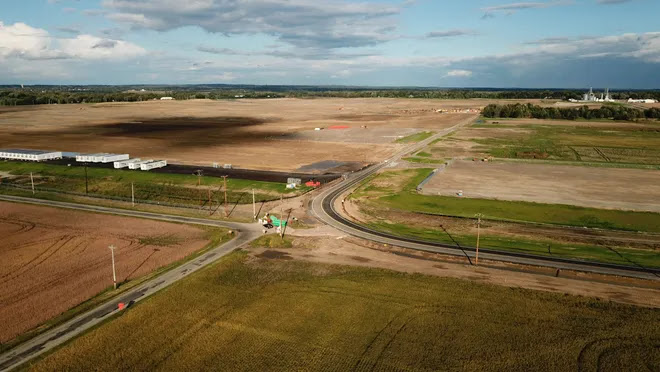
Intel's Ronler Acres Plant

Silicon Forest
If the type is too small, Ctrl+ is your friend

Showing posts with label Industry. Show all posts

Saturday, August 22, 2026

White Linen

View of Haarlem with Bleaching Grounds - Jacob van Ruisdael 1665

The painting's title takes me to Wikipedia which leads to asking Google about linen bleaching which gets me this:
In 1670, the linen bleaching process was a slow, multi-step photochemical method. Centered in places like Haarlem in the Dutch Republic, it required weeks of washing, boiling in alkaline lye, soaking in massive amounts of sour buttermilk, and prolonged exposure to sunlight on open grass fields (bleachfields).

More from Wikipedia:

The success of the linen-bleaching industry in Haarlem had reached its climax at the time that Ruisdael painted this work. There were other linen-bleaching centers in the Netherlands; however, none of these locations were endowed with the perfect mixture of natural resources that Haarlem had. During the seventeenth century, linen bleached in Haarlem was highly sought after and quite expensive; this was the cause of the economic prosperity in Haarlem and the wealth of Haarlem linen merchants. All linen bleached in Haarlem received the name toiles de Hollande, or "Haarlemmer Bleek," which means Haarlem bleach. Regardless of where the linen was woven, if it was bleached in Haarlem it was called toiles de Hollande.

I thought for sure 'wrapped in white linen' is a line in the song Lucky Man by Emerson, Lake & Palmer, but it's not. The line is from The Streets of Laredo by a host or artists.

Construction Physics got me started.

Tuesday, October 14, 2025

Baotou, China | The Worst and Most Important City You Never Heard Of


Baotou, China | The Worst and Most Important City You Never Heard Of
imperatur

Rivers in China
Pearl River is the one at the bottom

Good maps of rivers are rare. This is a nice one.

Left to right: Black Lake, Steel Mill, Frozen Kurdulun River, Baotou, China

Just checking to see whether the black lake actually shows up in Google Maps.

Friday, April 11, 2025

Cock O' The North

The London and North Eastern Railway (LNER) Class P2 locomotive, No. 2001, Cock o' The North, on the turntable at King's Cross Station, London, 1st June 1934. The new engine has just arrived from the LNER works in Doncaster. Image colourized by David P. Williams. (Photo by Douglas Miller/Topical Press Agency/Hulton Archive/Getty Images)

Just looking around the industrial parts of town, I was overwhelmed by the amount of steel that goes into these machines, structures, raillines, tanks and towers, and that's just one town. Every town in the industrialized world is built on a zillion tons of the stuff.

U. S. Steel Production vs. Imports

U. S. Steel Production peaked in the 1970s. Since then it has fallen by half. 

So why did this happen? Why did the U.S. go from a steelmaking powerhouse to an also-ran? As usual, there are a bunch of competing explanations — import competition, bad management choices by steel companies, and unions raising wages to uncompetitive levels. But while these were factors, the biggest reason the U.S. steel industry went into terminal decline was that we stopped building things that used lots of steel. - Noahpinion

Global Steel Production

U. S. and Russia steel production are about equal.

Monday, April 29, 2024

Peak Behind the Curtain

Roll Levelling Machine
with detail of the sheet bending between the rolls

When I hear about 'infrastructure' in discussions about the economy, I think of roads and bridges and dams, huge things that you can't friggin' miss if you go outside. What isn't often mentioned, and what you seldom see is all of the machinery inside of all of the factories that are busy making all the widgets that make our cushy, civilized life possible.

Driveshafts connecting the gearbox (foreground) to the 'large leveler' (background)

Bustednuckles has a post up that gives us a peak behind the curtain. He  had a very long day at work yesterday installing a gear box for a 'large leveler'. This machine is for relieving internal stresses in sheet metal as it is taken off of big rolls. The way it works is nuts. Why would bending sheet metal back and forth multiple times relieve stress? Sounds like it would just add more stress, but what do I know? Evidently it's a proven technique, so every place that is taking in big rolls of sheet metal direct from the rolling mill is going to have at least one of these.


Thursday, February 24, 2022

Hulett Unloaders


Cleveland's Forgotten Hulett Unloaders
Railroad Street

These machines look like something out of science fiction story, but they were real and existed all around the Great Lakes for the entire 20th Century. Prime examples of Victorian Engineering. Hard to believe it took them 100 years to start using conveyor belts. I suppose once you've invested a zillion dollars in building these monsters you are going to get your money's worth out of them.

Never thought about it before, but the shipping season only lasts nine months because the Great Lakes freeze over. If you are running a steel mill you probably don't want to shut down for three months every year, which means you need to stockpile a couple of million tons of ore to get you through the winter. You'd need acres of space to store it.

And now that I'm thinking about it, Pittsburgh was another big steel town. What do you need to make steel? Coal and iron ore, so you could use a train to haul iron ore from Cleveland to Pittsburgh and then use the same train to haul coal back from Pittsburgh to Cleveland. Paying freight both ways, a railroad man's dream.

I took the dates (there are a bunch of them) and put them in a spreadsheet:

Thursday, February 17, 2022

Evacuation of Industry: That Time the Soviet Union Moved 1,500 Factories


This video starts with an ad, the video proper doesn't really start until 1:20 mark. Pressing the right arrow key should jump you ahead by five seconds, and pressing it 15 or 16 times should get you to the start of the video.

I've heard about this mass migration of factories before, but not just how massive this project was. And the whole context thing was helpful. I have only a rough idea of Soviet history. The first 20 years of the 20th Century seem to be particularly jumbled with WW1, civil war and the Bolshevik revolution all happening in the same time period. It's hard to imagine the amount of progress they made crammed into just the few decades between WW1 and WW2, stuff that the West had been developing for Centuries.


Tuesday, May 11, 2021

Aluminum

Powerhouse, Aluminum Company of America (Alcoa), 1950

You need a great deal electricity to make aluminum. That's why we have these giant dams with their giant hydroelectric power plants all over the Cascade Mountain Range here on the West Coast. Or maybe the aluminum smelters came because of the relatively cheap power. But aluminum is evidently so valuable that building your own power plant is a worthwhile proposition. 

By the mid-1950s, the Aluminum Company of America (Alcoa) had 220 normally scavenged and 22 supercharged Nordberg radial engines installed in its Port Lavaca, Texas aluminum plant. Combined, these engines could produce 475,000 hp (354,207 kW). The engines were arranged in seven powerhouses, consisting of around 40 engines each. - Old Machine Press

The plant at Port Lavaca was shut down a couple of years ago. 

Alcoa Plant, Point Comfort, Texas

Point Comfort is on the Gulf Coast about 100 miles SW of Houston and a hundred miles SE of San Antonio. Looks a lot like other industrial sites around the shores of Galveston Bay, east of Houston.

Gunpowder and fertilizer (ammonia) production are also big power eaters.

Via daily timewaster

Thursday, April 7, 2016

Land Locked Boat Builder

Uniberp got me started with a video about building a steel hulled sailboat. These videos are a little longer than my usual fare. They run 11, 14 and 9 minutes. I enjoyed them thoroughly.


Sandblast Profile Comparator

They start out with technical discussion of surface preparation but then wander off into all kinds of various metal working, which got me to wondering just who are these guys? Which lead to this:


DIY Boat Propeller - Part 5 - The Success

Casting is one of those things that kind of gets glossed over whenever people are talking about machinery. Conceptually simple, you just pour molten metal into a mold, let it cool, and presto, there's your part. In practice there are a whole lot of details that have to be dealt with. I am sure that somewhere else in their series of videos they explain where the pattern comes from.

This boat is under construction in Tulsa, Oklahoma, of all places. How are you going to get it to the ocean? I mean it is obviously a deep water boat. Turns out Tulsa has a port. (No way, dude!) No ocean going ships, but plenty of barge traffic, and the waterway connects to the Mississippi and so to the Gulf of Mexico and all the oceans of the world.


Tulsa Port of Catoosa

Continental USA Inland Waterways

The Eastern USA is riddled with navigable waterways. The West Coast, no so much. I could not find a good map. This one is small and blurry. All the others either included some commercial distortion or were missing pieces. This one at least includes all the important parts.

Wednesday, January 27, 2016

Kerr Mason Jar

Kerr Wide Mouth Mason Jar
I've been saving my dead alkaline batteries in an old Mason jar in the hope of eventually recycling them. Dead batteries shouldn't be sent to the landfill, right? Like everybody saves their dead batteries in hope of their eventual resurrection. Whatever. I save mine. Someday I may even take them to someone who recycles them, or at least claims to. 
    Anyway, I'm looking at this Mason jar and I got to wondering about the whole Mason jar culture. I mean, everybody and their mother (especially their mothers) used to can stuff (fruits and vegetables, mostly) in Mason jars. I suppose some people still do. But I got to wondering just how big was the Mason jar empire. It must have been huge. So I do a little checking and I found some history with some characters, and some evidence of great wealth, but no actual numbers.
    I wrote to Ball, who used to be a big player in the Mason jar business but have since moved on to more profitable things like bullet proof glass for the DoD. All I got back from them was mindless corporate drivel.     The entire Mason jar business, such as it is, seems to have been absorbed by Jarden Corporation in Florida, who don't actually make anything, they just control a small empire of companies that do make stuff. I suppose that's about as close to actually making stuff as corporate America gets these days.
    So now I'm looking around and I found this little bit, which puts Kerr, another big player in the Mason jar empire, in Portland, Oregon.

Company History from Lehman Brothers
Then I found this about Kerr innovations:


From an obituary in the Los Angeles Times I extracted this:
Alexander H. Kerr founded the Kerr Glass Manufacturing Corp., the company famous for its mason jars for home canning, in Portland, Ore., in 1903 and moved it to Los Angeles in 1920. He died in 1925, and his wife, Ruth Kerr, ran the business until her death in 1967.
More info about Kerr from Glass Bottle Marks :

Kerr Glass Manufacturing Company
(“Corporation” after 1927)

Portland, Oregon (1904-1912, offices only)
Los Angeles, CA (1919-1992, offices only)


Kerr did not actually manufacture glass during the earliest period from 1904 to 1909, but had glass made for them (with the Kerr name embossing) by other companies. In 1909 their first glass manufacturing plant opened at Altoona, KS. Kerr had glass manufacturing plants located at:
  • Altoona, Kansas (from 1909-1912); 
  • Sand Springs, Oklahoma (beginning in 1912); 
  • Huntington, West Virginia (from 1933; this plant closed December 7, 1982); 
  • Santa Ana, California (from 1943); 
  • Plainfield, Illinois (from 1964); 
  • Dunkirk, Indiana (from 1968); 
  • Millville, New Jersey (1968) and 
  • Waxahachie, Texas (from 1968).
I also found a story about the Kerr glass bottle factory that survived the big  San Francisco earthquake of 1906.
Take that, Ball.

Saturday, November 7, 2015

Wiki Wander

144 Tall Fiberglass Pyramid in Russia built by Dr. Alexander Golod.
I'm not a great believer in the mystical properties some people, like Dr. Golod, attribute to pyramids, but having a positive mental outlook can help one overcome all kinds of difficulties, and if a pyramid can help you with that, well, then, I'm all for it.

Palace Of Peace And Reconciliation. Astana, Kazakhstan  2004 - 2006.
Looking for more pictures of Russian pyramids turned up the Palace Of Peace And Reconciliation in Astana, Kazakhstan. It was designed by Sir Norman Foster. Okay, who's that? Wikipedia tells us that he is one of Britain's most prolific architects of his generation. He grew up in Manchester, England:
Manchester was 'one of the workshops of the world' and 'the embodiment of a great city'; his father, Robert, worked at Metropolitan-Vickers at Trafford Park [a suburb of Manchester] which fuelled Foster's interest in engineering and design.
Metropolitan-Vickers? Vickers I have heard of, big British industrial outfit, widely known for their machine gun, but this branch made their own name, not that I had ever heard of it:
Metropolitan-Vickers, Metrovick, or Metrovicks, was a British heavy electrical engineering company of the early-to-mid 20th century formerly known as British Westinghouse. Highly diversified, they were particularly well known for their industrial electrical equipment such as generators, steam turbines, switchgear, transformers, electronics and railway traction equipment. Metrovick holds a place in history as the builders of the first commercial transistor computer, the Metrovick 950, and the first British axial-flow jet engine, the Metrovick F.2. Their factory in Trafford Park, Manchester, was for most of the 20th century one of the biggest and most important heavy engineering facilities in Britain and the world. - Wikipedia.
I've heard of Eniac, the world's first computer, but it was built with vacuum tubes. Vacuum tubes are great devices, but when you are using mass quantities their reliability begins to make life difficult. Using one tube means you need to keep one spare on hand. Using a zillion means you need to keep a bunch of spares on hand and you need to a small of army of technicians whose sole job is to run up and down the aisles of the computer (it's big) and replace burned out vacuum tubes. So making a computer out of transistors was a huge step up. Metrovick built 6 of the things and used them in their business for several years. Couldn't find
any pictures.
    A little farther on in the same article, I came across this:
On 15 November 1922 the BBC was registered and the BBC's Manchester station, 2ZY, was officially opened on 375 meters transmitting from the Metropolitan Vickers Electricity works in Old Trafford.
375 meters? What's that in Hertz? 800K. That put's it in the commercial AM broadcast band, meaning you can pick it up with your car radio.  800KHz is a "Clear Channel" frequency, which is whole 'nuther can of worms.
    I'm going to stop now as my wife is telling me I have chores to do.

Sharon got me started by sending me a link to an article about Dr. Golod.
Title from Tam.

Wednesday, October 28, 2015

Chain

Jumble got me started and I followed the chain. Other people, like you, might have followed other links, but these are the ones I followed.


The captions in today's Jumble cartoon sound awfully specific. Could it be referring to a real world event? Google turns up a story about Travis Barker, a drummer from Fontana, California, who has written just such a book. John, Sammy and Sir Paul (mentioned in the caption) might be Johnny Cash, Sammy Hagar and Paul Wall. Travis survived a nasty plane crash seven years ago in South Carolina.

Fontana may not be a thriving metropolis, but it does have its points:
Kaiser Steel, Fontana, California, back in the day.
Kaiser Steel built the largest steel plant on the West Coast during World War II. Located in the Los Angeles area’s Inland Empire town of Fontana, the plant operated for many years after the war, and employed more than 2,500 workers at its peak. Kaiser Steel declared bankruptcy in the 1980s, and much of the plant was torn down and redeveloped. Some of its modern components were purchased by the Chinese government, disassembled by a Chinese crew, and reassembled in China. A large part of the plant was paved over and turned into an automotive race track, the Automobile Association’s California Speedway. Another portion is operated as California Steel Industries, making pipe and steel products out of slabs and rolls from other sources. As one of the few remaining heavy industry sites near Los Angeles, the site is a common filming location. It was used as a location for the film Black Rain, and for the Schwarzenegger showdown with the cyborg in Terminator II. The film Pearl Harbor was refused permission to film at the site because the operator of the plant, California Steel, was partially owned by Kawasaki Steel, a Japanese company. - Center for Land Use Interpretation
One steel mill leads to another:
Geneva Steel © Chris Dunker (Dunker Imaging)
The Last Open Hearth In The U.S. was closed down in December 1991 at Geneva Steel in Utah. The end of an era for a nation that, in 1970, still produced nearly 40% of it’s raw steel out of open hearth furnaces. The Geneva OH-shop [Open Hearth shop] contained ten 340 ton furnaces first tapped in 1944 . . . Large portions of the mill (caster, plate and strip rolling mill) were sold to Chinese steel maker Qindago Steel. - Steel-Photo dot org
Huh, another steel mill dismantled and shipped to China. Sounds a lot like what the Russians were doing to their own stuff when the Germans invaded in WW2 (dismantled their industry and shipped it farther east, out of the reach of the Germans). Also a lot like what the Germans were doing when the conquered another country (take their stuff and ship to the fatherland) and what the Russians did after the war (take the German's stuff and ship it to the motherland.)

Anyway, Open Hearth Furnaces were the way to make steel, up until about 1950 when Basic Oxygen Steelmaking came to the for. The Basic Oxygen process was so much quicker and so much more efficient it would have made sense to shift over as rapidly as possible, but that didn't happen. Problem was that the steel companies had a huge investment in the Open Hearth process and they couldn't afford to write it all off.

While I'm following this trail of steel, I came across this very cool picture:
Rolling Mill Operators inside the helmstand of the 44 inch blooming mill at the Republic Steel company in Cleveland, USA, after 1968. Left to right: The stationary steam engineer, the roller, the manipulator.
And this one:
80 years ago Mexican Artist Diego Rivera finished his famous murals of the Ford  River Rouge plant.
The Ford River Rouge complex was the largest integrated factory in the world. Over 100,000 workers were employed there in the 1930s. Hyundai's factory in Ulsan, South Korea is now the largest.

P.S. Another view of the mural here.