Intel's Ronler Acres Plant

Silicon Forest
If the type is too small, Ctrl+ is your friend

Showing posts with label B-17. Show all posts

Friday, June 19, 2026

Boeing B-17 Flying Fortress

Chariots of Fire - Loren Blackburn

We built over 12,000 B-17s, but only 5,000 went to Europe. Thousands were used for training stateside. A few hundred were sent to the Pacific theater. Who knows how many ended up on the scrap pile.


B-17 gunners and fighter gun cam video
OkraJoe


The TERRIFYING Side of B-17 Flying Fortress Crews
Unbelievable true stories


Masters of the Air Clip - “Battle of Münster” (2024)
Action Society

The National Archives and Records Administration has the image at top.
The B-17 has been mentioned here before, once or twice.


Wednesday, June 10, 2026

Messerschmitt Bf 109

Bf 109-G14

From Wikipedia:

The Messerschmitt Bf 109 is a monoplane fighter aircraft that was designed and initially produced by the German aircraft manufacturer Bayerische Flugzeugwerke (BFW). Together with the Focke-Wulf Fw 190, the Bf 109 formed the backbone of the Luftwaffe's fighter force during the Second World War. It was commonly called the Me 109 by Allied aircrew and some German aces/pilots, even though this was not the official model designation.
The Bf 109 was designed by Willy Messerschmitt and Robert Lusser, who worked at BFW during the early to mid-1930s. . . . First flown on 29 May 1935, the Bf 109 entered operational service during 1937; it first saw combat during the Spanish Civil War.
During the Second World War, the Bf 109 was supplied to several states and was present in quantity on virtually every front in the European theatre; the fighter was still in service at the end of the conflict in 1945. It continued to be operated by several countries for many years after the conflict. The Bf 109 is the most produced fighter aircraft in history, a total of 34,248 airframes having been produced between 1936 and April 1945. Some of the Bf 109 production took place in Nazi concentration camps through slave labor.


Why 70% of Bf 109 Pilots Died
Unbelievable true stories


The Stigler-Brown Incident Animation
C-bass Productions

YouTube blurb:
"If I ever see or hear of you shooting at a man in a parachute, I will shoot you myself."

Those were the words that came to Franz Stigler's mind when he saw the badly damaged B-17 that was somehow still flying. To him, that plane limping back to England with its wounded crew was the same as a parachute. This story was kept classified for the remainder of the war and only came to light when the two pilots managed to find each other again in 1990.

Monday, August 25, 2025

Lucky 666

Lucky 666

I got to thinking about WW2 in the Pacific the other day. My Dad flew as a tail gunner in a B-24 during the war, but he never told me much about it, so I'm thinking there ought to be some books about it, and there are. This one is pretty great.

Port Moresby, Rabaul and Bougainville Island

Lucky 666 is the story of Jay Zeamer, troublemaker, misfit and pilot enamored of the B-17 bomber. The story concentrates on Port Moresby on New Guinea, Rabaul on New Britain and Bougainville Island. The distance from Port Moresby to Rabaul is 600 miles, the same as the distance from London to Berlin.

The climax occurs when Lucky 666 is attacked by a mess of Japanese Zeros while they are attempting to photograph the west coast Bougainville. The Zeros preferred method was to attack head on as the front of the B-17 has the fewest number of guns available to shoot back and is the most vulnerable with the glass nose. The book tells us that after they have made an attack run, it takes the Zeros ten minutes to circle around and come back for another pass. I'm guesstimating a zero can make a U-turn in about 6 seconds, but that will only put them about 1,000 feet to the side of the B-17's flight path. They will also now be a third of a mile behind the B-17, so they will still be in range of its guns. Zeros fly over 300 MPH and a B-17 taking photos is only flying at 200 MPH, so the Zero will be able to catch up to the bomber. The Zeros don't want to just catch the bomber, they want go way past it so they can turn around and head back towards it so they are heading right towards each other. That tight turning radius means they will only be 1,000 feet away from the bomber as they go by which is well within range of the top, tail, waist and belly guns, so they might want to be a little farther away which means a larger turning radius and more time taken. Now the Zero has to catch up to the B-17, then it needs to get several miles ahead so it has time to make another U-turn and time to line up its sights and fire a mess of bullets at the nose of the B-17. So, yeah, I can see that it could take ten minutes.

Metrogon Camera

Trimetrogon camera installed in B-17

Aerial reconnaissance was done using Trimetrogon cameras which were a lash up of three Metrogon cameras arranged so they covered a wide swath of ground. This swath of ground was perpendicular to the line of flight. By taking a set of three photos every few seconds a great deal of land could be covered with one pass.

Relationship of cameras to ground for trimetrogon photography (three cameras)

Metrogon cameras used nine inch wide film. If we assume a resolution of 600 pixels per inch, that's like 30 million pixels. Modern 35mm film might have a resolution equivalent to 3,000 pixels per inch. Funny, I could not find an article that gave a good account of the film versus digital images. They all seem to be tangle of mumbo-jumbo. Seems to me you should be able to make straight forward comparison.

Fairchild K-17 Camera

The Fairchild K-17 camera also used nine inch film. I suspect the camera body is the same as the one used with the Metrogon. Near as I can tell, the Metrogon name comes from the fancy, wide-angle lenses they used.


Wednesday, August 12, 2020

Push the Button

Crash landed B-17 and Pilot Controls
From  The UX of LEGO Interface Panels by George Cave:
Differentiating inputs 
What could cause 400 WWII pilots to raise the landing gear on their B-17 bomber just before touchdown? Catastrophic pilot error, or something more fundamental? 
It was the psychologist Alphonsis Chapanis who first suggested that the high rate of crash landings might be the fault of poor interface design. The adjacent landing gear and flap control knobs were identically shaped. The pilots never stood a chance. 
His temporary solution was to glue differently shaped strips of rubber to each switch, enabling blind operation by touch alone. This gave rise to the idea of shape coding and a system of differentiation still being followed in aircraft cockpits today.
 Via David Malki

Friday, April 10, 2020

Airplanes

Flight Aware's weekly newsletter always includes a bunch of photos. Most of them are usually airliners which don't hold much interest for me, but occasionally there are other things in there as well and today we got a bunch.

Boeing B-17 Flying Fortress
The B-17 has been mentioned here before, once or twice.

C-17 at St Maarten
These kind of photos are fairly common on Flight Aware, though
 the target is usually an airliner, not a military cargo aircraft.
The C-17 has been here before.

De Havilland Canada Twin Otter at Svetlaya
Svetlaya is on east coast of Russia, equidistant from Red China & Japan

North American F-100 Super Sabre at Oshkosh
This one is a real blast from the past. I had toy model of one when I was a kid,
and it will always be my ideal of what a jet fighter should look like.

COVID-19 strikes again
Alaska airliners parked at PDX

SHINMAYWA US-2 at Iwakuni, Japan,
possibly flying in from its normal operating base in the middle of the ocean.
Iwakuni is on Honshu, the main island.

Monday, March 14, 2016

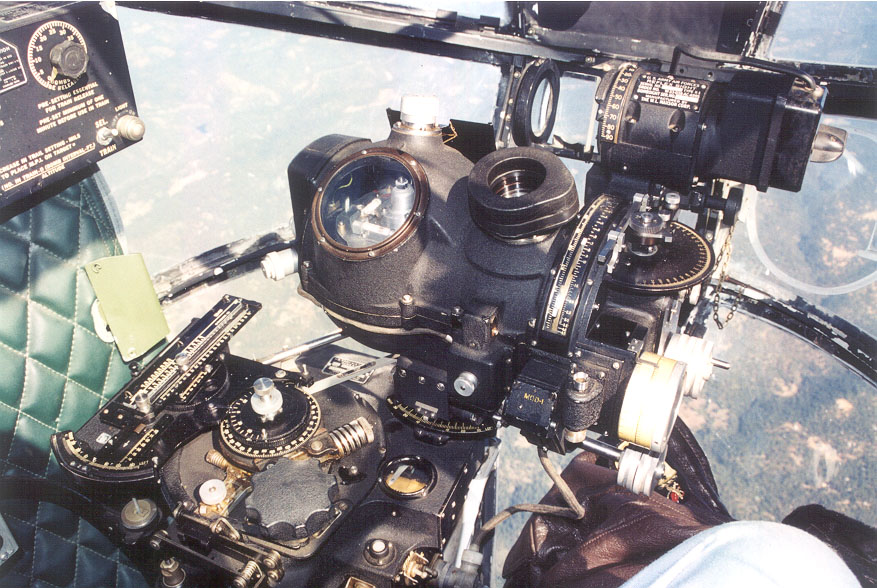
Norden Bombsight

Norden Bombsight in the nose of a B-25 bomber
Posthip Scott sent me an Ebay listing for a Norden Bombsight. I'd heard of them and I knew they were sort of a big deal, but I had never come across any good information about them, like how the machinery inside actually worked. I realize now that they are horribly complex mechanical computers that performed some operation that any $2 digital calculator could do now. The 20th century military-industrial complex was full of this stuff. In short, they were complicated, expensive pieces of precision machinery and if you were so inclined you could spend years sorting out all the ins and outs of their design, construction and operation. It might be fun, but at this point it's more like archaeology.
     Looking around I uncovered a couple of interesting bits. I found this one on Wikipedia.

At the beginning of WW2, after Britain was engaged but before the USA got into it, the Brits were keen on obtaining the Norden bombsight, so they sent some guys to the USA to talk about it. During one visit there was a demonstration.
The RAF's desires were only further goaded on 13 April 1939, when Pirie was invited to watch an air demonstration at Fort Benning where the painted outline of a battleship was the target. "At 1:27 while everyone was still searching [the sky for the B-17s] six 300-pound  bombs suddenly burst at split second intervals on the deck of the battleship, and it was at least 30 seconds later before someone spotted the B-17 at 12,000 feet". The three following B-17s also hit the target, and then a flight of a dozen Douglas B-18 Bolos placed most of their bombs in a separate 600 yd × 600 yd square outlined on the ground. - Top Secret Exchange: The Tizard Mission and the Scientific War by David Zimmerman
Malcolm Gladwell gave a TED Talk about the Norden bombsight back in 2011, wherein I found this bit:
And the U.S. military spends 1.5 billion dollars -- billion dollars in 1940 dollars -- developing the Norden bombsight. And to put that in perspective, the total cost of the Manhattan project was three billion dollars. Half as much money was spent on this Norden bombsight as was spent on the most famous military-industrial project of the modern era. 
That's in 1940 dollars which were worth about 20 times what they are now.

Thursday, December 3, 2015

Glacier Girl

Yesterday I was reading about some guys who dug up a 150 year old river boat that was buried under 45 feet of mud in a farmer's field in Kansas. This morning I'm reading about some guys who dug up a WW2 fighter that was buried under 265 feet of ice in a glacier in Greenland. Kind of weird to encounter two recent archaeological digs of recent events in two days, especially since there is no connection between the two. Here's some pics I collected of this one.

P-38 and B-17 where they were set down in 1942.

McBride’s team camped out in 2011 on the Arctic glacier where the Lightnings are located. The Wilga support plane is in the background. (photo via Ken McBide)

Excavating the P-38

P-38 Partially disassembled

P-38 Cockpit

Raising the central fuselage
The used a four foot diameter heated cone to drill through the ice, that and a pump to get rid of the water.
They spent $2.5 million retrieving this one airplane and another half a million restoring it to operating condition. Probably not a profitable venture, but emotionally satisfying.

Tuesday, March 31, 2015

Aluminum Overcast

K-13 gunsight on a B-17 waist machine gun. Speed and altitude settings can be seen
I always imagined that the machine guns on WW2 bombers like the B-17 and the B-24 had iron sights, but no. Here we've got a complicated black box that figures out the amount of lead you need depending on your altitude and speed. This from an aircraft that was built in 1944 and never actually saw any combat, so it's possible this was a mid-war development. Bernard Zee took this and a bunch of other photos, including inflight and interior shots on the ground, when the Aluminum Overcast visited Hayward California back in 2011. Via Posthip Scott.

Thursday, March 5, 2015

WW2 Story

From The Fall of Fortresses by Elmer Bendiner
Elmer Bendiner was a navigator in a B-17 during WW II. They were on a bombing run over Kassel, Germany, when their aircraft, the Tondelayo, was struck by antiaircraft fire. The aircraft was not crippled and they were able to complete their mission. On the morning following the raid, their pilot, Bohn Fawkes, went down to ask the crew chief if they had found any of the shells that had struck the aircraft, as he was looking for a souvenir. The crew chief told Bohn that 11 shells had been found in the gas tanks.
    Now it gets interesting. The shells had been sent to the armorers to be defused. The armorers told him that Intelligence had picked them up. They could not say why at the time, but Bohn eventually sought out the answer. Apparently when the armorers opened each of those shells, they found no explosive charge. They were as clean as a whistle and just as harmless.
    Empty? Not all of them! One contained a carefully rolled piece of paper. On it was a scrawl in Czech. Translated, the note read:


"This is all we can do for you now..."


Using Jewish slave labor is never a good idea. Via Posthip Scott. Paraphrased by me.