Intel's Ronler Acres Plant

Silicon Forest
If the type is too small, Ctrl+ is your friend

Showing posts with label Space Suit. Show all posts

Wednesday, October 28, 2020

Airlocks


SpaceX Starship Airlock Concept
smallstars

This isn't the best video, he doesn't really spend much time on what SpaceX is likely to do with their Starship, but there is a load of good background information.


Emergency Training Averts Airlock Disaster on MIR
Science Channel

There isn't much to this video, but it gives you a sample of how, when small things go wrong they can leave you in the lurch. You should probably be brushing up on your Russian. Even if you don't go to space, it can help you with negotiating bribes and/or defending yourself against criminal charges in Congress.

Wednesday, October 26, 2016

Cold Welding in Space


Welding in Space

I've seen several episodes of Veritasium, and Derek Muller, our host, passes muster. When he speaks, he is transmitting information, he is not just bloviating. While bloviating is a more popular speech mode, it has a much lower informational content.

Saturday, October 22, 2016

Emergency Space Suit

Groovy spacesuitby Carlo-Arellano

I was thinking what life might be like on space station sometime in the future. Imagine a large station somewhere out by Venus or Mars. It's taken you a long time to get there and you are liable to be there for a long time, probably years.
    Space is a dangerous place being full of radiation and flying rocks. If you are out there long enough you are liable to get hit by one of those rocks, and if it doesn't kill you outright it would do some real damage to your air supply, i.e. it would all be leaking out through the hole the rock made.
    Dividing your ship into air tight compartments that could sealed off, much the various chambers in a modern naval submarine can be sealed off, would be a good first step. But what if you are caught in the chamber that has the hole? Putting on a conventional space suit is slow and cumbersome and you would die before you even got it out of the locker where it was stored.
    I'm thinking a set of coveralls, with booties, made out of a space age polymer might be just the ticket. You would need a helmet, but a hood that came all the way over your head and fastened at the neck line in front might work out just fine. There are a couple of problems with this. The first is that you would get wet wearing a plastic suit, so you would need some kind of ventilation. The second is that once you got it on and the chamber you are in lost all its air, you would swell up like a balloon. Being swollen isn't so bad, but it could make moving your arms and legs a bit difficult.

Michelin Man
    So I'm thinking we put some straps around the extremities every few inches to reduce the balloony-ness. It might take considerable force to tighten those straps against the air pressure, but I'm sure we could come up with a technique or mechanism to get the job done. When you got done you would end up looking like the Michelin Man.


Sunday, January 24, 2016

Space Suit

1952 Demonstrating the dexterity of a remote manipulator.

Space suits are a pain. There are only a couple of reasons to have them. One is if you need to go outside when you are in space. These days this is typically only done to make repairs. Another is to send images of a man in a spacesuit back home so the public can see that we actually have men in space. The last is in case of emergency and something goes wrong with your spaceship. Space suits are difficult to make, to put on, to work in. If there was any way to avoid using them we would.


Anathem Spacesuit
    Maybe there is. In Neal Stephenson's Anathem, our hero, along with his cohort, don some spacesuits that were designed 6,000 years ago. One of the features of these suits was they didn't have any gloves. The arms of the suits ended in a small sphere that had room for your hand to flex. On the outside of this ball was mounted a mechanical hand and on the inside was a control for this hand. You manipulate the control on the inside and the mechanical hand on the outside echos your movements. No glove required.
    If you are going to use a remote manipulator, there is no reason to have it mounted adjacent to the control. Given the speed of electronic communication, anywhere within a thousand miles would be just fine. You get farther away than that and the delay due to lightspeed is going to be noticeable.

DARPA's BEBIONIC3 Prosthetic Hand

    The remote manipulator is key. I don't know if hands are really the best devices for manipulating other objects, but they are most versatile ones we have and we are certainly accustomed to them. Modeling remote manipulators on hands is probably our best bet. Arms are much easier and much simpler to build and control. From an amazed perspective, hands are wonderfully complex. From an engineering perspective, hands are horribly complex. The work being done with prosthetics is making the most progress. (There's even Lego versions out there.)

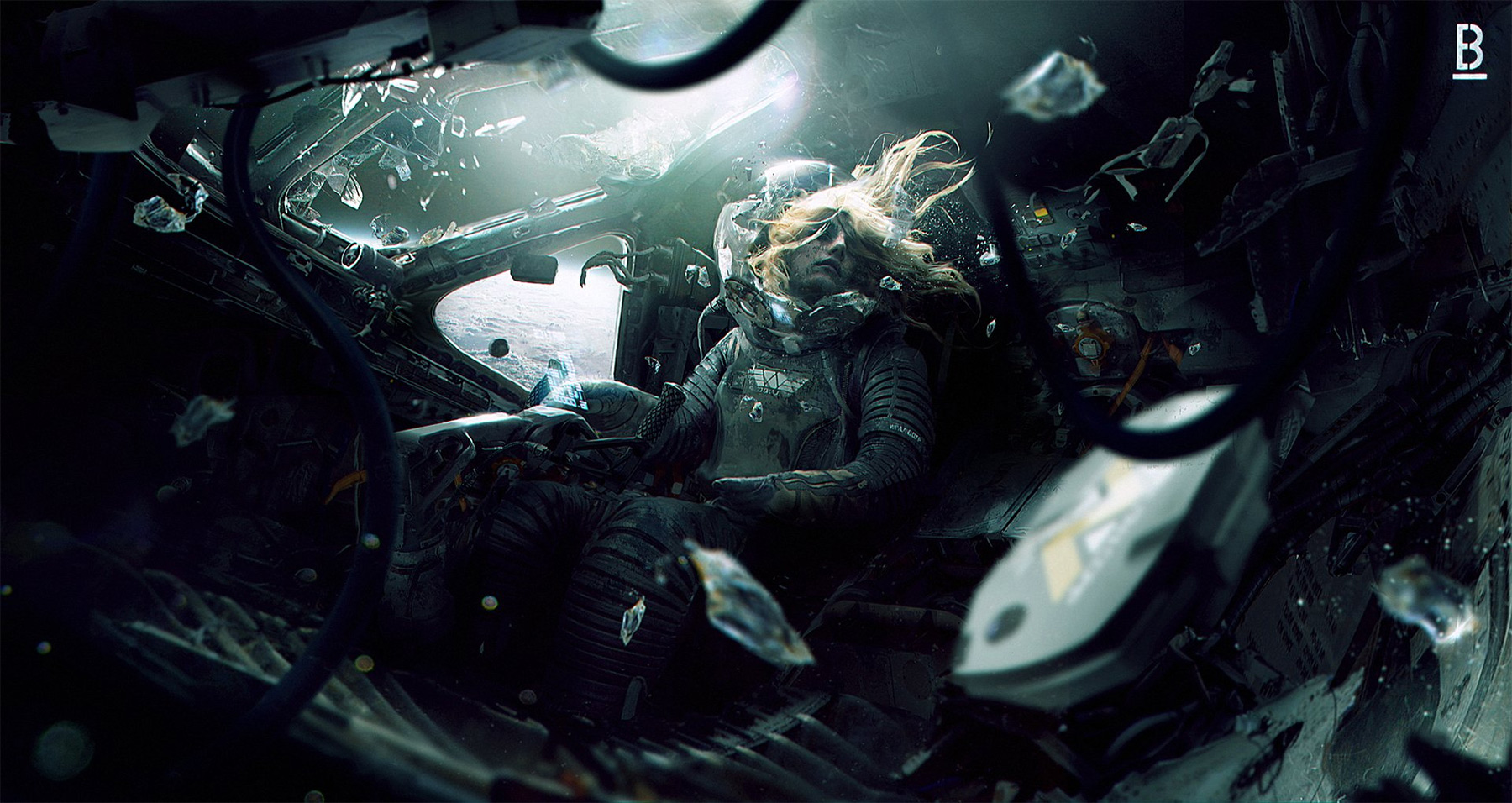
Weyland Yutani's shuttle failed to escape from LV-426 by Benoit Godde

Once you have a decent remote manipulator there is no reason to go outside your spaceship anymore, which got me to thinking that instead of individual space suits, maybe what we need is individual space ships. Space is a dangerous place. You are in constant danger of being struck by a deranged bit of matter that will poke a hole through you and your ship as if you were cheesecake. If you have a group of people, everyone having their own ship could increase the group's odds of surviving such a collision. An individual might be lost, but the group would survive.
    You would want an airlock on your personal ship so you could visit other people in your party, but you wouldn't want too many people to all be in one place at one time to the avoid the possibility of catastrophe. For a large group of people you would need an airlock hall so several people could dock their ships at the same time.

Spaceship art by Francis Tsai

    Originally I was envisioning these personal space ships to be like escape pods, maybe the size of a mini-van, just big enough for you to carry out daily chores without tying yourself in knots. Then I got to thinking that these are going to be for long term habitation, so they should be self sufficient, with power, lights, hydroponic gardens, recycling, reaction mass and engines. So now I'm thinking something along the size of a destroyer.

Update May 2018 replaced one missing picture and then another when Blogger "fixed" some old mystery stuff.

Monday, July 13, 2015

Inner-Space-Suit


Adam Savage Incognito at Comic-Con 2015 (with Astronaut Chris Hadfield!)

The video starts off sort of gooberish, which I guess is typical Adam Savage style, but it quickly gets technical. These two make some astute observations. Who'd a thunk a spacesuit for walking around on Earth would need to be so sophisticated? Via Iaman. Entertainment Weekly has a story with some photos.

Other Space Suit posts.

Thursday, March 19, 2015

Space Suit

Vos & Ney Testing Spacesuits in the 11-foot vacuum chamber at the Johnson Space Center. NASA Photo by Bill Stafford.
Check out the door. It's like something out of a bank vault.


Sunday, December 7, 2014

Orlan Space Suit

Orlan MK spacesuit at the MAKS 2009 exhibition
Can you tell that that the labels on the controls are printed backwards?
I didn't notice until someone else pointed it out, and then I zoomed in for a closer look and sure enough the writing might be backward. Little hard to tell being as it's Cyrillic and all.

Note the mirrors strapped to the cosmonauts right forearms.
From Encyclopedia Astronautica:
Russian space suit, operational 1978. The Orlan spacesuit was used for Russian EVA's on Salyut, Mir, and the International Space Station. It was designed by the Zvezda OKB, and derived from the Kretchet suit intended for use on the lunar surface.
It consisted of flexible limbs attached to a one-piece rigid body / helmet unit. The suit was entered through a hatch in the rear of the torso. The exterior of the hatch housed the life support equipment. Maximum operation time was three hours when the Orlan-D version of the suit was first used on Salyut 6. Later Orlan-DM versions of the suit increased this period to nine hours. The integrated design meant that no external hoses were required as in the American space suits. The suit standard pressure was 0.40 atmospheres, so that a prebreathe period of only 30 minutes was required. Electrical power and communications were via an umbilical cord to the station. Control of the suit was via a panel on the chest, with the markings in mirror image. The cosmonaut viewed the panel using a mirror on the wrist of the suit.

GazB tells us:
The old US suits needed to be put on one piece at a time. So body piece on first then upper leg joint and then lower leg joint and other leg, then arms and then helmet. With all the joints and the testing of seals it took two men over 4 hours to put on a suit. This Russian suit comes completely assembled already, the back pack folds open and you climb in from the back, the backpack is folded shut and the seals are tested and checked. All the systems can be tested and ready in about 40 minutes.

Wikipedia has an article as well.

Sunday, April 28, 2013

Space Indians

ISRO Flight Suit Engineering Model

ISRO (Indian Space Research Organization) has a Facebook page. They have some cool pictures. I like it much better than the sanitized-for-your-protection stuff that NASA puts out.

Sunday, October 14, 2012

Felix Baumgartner - Space Man


Since Roberta X and Tam alerted me to this event this morning, I was able to watch it live along with 7 million of my closest friends. I wonder if this set some kind of YouTube record. I mean, that's more than one person out of a thousand on the entire planet. Red Bull, the energy (?) drink maker sponsored this event. Giant balloon made out of old sandwich bags which they had somehow split into five layers and then seamless glued them all together, filled with gas near Roswell, New Mexico, and then let go. It reached an altitude of 128,000 feet (24 miles) whereupon they began the step-off-edge checklist. First order of business was to depressurize the capsule. Don't do it all at once, want to make sure your pressure suit is holding before you give away all your air. By the time they got the door open, the balloon had dropped down to 127,000 and something. Felix sat there for a minute after he got the door open. The ground controller is telling him to step outside, but Felix isn't moving. I think he was taking in the view. I think I would have spent a couple of hours looking at the view. A few seconds later though, Felix stepped outside and then stepped off into nothing. 2 hours plus to go up, five minutes to come back down. Preliminary estimates of his speed exceed 700 MPH. He was tumbling pretty good for a while, not spinning, but definitely tumbling, but eventually he got down to where there was some air and he straightened out.


Monday, March 22, 2010

Micrograph for the Day

Cosmic ray tracks in an Apollo space helment, amplified 10-millionfold by chemical etching.
I don't remember when I first saw this picture, but I told Jack about it at lunch today. I looked for it when I got home and was surprised how quickly I found it.
From the Wikipedia article on Ultra-high energy cosmic rays:
. . . in other words, a subatomic particle with macroscopic kinetic energy equal to that of a baseball (142 g or 5 ounces) traveling at 96 km/h (60 mph).
It was most probably a proton with a speed very close to the speed of light.
At some point I had the idea that cosmic rays were iron particles, and that might occasionally be the case, but they are more likely to be protons.

So I'm wondering if the astronaut noticed when this particle hit his helmet. Maybe it wasn't an ultra-high energy cosmic ray, maybe it was just regular cosmic ray, and he just thought someone was throwing spitballs at him. Jimmy! Stop that!

Update January 2017 replaced missing picture.