Intel's Ronler Acres Plant

Silicon Forest
If the type is too small, Ctrl+ is your friend

Thursday, July 31, 2008

Movies: "The Bank Job"


with Jason Statham and Saffron Burrows. Her name isn't listed on the cover, and her role is a bit in the background, though crucial to the story. But her picture is on the cover, front & back, though in the background. She's on the splash screen as well, but it's like she was grafted on as an afterthought: she has her own little sidebar. Weird. I smell picture politics.

That's okay, it was a pretty good picture. Based on a true story, it was very believable. We have a gang of second class criminals, getting by on small scale crimes and they get a chance at a really big job. The cars were awfully clean.

Wednesday, July 30, 2008

If I only had a plane...


Homebuilt Pietenpol Sky Scout
My friend Marc bought an airplane yesterday. It's a homebuilt wood and fabric monoplane designed back before WWII. Oh, and the engine doesn't come with it. He has another source for an engine. So Monday evening we drive up to Goheen airport North of Vancouver (Washington) to start taking it apart in preparation for hauling it home. Marc and I meet in downtown Portland so we can save a little gas. We spend two hours loosening bolts and disconnecting guy wires so the final breakdown will be easy. We come back Tuesday evening with a medium size truck and a flat bed trailer.

They already have the engine off and hanging from a front end loader when I got there. It takes just over an hour to break down the airplane, load it up and tie all the pieces down. It was handy having three people to take the wings off: two to hold up the wing and one to fight the bolts out of their holes.

Disassembled Pietenpol

At least that's what I tell myself. I spent three hours driving there and back to spend 45 minutes working on this project. When I drove downtown Monday evening traffic was a bit jammed up going into downtown Portland, but it was only a couple miles and was expected. Tuesday evening it started raining and traffic came to a stop at 185th, a good ten miles from downtown. I decided I did not want to deal with creeping traffic for that much distance, so I took Cornelius Pass North to Highway 30, thence South to the St. Johns bridge, across North Portland (look Daddy, those people are black!) to I-5 and then North.

When I left, I am wondering if it might not have been shorter to drive up to Longview to cross the river, but I don't have a map with me. I know we are already quite a ways North, Longview can't be that far. I'll just go ahead and drive up there, then I'll know. Turns out it was another 25 miles. Got to drive across the Lewis and Clark bridge, an enormous 2 lane edifice. It must be a zillion feet high and five miles across. Of course it isn't, but it sure looked that way. Took me an hour and a half to get home. If I'd had an airplane I could have flown to the Hillsboro airport, which is only two miles from my house. It's only 25 miles. It would have taken 15 minutes in even a very slow airplane like Marc's Pietenpol.

Lewis and Clark Bridge, with Mount St. Helens, Washington.
The sharp eyed among you will notice that the airplane pictures are of two different airplanes. The first one is a similar aircraft fully assembled. The setting is similar, though the hanger we were in was much dirtier. The second one (of the yellow plane) is the pieces piled outside Marc's house. And that is Mt. St. Helens in the background of the bridge picture. The plane and the bridge are from the same era.

Route to Goheen airport and back

Update September 2016 replaced missing pictures, removed dead link.
Update April 2026 replaced missing map.

Sunday, July 27, 2008

Useful Ceramic Art


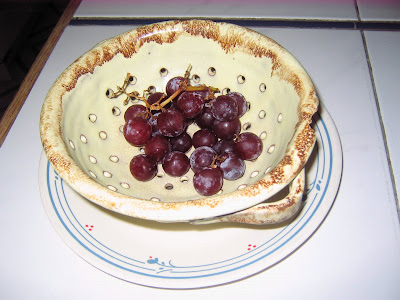
We have a small colander that my mother made and we use it often for rinsing small quantities of berries and grapes. You don't want to rinse off a large quantity because once they get wet they start growing mold, so you don't want to rinse off more than you are going to use in a day. Dry they will keep for several days.

My brother Andy and his fiance Dianne came to visit earlier this month. We were sitting around one afternoon/evening (it does not get dark till around 10PM) and we got to talking about ways to make money and Dianne pointed out that there is probably a big market for useful handmade ceramics, like this colander.

Andy had picked up a necklace for his daughter at the local farmer's market with her initial on a small ceramic square. That gives me the idea for computer keyboards with ceramic keycaps. You could even do a ceramic body for the keyboard, or maybe just a surround to give the keyboard a distinctive look.

Update December 2016 replaced missing picture.

Thursday, July 24, 2008

Goto

Goto? What's that? Spanish for duck? Greek for tarantula? How would you pronouce it? Got-oh, like in "Got Milk"?

No, no, no. Goto is why programmers can't spell. Goto is short for "go to". Wow, you save a whole space. It's an instruction used in computer programs to arbitrarily change the point of execution. Back in the good old days, when Fortran was the king of beasts, goto's were the only way to change course in a computer program.


IBM Keypunch Machine
Back in the good old days, computer programs were written on punched cards. You sat at a keypunch machine and typed in one line of your program at a time. As you typed, the keypunch machine typed the letter on the top line of the card and punched a series of holes representing the machine code for that letter in a column beneath the letter. If you made a mistake, the card went in the trash, and you started over with a fresh card.

Most of my early programs were pretty small, on the order of a hundred cards or so. You take your deck of punched cards and hand them in to the opertor who loads them in the card reader, one program/job after another. There were always a dozen or two people in there. The computer reads the cards, compiles the program, runs the program, and then queues the output to the printer. The operator seperates the output from the printer into seperate jobs and turns them over to the waiting geeks/students.

You looked at the output to see, first of all, if your program compiled correctly. If it didn't, it was back to the keypunch machine to correct your typing errors. If it did compile correctly, you looked at the output to see if the program performed as expected. Simple programs were easy to debug. More complex programs, well, then you got to strain your brain.


If you were only dealing with a hundred cards or so, things were not too tough. But some people, especially in engineering were running massive programs that might be one or two thousand lines/cards long. These required boxes to carry around, and don't dare drop them. You might never be able to put Humpty together again.

There was one story floating around that this happened to one poor guy, and to ensure that it never caused him a problem again, he added a goto to every line of his program. The version of Fortran we were using was an advanced (!) version: it allowed two statements on each line. What our hero did is he gave each line of his program a label (Fortran uses numbers in the first few columns), and tacked on a second statement to end of each program line. The second statement was simply a GOTO directing the program to the next line.

Take the box of cards, drop it on the ground. Gather up the cards in any random order, just make sure the first card is first, and turn them in. The program will compile and run. A horrible idea, but effective for dealing with a box of a thousand cards.

Update December 2016 replaced missing picture.

Tuesday, July 22, 2008

Movie: "The Dark Knight"

Well done, but all-in-all a very unpleasant movie. Perhaps it is a reflection of the times we live in where corruption seems to run rampant and even upstanding citizen-soldiers can be corrupted with threats and intimidation. Corruption is always present of course, but the extent of it varies. Sometimes it is tamped down to the point where even a little scandal is big news. Sometimes it flares up to the point where a new household name connected to a scandal is just more of the same, like now.


My memory failed me on the batmobile. I was sure it was a real military prototype that had been co-opted by the film makers for this movie. My son assured me that no, it was a special for the movie, and had actually been used in the previous movie as well. A little more information from my son, and (whipper-snapper can't be right, this is my area of expertise, not his) some research on the web reveals that this is the case. Turns out that the story in the previous movie was that it was a military prototype. So my memory was right about the origins, it just failed to distinguish fact from fiction. Give me a break, it was two years ago.

There were two comments from the Joker that stuck in my mind. One was that he claimed to be more impulsive than a careful planner, but almost everything that happened required a good deal of advance preparation. All of his attacks could have been pulled off within a day or so, but only if a good percentage of the population was totally corrupt, of a criminal bent, or insane. There certainly were a lot of them in the movie.

The other comment was that gasoline and bullets were cheap. Even at four dollars a gallon, gasoline is still one of the cheapest tools of destruction available.

Target practice with a centerfire firearm can get expensive, depending on many hundred's of rounds you expend. But a single bullet aimed with destructive intent can cause untold damage, and being as people are our most valuable assets, killing a person can be a catastrophic loss. Of course, some people, like the Joker, would show up in society's ledger in red ink, indicating a deficit, not an asset.

And don't confuse Christian Bale (Batman) with Christian Slater (not Batman).

Sunday, July 20, 2008

A/C Repair


Last summer the A/C unit started dripping into my basement storage area. The area doesn't get visited often so things were pretty water logged when I finally discovered it. I surmised that the water was escaping from the condensation collection system, whatever it was, and running down into the ductwork in the basement and thence dripping onto the floor. I put some buckets down to collect the water and put a fan in there to dry it up. Summer doesn't last long here, so pretty soon the A/C was shut down.

It's been a little warm this summer so we have been running the A/C intermittently, and, surprise, surprise, the A/C has not fixed itself. Condensation is still leaking into the basement. I had been wanting to open up the A/C chamber and take a look to see if it was something simple, but that would have meant actually doing something, and lord knows we sure did not want that.


My brother from Iowa came out to visit a couple of weeks ago, and not having anything better to do, we decided to take a look. It wasn't too difficult to open up, move a few items out the way, take out a dozen or so sheet metal screws, pull back some rubber insulation on the A/C pipes and all is exposed. Most of it anyway. Only problem is that there does not seem to be anything really wrong. No clogged drains, no big cracks, nothing that would give us an obvious clue as to where the water is coming from.

Brother Andy notices some of the fiberglass insulation has broken down and fallen into the condensation collection tray. It doesn't look like much, but I suppose the water is wicking up into the insulation and thence over the edge and down into the basement. The theory is pretty thin, but it is all we have so we look around for something to put between the tray and insulation to keep things tidy. A thin sheet of rigid plastic would do the trick. What do we have?


We look around for a bit and finally light on some surplus plastic kitty litter buckets. We get out the saber saw, cut off the top rim and the bottom and run a cut down the side and we have a good size sheet of semi-rigid plastic. Estimate the size, cut to length and slide into place, one on each side of the A-coil.


Turn the A/C on, and at first it doesn't seem to help at all, more water than ever is running out. But I check back a couple of days later and there is no water at all! Hooray, we fixed it! I'm still a little skeptical that our Afro-American engineering actually solved the problem, but I have had no more water in the basement. This is just too weird for words.

The A/C A-coil sits underneath the downdraft furnace.


Update November 2016 replaced missing pictures. At some point I realized the problem with the water overflowing the catch tray was that 1) it was very humid so a great deal of water was being condensed out of the air, and 2) the drain pipe wasn't big enough to handle the increase. There is a provision for a second drain pipe but I still haven't gotten around to fitting one.

Saturday, July 19, 2008

Planetary Granny Gear for Bicycles


Out here in Oregon long bike rides often mean climbing big steep hills, which means shifting down into granny gear and slogging away for an hour or so till you get to the top. Once you get over the top and start going down, you want to shift to top gear to pick up speed in order to put a big stupid grin on your face. Or if you want to be practical, so the breeze will cool you off after you put in all that work climbing the hill.

The way things are out here is that soon after you get to the bottom, you face climbing another big stinking hill, which means shifting into low-low gear again. After doing this for a while you begin to wonder why you even have the other twenty zillion gears, the only ones you are using are top and bottom.

This wouldn't be a problem except for the way bicycle gear trains are built. You can't shift directly from low to high, you have to shift through all the intermediate gears as well, or a substantial number of them. And using the front derailleur to change chainwheels requires that you ease off on pedalling until the chain has been moved. This can be a real trick if you have misjudged how quickly the hill starts going up. You may even have to stop or turn around in order to be able to change to a smaller chainwheel.

Now there a number of internal gearboxes available for the hub of the rear wheel, but there really isn't anything available for the bottom bracket, and if you want big changes, this is where they need to be made. The reason is you don't want eight inch diameter gears whirling around at wheel speeds on the back axle. You really want to minimize your rotating momentum.

How about a planetary gearset for the bottom bracket using large diameter, very thin gears? You would only need three speeds, which means one of the elements could be locked to the frame. The crankshaft would alternately engage one of the other two elements, as would the chainwheel. I think a device like this could be made as light and durable as the current multiple chainring scheme, plus it would have the added benefit of being able to shift much more quickly. If would be virtually instantaneous, especially when compared to a derailleur.

It would take some figuring and no doubt some fiddling to be able to come up with a design that would fit in the space currently being used by current derailleur designs, but if it worked, and worked reliably, it could be a big hit in the bicycle market. Yeah, and if wishes were horses, beggars would ride. Anyway that's my big idea for the day. Here's a spreadsheet that illustrates the gear ratios you can get from planetary gear sets.