This New Pyramid Theory Explains the Missing Evidence
DamiLee
I ran across the internal tunnel theory once before and it seemed pretty good then. Muon post here.

 |
| 1923 Dunelt 499cc Two Stroke Motorcycle |
 |
| Dunelt two-stroke cylinder with stepped piston – Montagu Cars and Motor Cycles |
The patented Dunelt 499cc engine had a cylinder barrel with different upper and lower bore diameters, in which slid a ‘stepped’ piston with two matching diameters.
The pistons were double diameter and also bi-metallic, with an iron/steel section cast in for the ring grooves – not cheap to make.
Where a standard-bore engine had 499cc-limited mixture induction and transfer ability, the Dunelt engine could suck into its crankcase and transfer into the cylinder about 770cc of charge petrol-air mixture.
A deflector piston ensured that most of that mixture remained in the combustion chamber.
This basic form of supercharging had the desired effect and, in conjunction with a heavy flywheel, earned the Dunelt a reputation for being a torquey, ‘slogging’ engine that lent itself to sidecar applications, including commercial service and delivery tasks.
Also, a Dunelt motorcycle was the first to cross the desert from Cairo to Siwa Oasis and back in 1924.
 |
| Siwa Oasis |
The oasis is in a deep depression that reaches 62 ft below sea level. . . . The depression is fertile due to both natural flowing artesian wells and irrigation. . . . The oasis supports the cultivation of thousands of date palms and olives. - Wikipedia
The Rhind Mathematical Papyrus (RMP; also designated as papyrus British Museum 10057, pBM 10058, and Brooklyn Museum 37.1784Ea-b) is one of the best known examples of ancient Egyptian mathematics.It is one of two well-known mathematical papyri, along with the Moscow Mathematical Papyrus. The Rhind Papyrus is the larger, but younger, of the two.In the papyrus' opening paragraphs Ahmes presents the papyrus as giving "Accurate reckoning for inquiring into things, and the knowledge of all things, mysteries ... all secrets". He continues:
This book was copied in regnal year 33, month 4 of Akhet, under the majesty of the King of Upper and Lower Egypt, Awserre, given life, from an ancient copy made in the time of the King of Upper and Lower Egypt Nimaatre. The scribe Ahmose writes this copy.
Several books and articles about the Rhind Mathematical Papyrus have been published, and a handful of these stand out. The Rhind Papyrus was published in 1923 by the English Egyptologist T. Eric Peet and contains a discussion of the text that followed Francis Llewellyn Griffith's Book I, II and III outline. Chace published a compendium in 1927–29 which included photographs of the text. A more recent overview of the Rhind Papyrus was published in 1987 by Robins and Shute.
Farther down the Wikipedia page is this image:
 |
| Ancient Egyption Units of Measurement in the Rhind Mathematical Papyrus |
The present table is a concordance of ancient Egyptian units of measurement which are used throughout the Rhind Mathematical Papyrus, an ancient Egyptian document which is a record of elementary mathematics. The papyrus consists of four sections:Many of the latter problems make use of certain ancient Egyptian units of measurement, whether of length, volume, time, or otherwise, and this is what the present table summarizes. It happens that none of the 2/n table, the 1-9/10 table, or even most of the first several problems 7, 7B, 8-34 make any mention of units, and they are therefore not included in this table.
- a title page with historical information,
- a table of fractional calculations for 2/3 - 2/101, or the "2/n table" (where n is always odd),
- a much smaller table of fractional calculations for the nine fractions 1/10 - 9/10, or the "1-9/10" table, and finally
- a series of 91 "problems" or numbers, which are numbered from 1-87 (a modern convention imposed on the document to differentiate the problems) and include four additional items designated by moderns as 7B, 59B, 61B, and 82B.
Almost all usage of units of measure is confined to the later problems in the papyrus (with some early exceptions, also listed), being the title page, problems 1-6, and problems 35-87, which include three additional items designated as 59B, 61B, and 82B.
For the title page and numbers 86-87, the context of the usage of units is not mathematical, but historical.
The units are grouped by unit type, and color-coded. From top to bottom, the unit types are:The seked is not strictly speaking a trigonometric item, but its context is so close to our modern understanding of trigonometry that we identify it with that word.
- length,
- area,
- volume (deben),
- monetary (sha'ty),
- trigonometric (seked),
- food/manufacturing (pefsu), and finally
- "foodstuff" (loaves, des-measure).
The pefsu is also a kind of derived unit of measure relating to food preparation and manufacturing.
Finally, the "loaf' is not really a standard unit of measure within the papyrus as such, but it is mentioned so frequently in related contexts that it merits its own entry. In any one problem, it can be interpreted as a measure of solid food.
Likewise, the "des-measure", mentioned in only a few problems, can be interpreted as a volume unit of liquid measure (especially in the context of food and drink) which is not immediately related to the other volume units.
Entries in black indicate that a given unit of measure is explicitly named or entailed in the problem, in the original document.
Entries in gray indicate that although the unit's word is not expressly stated in that problem, the context of the document makes clear that the unit is implicitly being used in the course of the problem's calculation, statement, etc.
Note that neighboring groups of problems often tend to entail similar units, although in some cases the units are merely strongly implied by context, as opposed to being explicitly stated in the original document.
In the Rhind Papyrus, units of a given type have precise, exact, simple relationships to one another, which conversion factors we can and therefore do easily express in modern terms, using only integers.
Although there is historical evidence that certain units of measure can be "concretely" compared with modern units, these exact specifications are not essential to reading the Rhind Papyrus as a mathematical document.
Indeed, one can read the papyrus has having an internally consistent system of units of measure, which is all that is presented in this table and explanation.
The reader is cautioned that ancient Egypt had a very long history, and that the present information about units pertains directly to the Rhind Papyrus only.
At other periods of ancient Egyptian history, certain units were taken to have different conversion factors relative to other units.
Among units of length, 1 khet = 100 cubits = 700 palms = 2800 fingers.
Among units of area, one square khet is called one setat, and 1 setat = 100 cubit strips, where one cubit strip is a rectangular strip of area being 1 cubit by 100 cubits (or any other sector of equal area).
Among units of volume, the following holds:2 cubic cubits = 3 khar = 60 heqats = 600 hinu = 19200 ro.
Furthermore as one might expect, the somewhat redundant "hundreds/multiples" versions of the heqat and the ro can be equated with those same "base units" in the following wise:1 hundred quadruple heqat = 2 hundred double heqats = 4 hundred heqats = 100 quadruple heqats = 200 double heqats = 400 heqats = 128000 ro = 64000 double ro = 32000 quadruple ro.
Combining these two chains of equalities, rearranging their terms, and expressing all of the units' conversion factors in the simplest terms of integers yields the following comparison among all of the standardized units of volume measurement in the Rhind Papyrus:3 hundred quadruple heqats = 6 hundred double heqats = 12 hundred heqats = 300 quadruple heqats = 600 double heqats = 1200 heqats = 40 cubic cubits = 60 khar = 12000 hinu = 384000 ro = 192000 double ro = 96000 quadruple ro.
Among time units, since the Egyptian month is always exactly 30 days, then 6 years = 73 months = 2190 days. The remaining units, being of different types and not having simple or relevant conversion factors into other units of like type (at least as far as the papyrus itself is concerned) are therefore not expanded upon here.
Another post about ancient mathematics: the Babylonian Plimpton 322 clay tablet. It dates from 1800 BC, so roughly the same era the Rhind Papyrus.
 |
| U.S. and Egyptian aircraft over the Pyramids during Exercise Bright Star '83 Click to embiggenate |
This photograph is phenomenal. Whoever managed to get all these aircraft to fly together and then managed to capture this photo as they flew over the pyramids deserves a medal.
The Bright Star exercises started in 1981 and are still going on every couple of years.
 |
| Russia's President Vladimir Putin and Egyptian counterpart Abdel Fattah El Sisi in Sochi, Russia, in 2014. Reuters |
 |
| A Thebaid: Monks and Hermits in a Landscapeabout 1505 Lorenzo Costa (Italian, about 1460 - 1535) |
". . . being no more particular about washing, shaving and brushing than the monks of the Thebaid."
Thebaid? Getty Museum gives us this explanation of the above image, though it doesn't say anything about their personal grooming habits:
Using only pen and ink, Lorenzo Costa portrayed the cradle of Christian monasticism, the Thebaid, a Roman division of the upper Nile River valley. Beginning with Saint Paul of Thebes and Saint Anthony of Egypt in the 200s, Christian monks retreated to this region, to live a solitary life of ascetism and prayer. Over time, these monks, also known as "desert fathers," organized into communities.
Costa's scratchy, energetic draftmanship created a bustling composition filled with monks and a landscape riddled with the grottoes, huts, and caves they used for prayer and shelter. He portrayed an imaginary scene, incorporating a variety of monastic saints and spanning different periods. In the upper left background, Saints Paul and Anthony are shown seated, receiving bread from a raven through which God provided nourishment. Mary Magdalene, who supposedly lived her later years alone in the desert, stands near the river to the right. The landscape itself appears more European than Egyptian, perhaps reflecting Costa's native countryside around Bologna, Italy, rather than the real Thebaid.
A thousand years later there was also a Northern Thebaid in Russia. Now I wonder which one Stephen was referring to. Personal preference says the Egyptian ones as they were in the domain of the known world. Russia was like beyond the pale.
P. S. In the book, Thebaid has two dots over the i, not one, but every reference I saw on the net has just one.
 |
| Nickel, sulfur, and chlorine elemental distribution maps of one side of King Tut's dagger, analyzed with portable XRF spectroscopy. |
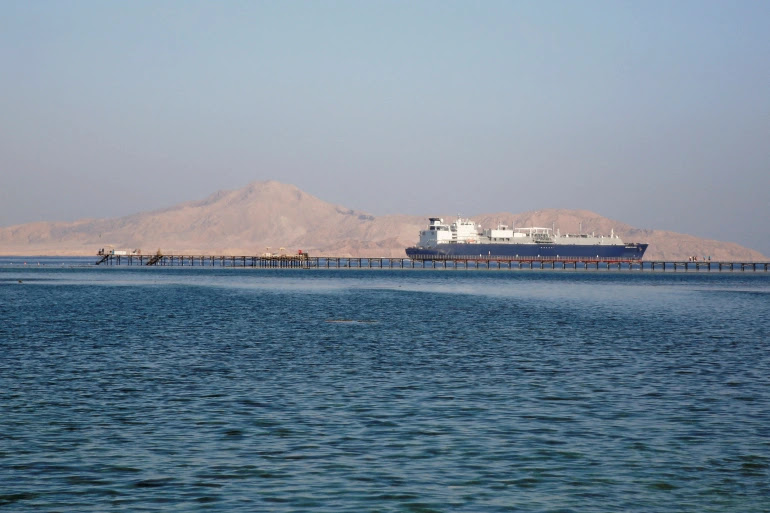 |
| Ship passing through the Straits of Tiran - Amr Abdallah Dalsh/Al Reuters |
 |
| Straits of Tiran, Tiran and Sanafir Islands |
 |
| Party at Jackson Reef Island in the background is the same one as in the first photo |
 |
| Divers at Jackson Reef |
Turns out they are dive boats for tourists from the resorts and all the people are underwater. The sea life on the reefs is pretty spectacular.
 |
| Piers |
I wasn't able to locate the pier on Google Maps until I realized that there were lines crossing a large green area adjacent to the shore and I realized that it was shallow water, not land, and those lines were light duty piers suitable for people to walk on, not for freight.
P.S. I thought I had looked at this part of the world once before but I couldn't remember why. Then I clicked on the place mark on the resort and all was revealed. The Super Tucanos stopped there on their round the world delivery flight.
 |
| Sunk ships Blocking the Suez Canal |
In July 1956, Egyptian President Gamal Abdel Nasser seized control of the Suez Canal and nationalized the British- and French-owned company that managed it, threatening both British and French stock holdings and Europe's access to Middle Eastern oil. The ensuing crisis had important consequences for U.S. relations with its European allies and the Middle East. Not surprisingly, a crisis transpired. Previously, the United States and Britain had agreed to finance Egypt’s Aswan Dam, which was to be both a symbol of modernization and a source of electricity. However, after Nasser made several moves that appeared friendly to the Communist bloc, the United States and Britain reneged on the agreement and withdrew financing. Belatedly, Nasser realized that the building of the Aswan Dam was important to Egypt’s future.
The United States regarded Nasser's nationalization of the Canal as a problem and pursued a diplomatic solution. Britain and France, however, viewed it as a threat to their national interests. They secretly contacted the Israeli government and proposed that Israel invade the Sinai Peninsula and march toward the Suez Canal zone. Then Britain and France would warn both Egypt and Israel to stay away from the Suez Canal and land paratroopers in the zone on the pretext of protecting it. In October 1956, Israeli forces crossed the border to defeat the Egyptian army in the Sinai. Britain and France then issued their warning and landed troops as planned.
Both the United States and the USSR responded by demanding a cease-fire to these events. In addition, the United States also called for the evacuation of Israeli, French, and British troops under the supervision of a special UN force. This force arrived in mid November and by the end of the year the last British and French troops had withdrawn.
The Suez conflict was a military defeat for Egypt, but Nasser’s status as the defender of Arab nationalism grew in the Arab world. The United States had improved its relations with Egypt, but fundamental disputes between Israel and its neighbors remained unresolved. Israel withdrew from Egyptian territory gained in the fighting but regained access to the Straits of Tiran.
Before the Egyptian forces were defeated, they had blocked the canal to all shipping by sinking 40 ships in the canal. It took the Brits five months to clear them out.
 |
| Egypt's New Ministry Of Defense "Octagon" Complex |

Security forces said Sunday that tens of thousands of forces have pushed into Sinai and its villages near Egypt's volatile border with Israel and the Gaza Strip, seizing vast stockpiles of weapons, including shoulder-fired anti-aircraft missiles, known to the US intelligence community as MANPADS.MANPADS? What happened to Stingers? Seems MANPADS (Man-Portable Air Defense Systems) is the new catch-all term for Russian and American hand carried, anti-aircraft missles. The FAS (Federation of American Scientists) has a page on the subject. The first 20% of this page gives a brief overview of the existing weapons, the threat they pose, and some blather about what can be done. The remaining 80% is a list of documents that also talk about the subject, which is kind of telling all by itself. Typical bureaucrats, one fact can generate a whole encyclopedia of discussion.


Tests run using Sundstrand vibrating beam accelerometers to sense microgravity are described. Lunar-solar tidal effects were used as a highly predictable signal which varies by approximately 200 billionths of the full-scale gravitation level.and
Spring Gravimeters and Other AlternativesEven now it seems to fall in the realm of scientific research, not a practical technique for which you can just buy a meter and go at it. Interesting that the two companies names I came across in all this are both big aerospace contractors: Hamilton Sundstrand and Groupe Dassault.