Intel's Ronler Acres Plant

Silicon Forest
If the type is too small, Ctrl+ is your friend

Showing posts with label RADAR. Show all posts

Wednesday, March 11, 2026

The Future is Here

Garmin Xero C1 Pro Chronograph $500

Tam writes about going to the gun range and mentions this device and tells us she can "sit there in the dry while making notes" about her shots. How does that even work? I remember chronographs having screens or antennas downrange from the firearm. How does the Garmin work? It has RADAR, that's how.

Chronograph and Shooter

Sunday, October 23, 2022

Interceptor - Netflix Movie


INTERCEPTOR | Official Trailer | Netflix
Netflix

Total comic book action movie. The heroine is a tough girl who takes on a succession of bad guys in the close confines of the command center of the SBX, a giant floating radar station. It's kind of like a James Bond movie, lots of high tech gadgets, a plethora of bad guys, really nasty villains and a smart, savvy hero who wins against impossible odds. The fight scenes are very well done. They are almost believable, not like some of these science fiction fantasies where a hundred pound cutey takes on a dozen bruisers and knocks them down with one blow. Our girl takes a beating, but she also responds in kind and manages to defeat them using skill and whatever material is within her reach. She does have a problem with running out of bullets at the wrong time. A little ammunition management would have helped, but I imagine that might be a little difficult to enforce in the middle of a fire fight.

The entire show (well, 90% of it) takes place in the command center. A rather small room filled with computers and radar displays and manned by 3 or 4 people. Entrance to the room is through two super-fancy security doors. Bad guys don't care, they have a cutting torch. Zero hour is approaching and they haven't finished cutting through the second door, so it looks like their fancy scheme will come to naught, but then a ninja jumps up from a hatch in the floor. Criminently, that looks like a weak point in the control room's security. Then we look down through the hatch and it's a straight drop to the water a hundred feet down. Evidently this ninja is Spider Man because he was able to crawl along the underside of the platform.

SBX

Later on, we open a hatch in the ceiling that gives us access to the upper deck. For all the planning the bad guys have supposedly done, you'd think they would have thought of this. Stupid bad guys.

The highlight of show is when our girl climbs up a ladder attached to the side of one of the supporting pylons. That's no small feat, it is at least a hundred feet straight up, and she does it with a broken arm that is just hanging by her side. Then she has to follow the ninja's path across the underside of the deck. Seems that someone thoughtfully provided a set of monkey bars and she manages to traverse them, once again one handed. In case your hands aren't sweaty enough she gets to a place were a couple of bars are missing, so she has to really swing to throw herself across the gap. Criminently, who is this chick? And was that a real stunt? Her name is Elsa Pataky and Netflix Tudum has the story.

The SBX is a real thing, though I don't think there are any missiles on board. The movie version has a bunch of anti-ICBM missiles, kind of like you might have on a G.I. Joe toy. Our real anti-ICBM missiles are carried on ships. We might have some on land bases but I'm not too sure about that.

The whole anti-missile missile thing is kind of iffy at best. They whiz kids in the military industrial complex have been working on the problem for years and they have some missiles that they have demonstrated successfully, but we don't know how reliable they are. A demonstration is one thing, but how well would they work against a real attack? Here's hoping we never find out. Then there's the problem of quantity. Russia has a zillion ICBM's. How many anti-missile missiles do we have? Assuming the missiles worked reliably, do we have enough to stop an attack? And how many do you need if the missiles are not reliable? And how do you demonstrate that your missiles are reliable enough to justify spending a zillion dollars to build up your inventory? I don't think Biden cares, he seems bent on armageddon.


Friday, August 19, 2022

Comedians

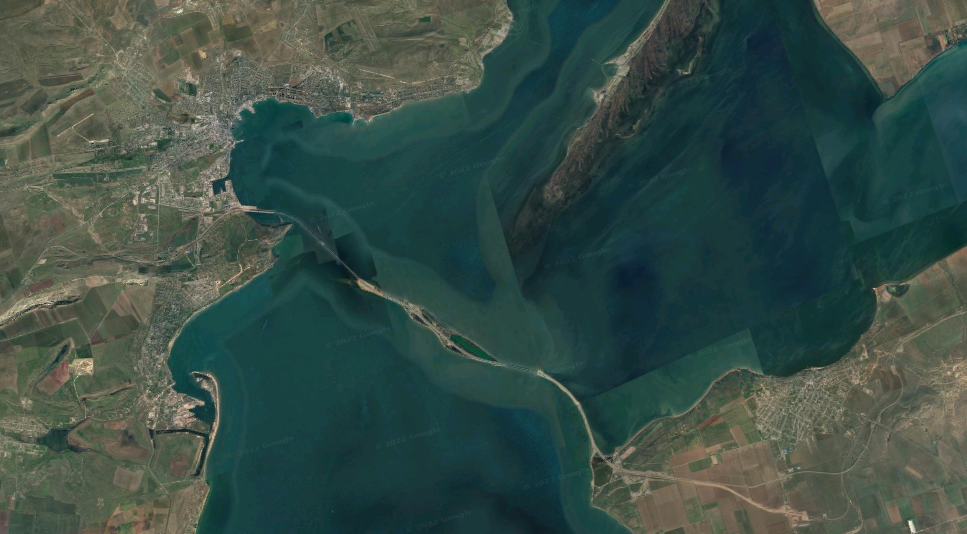
ICEYE Satellite Image of Crimea Bridge

The Crimea Bridge is a relatively new bridge that connects the Russia mainland with Crimea.
Finnish satellite-imagery venture ICEYE announced on Thursday that it has signed a contract with the Serhiy Prytula Charity Foundation which will provide the Government of Ukraine with ICEYE’s Synthetic Aperture Radar (SAR) satellite imaging capabilities. - Defence Blog
ICEYE is a Finnish company that builds and operates microsatellites. I am surprised that microsatellites can deliver high resolution images. I thought you needed big cameras with big lenses being carried by big satellites. But ICEYE isn't using cameras, they are using radar.

Looks like we have another charity supporting Ukraine's war against the big, bad, Russian bear. But just who is this Serhiy Prytula Charity Foundation? It's a foundation founded by Serhiy Prytula, a Ukrainian comedian. Is this whole war effort just a big comedy show? I mean, the President of the Ukraine is also a former comedian. And the war doesn't make a lot of sense unless funnelling a few million more dollars into Joe Biden's pocket is more important than all the worthless peasants in Ukraine.

Google Satellite Image of Crimea Bridge

Or you are afraid that Russia will take over the world. I, for one, am not too concerned about that happening.


Friday, June 10, 2022

Not Top Gun

F89-D Scorpion armed with rockets - John Mollison

Tam digs up some ancient history:
In the early Fifties, our nation's first line of defense against Rooskie nukyular bombers was "all-weather" fighters with on-board radar for finding the incoming targets. 

The weaponry needed to destroy jet bombers once the radar-toting fighter had located them was the sticking point. Guided missiles were still in their infancy, machine guns lacked the power required to bring down a big bomber, and even cannon weren't a sure thing since a head-on pass by a 600mph Lockheed F-94 Starfire at a formation of Soviet M-4 Bisons doing 500mph would be over in an eyeblink. A 20mm autocannon might only chug out a few rounds in that blink.

Stealing an idea from late-WW2 German jet interceptors, the USAF turned to unguided rockets. The Northrop F-89 Scorpion carried a hundred and four of the things, split between two wingtip pods.

She goes on to talk about an incident that demonstrated just how effective these rockets were.

The Scorpion has appeared here before.

Sunday, October 17, 2021

FOBS vs ICBM

FOBS vs ICBM RADAR Detection

The Unwanted Blog has a post up about Chinese FOBS (Fractional Orbital Bombardment Systems) that might keep you up at night, that is, if end-of-world, apocalyptic destruction is something you worry about. I tend to leave those kind of worries to the professionals in the defense department. It is a little worrisome when we have a clown show that is purported to be in charge, but I suspect that the fools we see and hear are only a thin layer of icing on a very substantial cake. I think they will be scraped off and tossed in the garbage sometime in the next few years. I like to think that the cake is substantial and will not be affected by the idiocy in the icing. Yes, I may be delusional.

Anyway, somehow I never considered that ICBMs (Inter-Continental Ballistic Missiles) flew so much higher than a LEO (Low Earth Orbit), so this picture was illuminating.


Saturday, July 3, 2021

Boeing E-3 Sentry

Boeing E-3A Sentry (707-300) LX-N90447
Zweibrücken, Germany

The Boeing E3 Sentry is an AWACS (Airborne Warning And Control System) aircraft developed from the Boeing 707 back in the 1970's. The last one was built in 1991, so the newest one is 30 years old. We think of the 707 as an airliner, but the first customer was the USAF (United States Air Force ) who bought the KC-135 aerial refueling tanker. So the first and last customers for the 707 were the military.
 

Boeing E3 (77-0355)
Fairbanks, Alaska

Half of the 68 units built went to the USAF, the rest went to other allied countries.

Boeing JE-3 Sentry
Fairchild Air Force Base, Spokane, Washington

Not to be confused with the E6 which is also based on the Boeing 707, nor should it be confused with the E4, which is based on the Boeing 747. Neither the E4 or the E6 carry the big radar dish on top. They are both more of a command and control kind of thing.

P.S. I added a new label, Aircraft Military Special, to cover military applications of what are essentially civilian airliners. There were getting to be too many and too hard to find.


Friday, February 7, 2020

XB-70

XB-70
An old photo of this airplane showed up today and it just struck me that this was like peak Air Force dream time. I suspect the blue fire from the jet engines in the above image were added, but it does look pretty cool. Wikipedia has a good summary of the airplane:
The North American Aviation XB-70 Valkyrie was the prototype version of the planned B-70 nuclear-armed, deep-penetration strategic bomber for the United States Air Force Strategic Air Command. Designed in the late 1950s by North American Aviation (NAA), the six-engined Valkyrie was capable of cruising for thousands of miles at Mach 3+ while flying at 70,000 feet (21,000 m).
At these speeds, it was expected that the B-70 would be practically immune to interceptor aircraft, the only effective weapon against bomber aircraft at the time. The bomber would spend only a brief time over a particular radar station, flying out of its range before the controllers could position their fighters in a suitable location for an interception. High speed also made the aircraft difficult to see on radar displays and its high-altitude and high-speed capacity could not be matched by any contemporary Soviet interceptor or fighter aircraft.
The introduction of the first Soviet surface-to-air missiles in the late 1950s put the near-invulnerability of the B-70 in doubt. In response, the United States Air Force (USAF) began flying its missions at low level, where the missile radar's line of sight was limited by terrain. In this low-level penetration role, the B-70 offered little additional performance over the B-52 it was meant to replace, while being far more expensive with shorter range. Other alternate missions were proposed, but these were of limited scope. With the advent of intercontinental ballistic missiles (ICBMs) during the late 1950s, manned bombers were increasingly seen as obsolete.
The USAF eventually gave up fighting for its production and the B-70 program was canceled in 1961. Development was then turned over to a research program to study the effects of long-duration high-speed flight. As such, two prototype aircraft, designated XB-70A, were built; these aircraft were used for supersonic test-flights during 1964–69. In 1966, one prototype crashed after colliding with a smaller aircraft while flying in close formation; the remaining Valkyrie bomber is in the National Museum of the United States Air Force near Dayton, Ohio.
It was quite the aircraft: Mach 3 at 70,000 feet in 1961. The Russian Tu-160, which is the nearest commie plane I can think of, only manages Mach 2 and didn't fly until 20 years later.

The Tu-160 has appeared here before, but this is the first post for the XB-70. The Unwanted Blog has several posts about the XB-70.

Sunday, July 7, 2019

Greenland


AIRBUS A380 F-HPJ Greenland Fan Hub Recovery by GEUS / BEA (June 2019)

A couple of years ago an airliner engine disintegrated while it was flying over the North Atlantic Ocean. The airliner landed with all passengers and crew safe in Goose Bay, Newfoundland, Canada. The airline people, pagans that they are, were unwilling to accept that an act of God caused the engine to fail. They wanted to examine the pieces of engine and apply their godless scientific acumen to try and figure out what happened. In order to do that though they needed to locate the pieces that fell off.

Map of flight path with altitudes
Being as the aircraft was over Greenland and they knew exactly where it was when this happened, if should be easy enough to find them. And they did find some of the pieces right off. But then it started snowing, winter came and they were stymied. Come the following spring they resumed their search, but now everything is covered with snow. And while they knew where some parts had fallen, other parts might be miles away. The airliner was flying along at 500 knots at an altitude of 35,000 feet when the engine exploded. Predicting where anything jettisoned from that altitude at that speed, not to mention rotating at several thousand RPM, will land is going to be guess work at best.

The Falcon 20 F-GPAA with SETHI. The two containers that it carries under the wings are part of the system - BEA via Austin Lines (Polar Research Equipment) and Thue Bording (Aarhus HGG)
But the science guys persisted. They got out their ground penetrating radar, attached it an airplane, flew a search pattern over the suspect area and got some hits.

Ground Penetrating Radar Set on Sled
Then the put their radar on a sled and dragged it back and forth over the snow until they had a pretty good idea where they might find something, and then they started digging.

The Bureau d'Enquetes et a'Analyses has a full report available (pdf).


Saturday, August 18, 2018

Big Toyota

Big Toyota
I took my car to Scottie's Body Shop on Monday to get some dents fixed. They needed it for a week so I walked across the street to pick up a rental at Enterprise Rent-A-Car. I was just going to get some econo-box, but the econo-box wasn't ready, so they gave me this monster with red, green, yellow and black New Mexico license plates. New Mexico must have changed their plates recently because I have never seen any that look like this.

The monster is a Toyota Highlander, at least that's what a couple of people have told me. I have seen any insignia to indicate anything other than it's a Toyota. It's very like my wife's Mitsubishi Endeavor, though it seems bulkier, but maybe that's just the swollen looking body shape.

It works fine like you would expect a late model rental to work, though there are a few little quirks that I have not yet learned to appreciate. The cruise control is one. On my old Dodge truck, you could not set the cruise control any lower than 35 MPH, which kind of sucks when half of the time I spend driving is on streets with a 25 MPH limit. Yes, I know, it only takes a minute to cover six blocks at 25 MPH but it feels like a friggin' eternity, especially when the road looks like it could handle 100 MPH traffic. Well it could if it wasn't for all the people toddling out into the road. You can set the cruise control in my car, a Hyundai Sonata, or the Endeavor to 25 MPH which is great. Keeps me from blasting my way to a suspended license. So I'm thinking plus one for Asian cars. But not this monster. This one the lowest you can set it is 28 MPH. Why 28 for Pete's sake? Don't tell me, I don't wanna know.

But 28 is okay, I am unlikely to get a speeding ticket for going 28 in a 25 zone. Out on the freeway it's fine. Or is it? Cruising down the Sunset and the car starts slowing down. What the heck? What are you doing you stupid machine? I set the cruise control for 60 MPH and I expect you to stay right on 60 MPH, not go wandering around the speedometer. I can do that all by myself, thank you, I don't need any help. It took me a while but I eventually realized that it only did that when there was a car ahead of me, and it wasn't that close, maybe ten car lengths. This car has RADAR. Too bad it isn't also equipped with Sidewinder missiles.

The windows in the front doors will go all the way open or closed with just a momentary touch of the button, which is great except when it's 90-odd degrees out. Then you want to leave the windows open a fraction of an inch so the inside of the car doesn't turn into a superheated oven when you have to leave it parked in the sun. Getting the windows to stop at the requisite position takes considerable fiddling. If it was my car I am sure I would eventually figure out how to get it to behave, but right now it's kind of a pain.


Thursday, June 2, 2016

Solid State Microwave

Ampleon Solid State Microwave Module
Something new, sort of: solid state microwave ovens. Monolithic microwave integrated circuit (MMIC) is Wikipedia's term for the device, which explains why I had a hard time tracking it down.

Regular microwave ovens employ magnetrons, which are large, complicated vacuum tubes, to generate the mircowave radiation they use to heat your coffee. A Magnetron requires high voltage electricity, which is provided by a big, heavy, electrical transformer, which is why the control panel end of the microwave oven is so heavy.

Now some guys have come out with an MMIC that can produce enough microwave energy that it could be used for cooking. Solid state microwave devices have been around for years, but they are generally very low power, like your cell phone. Yes, that's right, your ear gets warm when you hold the phone up it because of that whole watt of microwave radiation being beamed into your head. NOT. Your ear gets warm because the phone is keeping the air from circulating past your ear and carrying off the excess heat being produced by your ear, which is much greater than that one watt being produced by your cell phone.

The military has probably been using them for years, but we haven't heard anything because 1) they're secret, and 2) we can't afford to buy one anyway.

While I was looking for an explanation, I did find these little bits:
Passive electronically scanned array (PESA) radars, introduced in the 1960s, used a single microwave source and a series of delays to drive a large number of antenna elements (the array) and electronically steer the radar beam by changing the delay times slightly. The development of solid-state microwave amplifiers, JFETs and MESFETs, allowed the single klystron to be replaced by a number of separate amplifiers, each one driving a subset of the array but still producing the same amount of total power. Solid-state amplifiers can operate at a wide range of frequencies, unlike a klystron, so solid-state PESAs offered much greater frequency agility, and were much more resistant to jamming. - Frequency agility
To meet the marketplace demands on cost, size, and power consumption of monolithic microwave integrated circuits (MMICs), research continues in the development of mainstream digital bulk-CMOS processes for such purposes. The continuous scaling of feature sizes in current IC technologies has enabled microwave and mm-wave CMOS circuits to directly benefit from the resulting increased unity-gain frequencies of the scaled technology. This device scaling, along with the advanced process control available in today's technologies, has recently made it possible to reach a transition frequency (ft) of 170 GHz and a maximum oscillation frequency (fmax) of 240 GHz in a 90 nm CMOS process. - Distributed amplifier
Microwaves have a wavelength between one and ten centimeters, which means thay are actually longer and lower frequency than millimeter waves, never mind the nomenclature.

Via Bayou Renaissance Man

Wednesday, July 29, 2015

Litton

Charles Litton
Tex Thornton
Last week a couple of high powered radio telescopes managed to take some pictures of an asteroid passing near the Earth. I got to wondering just how they managed this, being as the asteroid (2011 UW 158) was millions of miles away. Seems they used a 20 terawatt radar signal which came from a pair of Litton Klystrons. A klystron is a device for generating high power microwaves. It's the big brother to the magnetron found in microwave ovens. But what's this 'Litton'? That name sounds vaguely familiar. Well, it should. It was a giant defense conglomerate. Started by Charles Litton, but driven to success by Tex Thornton. Tex was awarded the Presidential Medal of Freedom by President Ronald Reagan in October, 1981.

Actual information about the radar gear at Arecibo is sparse and hard to come by. The web site is sadly neglected. An inquiry to the Wikipedia Reference Desk finally produced a useful, if outdated, link. Makes me wonder if information on high powered radar is a matter of national security.

Tuesday, July 21, 2015

Space Rock


Вращение астероида 2011 UW158 (Аресибо)
(The rotation of asteroid 2011 UW158 (Arecibo))
Radar image from Arecibo radio observatory in Puerto Rico.


The Near-Earth Object (436724) 2011 UW158 on 2015-07-09
Optical observation from from Siding Spring Observatory, Coonabarabran, NSW, Australia.

While we are sending probes to reconnoiter rocks in the far reaches of the solar system, whatever gods there be are sending rocks to probe our local space neighborhood. Asteroid 2011 UW158 passed a little more than 1.5 million miles of earth last Tuesday and thanks to our astronomers, we got some pictures, or so the news reports would have you believe. I had to dig a bit to come up with these, and while they are not Hollywood Awesome, they are pretty impressive considering how far away (4.3 million miles when the pictures were taken) and how small this thing is (1,000 by 2,000 feet), and I certainly didn't expect to get images from a radio telescope!
    The news reports are all blathering about how this rock in made of platinum and is worth a fortune. On one hand I want to say 'I told you there was gold in them that hills'. On the other hand I can just see this prompting someone to embark on a half baked scheme to bring it into a low earth orbit so we can mine it, and then the funding runs out and as a desperate last gasp, the miners deorbit this rock and bring it crashing down to earth which brings our civilization to an end. At least we'd die rich.

Via Detroit Steve.

Tuesday, February 3, 2015

The River of Doubt by Candice Millard

The Amazon River Basin as observed by ERS-1 Radar Altimeter, including so-called 'wet' radar echoes from rivers, lakes and swamps. Credit: ESA
The book is about Teddy Roosevelt's South American Expedition. The way it was framed made the title sound like a philosophical journey, but it turns out there really was a 'River of Doubt'. It's about a quarter of inch long in the middle of the above map. It was renamed Roosevelt River.
    The book is full of interesting stuff about the early 20th Century. I've only just started and already my world view is being altered. The story of Teddy and the Panama canal is a little unsettling for someone who thinks we shouldn't be jerking around poor little third world countries.
    Meanwhile, I'm looking for a map of this river and I found this image, which I think is pretty cool. The Amazon River does not come anywhere Rio de Janeiro. The Amazon is that white, vein like structure spreading over the central blue (low altitude) area. It empties in the Atlantic right at the equator. How did I not know that? Rio is too far South to even show up on this map.

Buy the book from Amazon.

Friday, September 6, 2013

Voronezh, Part 2, or Russian Radar & Israeli Rockets

Flight path of Israeli Missle. We are looking North over Africa. That's Sicily near the left hand end of the yellow arc and Israel near the right hand end. I suspect the diagonal stripe is the plane of the radar's horizon. It can only see things above the plane.

Somebody launched a missile from the central Mediterranean a couple of days ago. The Russians picked it up on their radar and eventually the Israelis fessed up to firing a test target, something for their anti-missile missles to shoot at. Shooting a missile off without telling anybody can be a little scary. Shooting it at yourself makes it a little less so. The target area was somewhere off their coast.

Voronezh-DM Radar installation in Armavir, Russia. Doesn't look like much but it is a big improvement over previous Russian radar systems. This one has a power of 700 kilowatts. Previous generation transmit power was in the hundreds of megawatts. Big commercial radio stations in the USA use 50 kilowatts.
Voronezh-DM Radar works in the decimeter range, which means it has a wavelength of about 4 inches and operates at a frequency of about 3GHz. It has a range of 3,500 miles and is capable of tracking 500 objects simultaneously.

View Larger Voronezh Radar Map
Voronezh Part 1.

Saturday, June 29, 2013

What Watt? Watson-Watt!

Atmospheric Dynamics Group (ADG) Medium Frequency (MF) Radar, Saskatoon, Saskatchewan

Up on Andøya Island in Northern Norway, near the Andøya Rocket Range, is a MF (Medium Frequency) Radar installation, the largest in Europe. MF Radar seems to be mostly used for atmospheric research and/or weather prediction. I'm always interested in big government projects, so I spent some time looking for pictures of such a device, but I didn't find much. Basically you have a series of tall, thin, antennae towers. You can see shadows on satellite images, but that's about it. So now I'm reading up on radar and I find that Sir Robert Watson-Watt developed the first pulsed radar system in Great Britain in 1935. Watson-Watt? Would that be Watt, son of Watt? Yes it would:
Born in BrechinAngusScotland,on the 13 April 1892 Watson-Watt (the hyphenated name is used herein for consistency, although this was not adopted until he was knighted in 1942) was a descendant of James Watt, the famous engineer and inventor of the practical steam engine.
Knighted for his work on radar.

Saturday, June 8, 2013

Reflectance

I just walked down to the mailbox. On the way back I noticed that one of my neighbors has a new sports car so I walked across the street to ask him about it. Walking barefoot on the sidewalk is a bit of a challenge for my tender tootsies. The concrete has a rough surface and it was a little warm. The black asphalt on the street was unpleasantly hot. Ow, ow, ow, ow, ow!
    The other day when I was studying the Tu-160, a.k.a. the white swan, I read that it was painted anti-flash white. This paint gets its name because it is supposed to reflect some of the thermal radiation given off by atomic bombs when they go off. I imagine they were hoping to reflect the infrared radiation. Higher energy electromagnetic radiation, like X-rays and gamma rays aren't going to be dissuaded by mere paint, or even by a thin sheet of aluminum. Still, simple heat energy can cause plenty of damage all by itself, so maybe it would help. At least it might keep the air crew from being roasted alive. That way they can return to base and fill out their reports before they succumb to radiation poisoning from the atomic radiation that the paint did not reflect.


    The other day there was a mystery radar event down at the Redstone Arsenal in Alabama. Well, it's a mystery to everyone who wasn't in on it. Looks like they might have been testing a new kind of chaff. Chaff. That's a funny word. Developed about the same time as radar (WW2)  it wasn't initially used by either side because they were afraid that once the enemy caught on to it, they would start using it, which would render their radar useless. The original chaff was foil backed paper cut into thin strips one-half the wavelength of the radar you are trying to fool.


The stuff that turned up on the ground outside Redstone looked by little tufts of fiberglass. Wouldn't think fiberglass would reflect RADAR, but then maybe it's not ordinary fiberglass but some sooper-secret glass with little bits of magic inside.

P.S. Turns out the 'new' sports car is 14 years old. Several years ago the check engine light came on and previous owner parked it, not wanting to pay the German car dealer the umpteen zillion dollars they wanted to turn the light off. My neighbor rescued it and has spent the last couple of years removing the moss and tree and sap that had accumulated while it was parked.

Monday, April 15, 2013

Luneburg Lens

The Zeus Acquisition Radar and smaller Target Track Radars on Kwajalein Island, Republic of the Marshall Islands

The idea of a 1,000 ton radar unit piqued my curiosity, so I looked into it a little bit. I was picturing some giant radar dish mounted on giant pivots being pushed around by giant hydraulic rams. Not the case. It's more like a building, a large static structure that just sits there. Nobody measures buildings by weight, well, except reporters maybe. Anyway the thing is more like one of the Elephant Cage antennas that the US armed forces built for radio direction finding. So it was big and no doubt expensive, but there were no giant hydraulics. Darn.


    Luneburg Lens was the operative principle, although Luneburg envisioned a sphere and what we are using is more like a truncated cylinder, i.e. shaped like a tuna can. The Luneburg Lens would be really cool if anyone could ever build one, but as near as I can tell it is only a theoretical construct. Supposedly it would work equally well for any kind of electromagnetic radiation: light, radio, microwave, or as in this case, RADAR. Obviously you would need different materials for different kinds of radiation, but the principle is the same. However, as far as I can tell, no one knows how to create a substance whose index of refraction varies continuously and evenly from one point to another, which is what you need to make one of these things. Some people are making stepwise approximations of them for RF (radio waves), and some other people tried to make a better one using foam, but it didn't work out so well.


    There is one other issue that I wonder about. Supposedly a Luneburg Lens focuses the radiation on its outside surface, so you need to have your detector out side this giant circular cage, and you need to move it around in order to determine the direction of your signal, but I haven't come across any mention of traveling detectors. So maybe they just had a bunch of fixed detectors all operating simultaneously. I suppose that might work better. Just look at the signal strength meters and you could tell which direction your target was.

Sunday, April 14, 2013

The Range Goes Green


Anti-missile missiles aren't anything new, as you can see from this film from 1963 (that's '63 dang it, not '64, didn't your mama teach you no Roman Numerals?). Anyway, we've got a fine example of high speed photography run amuck, along with a host of mystery RF equipment and signals, including a 1,000 ton radar unit.
   One thing I have wondered about was how the cameras track a missile on take off. I thought about it a couple of times, but I never came up with a sure fire way of doing it without a lot of expensive and complicated equipment. Or software, which amounts to the same thing. There are probably some image processing software libraries that would enable you to cobble together some kind of computerized solution, but I imagine it would take some trial and error to get the kinks worked out.
   Or we could just do it like they did it in 1963 (at the 4:50 mark), which is to do it by hand. See the two guys on opposite sides of the telescope/camera? The guy on the left turning the crank? He controls the elevation. The guy on the right also has a crank, but he doesn't start turning it right away, and when he does, he's turning it slower. He's controlling the azimuth (which compass direction it's pointing). I suspect that is still how it's being done.

Friday, April 5, 2013

Smokin'

U.S. Army Cpl. Jacob Bath enjoys a cigarette during a break on Forward Operating Base Farah, Farah province, Afghanistan on April 7, 2009. U.S. Air Force photo by Jonathan Lovelady.
I was stunned when I came across this photo on Military Photos dot net. It was the first time on that site that I had ever seen a member of the US military smoking.

System console for the AN/FSQ-7 computer system, circa 1960. It includes the OA-1008 Situation Display with a light gun (at end of cable), cigarette lighter, and ash tray (left of the light gun). 
The AN/FSQ-7 computer system was part of the Defense Department's early warning radar network. Photo by Joi Ito.
Today I'm looking at US radar systems and I come across this photo of a radar operator's console from 1960, where the cigarette lighter and ashtray are standard equipment. What a difference 50 years makes.

Now that you mention it, it's kind of funny that new cars still come equipped with ashtrays and lighters. The ashtray in my nemesis, the Chrysler Sebring, fits in a cup holder, and is removable, so maybe even the auto industry is changing.

Friday, February 22, 2013

Russian Polikarpov Po-2 Biplane

Came across this while reading about the Korean War.
 It is perhaps the second most produced aircraft, and may be the most produced biplane, in the history of aviation. Some estimates put the number built at more than 40,000 between 1928 and 1953. Correct figures are hard to come by since low-rate production by small repair shops and air clubs continued until 1959. - paraphrased from Wikipedia.
During the Korean War:
Undoubtedly the most effective arm of the NKAF (North Korean Air Force) was the night harrassment units with Po-2 biplanes who kept up night bombing sorties over Korea for the whole war with biplanes and from time to time scored amazingly lucky hits. In fact, those biplanes destroyed more USAF planes on the ground than the entire NKAF destroyed in the air. JCR commenting on Military Photos dot net
More from Wikipedia about the PO-2 in the Korean War:
North Korean forces used the Po-2 in a similar role in the Korean War. A significant number of Po-2s were fielded by the Korean People's Air Force, inflicting serious damage during night raids on Allied bases. On 28 November, at 0300 hours, a lone Po-2 attacked Pyongyang airfield in northwestern Korea. Concentrating on the 8th Fighter-Bomber Group's parking ramp, the Po-2 dropped a string of fragmentation bombs squarely across the Group's lineup of P-51 Mustangs. Eleven Mustangs were damaged, three so badly that they were destroyed when Pyongyang was abandoned several days later.
On 17 June 1951, at 0130 hours, Suwon airfield was bombed by two Po-2s. Each biplane dropped a pair of fragmentation bombs. One scored a hit on the 802nd Engineer Aviation Battalion's motor pool, damaging some equipment. Two bombs burst on the flight line of the 335th Fighter Interceptor Squadron. One F-86A Sabre was struck on the wing and began burning. The fire took hold, gutting the aircraft. Prompt action by personnel who moved aircraft away from the burning Sabre preventing further loss. Yet eight other Sabres had been damaged in the brief attack, four seriously. One F-86 pilot was among the wounded. The North Koreans subsequently credited Lt. La Woon Yung with this damaging attack.
UN forces named the Po-2's nighttime appearance Bedcheck Charlie and had great difficulty in shooting it down — even though night fighters had radar as standard equipment in the 1950s, the wood-and-fabric-construction of the Po-2 gave only a minimal radar echo, making it hard for an opposing fighter pilot to acquire his target. As Korean war U.S. veteran Leo Fournier remarks about "Bedcheck Charlie" in his memoirs later on: "... no one could get at him. He just flew too low and too slow." On 16 June 1953, a USMC AD-4 from VMC-1 piloted by MajorGeorge H. Linnemeier and CWO Vernon S. Kramer shot down a Soviet-built Polikarpov Po-2 biplane, the only documented Skyraider air victory of the war. One Lockheed F-94 Starfire was lost while slowing to 110 mph during an intercept of a Po-2 biplane.
I saw a comic book once upon a time that repeated this story. At the time I put it down as a school boy fantasy. No biplane is going to take out a modern fighter. But this story tells me that maybe it wasn't a fantasy.