Intel's Ronler Acres Plant

Silicon Forest
If the type is too small, Ctrl+ is your friend

Showing posts with label 1995 Ford Windstar. Show all posts

Sunday, March 9, 2008

Remote Entry

Our Mitsubishi Endeavor (a mid-sized SUV) has a remote entry system. Actually, all of our cars have this. The Endeavor is different in that: a) the remote control key fob is integrated with the key, and b) it has only one actual key lock on the outside of the vehicle.

The integrated remote control has its' pros and cons. On the plus side you only have the one do-hickey to keep track of. On the minus side it makes the key big and thick. I have a remote for my truck but I don't carry it around because I don't want the extra bulk in my pocket where I keep my keys. (I realize this may seem silly, maybe my pants are just too tight.) So anytime we go anywhere in the Endeavor, I pick up the key on the way out the door.

Sometime ago I noticed that there was no key lock in the backdoor, and no key lock in the passenger's door. The only outside key lock was in the driver's door. I wonder if this a preview of the future when there will be no mechanical locks at all and everything is done by remote control. I mean it is not too far fetched. They are building airliners that fly-by-wire now.

I am sure it is all part of a great conspiracy to eliminate all the old mechanical trades. Radios used to have mechanical presets. To set a radio button to a particular station you simply tuned to that station and then pulled on the button. Of course it wasn't really obvious. I did not figure out how to set the presets for a long time. I took apart a radio with mechanical presets one time. They were a marvel of mass production: full of complicated, tiny parts that worked with unexpected precision.
Now they are trying to get rid of mechanical locks. We got an after-market remote entry for our old Ford Windstar minivan. At the time, it was imperative that we have it. Probably had something to do with having little kids. It worked fine for a number of years and then it started to develop this bad habit of locking the doors all by itself. My wife got locked out a couple of times when she was getting coffee because of this. Recently the mechanical locks on the front doors started to act up: they just would not turn. Eventually I figured out how to hold my mouth, er, the key, so it would work. It was odd because it happened to both front doors at about the same time, and the drivers door is the one that gets all the use.

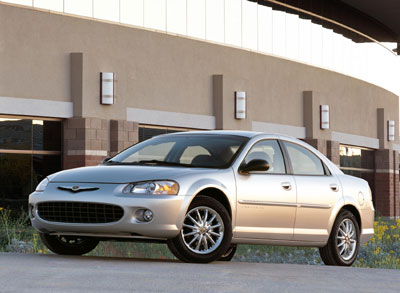
The Chrysler Sebring has it's own set of problems. It has remote entry, a special theft deterrent key and an alarm system. The remote entry has it's own key fob and works fine, or at least I haven't heard about any problems. The key has a padded handle that is maybe a quarter inch thick. It contains some kind of passive radio device that interacts with an antennae around the ignition lock. This means that if you need a new key you can't just get a copy made of the metal key: it won't work. You need to get a special key blank and then have it cut to match. And the blanks aren't cheap. They cost somewhere North of $35.

So just don't lose the key. But we still have the alarm system to contend with. First of all car alarms are one of my pet peeves. They do an infinitely better job of irritating people than they do deterring theft. Besides, that's why you buy insurance. Let the thieves steal the car quietly, without waking your neighbors up. Call the insurance company in the morning and go buy a new car. I know it's a bit of an inconvenience, but it doesn't ruin my sleep.

Anyway, the alarm system on the Sebring sometimes goes off for no good reason. Press the wrong button and it gets all upset, at loud volume, and only by going through the correct machinations can you get it to shut up. I tried to get it removed, but it is integrated into some other piece of electronics that is basically essential to the operation of the car. I think we have learned through trial and error, what not to do, so it has not gone off recently.

But back to the Mitsubishi. Just for grins I tried unlocking the drivers door with the key. It took a little finesse. First attempt resulted in my simultaneously turning the key and pressing the button in the key fob to lock the doors. Second, more careful, attempt worked fine. The ignition still requires a metal key. Never noticed a problem with locking the doors when turning on the ignition. I mean it wouldn't be a problem, but I have never heard the electric locks engaging at that time. I got used to using the key fob to lock this car because it is not clear to me which way to push the inside control button on the drivers door. If I drove it more than a couple of times a month I might get it sorted out.

Update June 2015: Replace missing picture of Windstar.
Update October 2016: Replace missing picture of Mitsubishi.


Monday, June 11, 2007

Cruise Control

I use Cruise Control wherever I go, even for as short a distance as two blocks. Left to my own devices, there is no telling how fast I might go, so in the interests of public harmony, I restrain my speed and Cruise Control helps me do that. Driving any distance, even as short as two blocks, at 25 miles per hour is tedious in the extreme. Twelve years of living in Hillsboro has inured me to this and it no longer bothers me as much as it did, but it is still very bad.

I like the Cruise Control on our 1995 Ford Windstar minivan because it lets you set the cruise speed to as low as 25 MPH. The lower cruise limit on our other three (!?!?) (all newer) vehicles is 35 MPH, which makes it useless for traveling through these endless suburban neighborhoods. I would like it better if it went even lower, like 20 MPH for school zones, and 10 MPH for parking lots. It can take a subjective hour to get from one side to the other of some of these mall lots at 10 MPH. I cannot do it. With a Cruise that controls my speed down to that level, I could.

The Cruise Control on my 1999 Dodge Dakota has a "Cancel" button, something the Ford does not have. It's function is mostly psychological. It has the same effect as tapping the brakes: it disengages the Cruise function, but does not turn it off, so it retains the speed setting. Pressing resume will return the vehicle to its' previous speed. You can tap on the brakes so lightly as to not have any noticeable braking effect, yet it will disengage the cruise control. However, your brake lights will undoubtedly come on, and you are using a control for other than it's intended purpose. Disengaging the Cruise Control can also cause the vehicle to slow down, but it is mostly a function of wind resistance. Brakes are to slow the vehicle very quickly. In any case I like and use the "Cancel" button.

Another feature of the Windstar's Cruise Control is that you can adjust the speed in one MPH increments. Tap the "ACCEL" button, and speed will increase by one MPH. Tap the "COAST" button, and speed will be reduced by one MPH. Five taps will change your speed by five MPH. I also use this feature. I would rather have a dial that would allow me to set the speed anywhere from five to five hundred MPH (Whoa dude! five hundred MPH! That would be so cool!), but dial controls seem to be out of favor these days. Maybe I will build one someday.

The Cruise controls on our three American vehicles are buttons on the steering wheel around the central horn button/air bag. Our newest vehicle, a Japanese Mitsubishi Endeavor, uses a short stalk, like a turn signal stalk, which gives it a total of three. One for lights, one for wipers, and one for cruise. I think they moved the Cruise control to a stalk because they put a bunch of radio control buttons on the wheel itself. No more room there for Cruise controls. Interestingly, the buttons for the radio are on the back side of the wheel, invisible to the driver, though they can be easily located by touch. But back tot he Cruise control. The first two stalks (for lights and wipers) are mounted to the steering column housing, that is, they do not rotate with the steering wheel. However, the Cruise control does. It is a little odd. And this little lever has more functions than Carter has pills. It moves up, down, back and it has a button on the end to be pressed.

Wednesday, March 22, 2006

Elephant Wrench

Friday Johnny and I replaced the leaking heater hose in the van (1995 Windstar). To get to it, we had to remove the alternator. To do that, we needed to get the serpentine belt off the alternator pulley. Well, it was not really necessary to unship the belt first. I think it would have come loose when we got the alternator loose. But how do you get it back on afterwards? I tried an adjustable wrench, but I could not pull it quite far enough to get enough slack in the belt to shift it off of the pulley. Then I remembered I had a large pipe wrench, and I thought it might work. So I got down my box of big, ugly iron tools, and lo and behold! An elephant wrench! Just what the doctor ordered! Put it on the tensioner, pulled, and the belt came off the pulley easy as pie. And what, you may ask, is an elephant wrench? Well, there are guns, and then there are elephant guns. This wrench is a large adjustable wrench. Johnny named it. It must be 18 inches long, and the head must be five inches in diameter. Andy gave it to me. He used to use it for fixing forklifts. I have had it for years, and I think this is the first time I have used it. Only problem was that after I got the belt off the alternator pulley, and I relaxed the pressure on the wrench, when it went back, it ran into the edge of the engine compartment, so I couldn't get it off the bolt. Fortunately, it wasn't in our way. It also means that if I had just dumped the belt off the pulley when I took out the alternator, I probably wouldn't be able to get the wrench on the tensioner at an angle that would allow me to compress it enough to get the belt back on. Oh well, no point in worrying about that now. So we got the alternator out of the way. Now to take the hose loose. The right hand (as you look at the engine) end of the hose is relatively easy to get off. It has a spring clamp holding it in place, and there is room to get to it with a pair of pliers. It is simply a matter of wrestling with it until it comes free. Well, maybe not that simple. I resort to cutting the hose to make it easier. The other end of the hose requires a decision. The hose connects to a Y-pipe that connects to the water pump and to another hose that runs off in back of the engine. It might be wise to replace the whole thing, but only this one piece is leaking and I want to finish this today, not in six months. So I decide to only replace the section of hose that is leaking and not the entire two hose and Y-pipe assembly. This requires cutting the crimp ring that secures the hose to the Y-pipe. It is aluminum, it is in the open, so it is easy enough to cut with a hacksaw. Well, at least most of it. Get down to the bitter end and the full hacksaw can't get to it. Pull the blade out of the saw, wrap a rag around one end for a handle and manage to get through the last little bit of the ring. A screwdriver works well to pry the ring open. The hose slides right off. Now it is off to the local NAPA auto parts store for a piece of hose and a couple of clamps. $7 and change. Sliding new hoses over fittings works better if there is some lubrication. Spit works well for this, though it grosses Johnny out. I can get the hose started on the one fitting, but it won't slide all the way on. Fuss and fume and finally go dig out some old spark-plug-wire-pulling pliers, they work surprisingly well. Now I am fussing with the other end, and I push down on the hose, which pushes down on a hard plastic vacuum line and snaps it in two. Bah! Now I have to replace it as well. We have the water hose on, so we postpone the vacuum hose till tomorrow. Saturday Johnny and I eventually get back to the auto parts store. The guy trys to find some fittings that will work but he is not having any luck. I finally ask for a generic PCV valve and some hose. This he manages to deliver. Meanwhile Johnny has found a package of magnetic tipped screwdrivers. I find magnetic tips more annoying than useful, but I do have one on my electric screwdriver. Johnny wants them for working on computers and he has money so we get them. The PVC valve is a valve, where as the old fitting is just that, it has no innards. So it behooves me to gut the PVC valve before using it. Clamp it gently in the vise and saw around the bottom with a hacksaw, very gently. The top end is plastic and we don't want to break it. Manage to get the end off and the guts out. File the burrs away and plug it into the valve cover. Fits fine. When I pulled the old fitting out a small pile of rust fell out. Can't imagine where it came from. Tried to use the old fitting, but ended up destroying it while trying to get the old vacuum line off. I think the tube was shrunk onto the fitting. The other end of the old tube plugs into a hole in the intake system. The new hose needs a fitting, so I end up using a short piece of the old vacuum line to adapt the new hose to the intake. Now for the alternator. Johnny manages to pinch his finger under the alternator while putting it back in. Other than that it goes in easy enough. Tighten the bolts, pull on the elephant wrench and slip the belt back on. Connect the wires to the alternator and battery, add some antifreeze to the overflow tank and we're done.
