SS Normandie was a French ocean liner built in Saint-Nazaire, France, for the French Line Compagnie Générale Transatlantique (CGT). She entered service in 1935 as the largest and fastest passenger ship afloat, crossing the Atlantic in a record 4.14 days, and remains the most powerful steam turbo-electric-propelled passenger ship ever built.
Normandie's novel design and lavish interiors led many to consider her the greatest of ocean liners. During service as the flagship of the CGT, she made 139 westbound transatlantic crossings from her home port of Le Havre to New York City. Normandie held the Blue Riband for the fastest transatlantic crossing at several points during her service career, during which RMS Queen Mary was her main rival.
During the Second World War, Normandie was seized by U.S. authorities at New York and renamed USS Lafayette. In 1942, while being converted to a troopship, the liner caught fire and capsized onto her port side and came to rest, half submerged, on the bottom of the Hudson River at Pier 88 (the site of the current Manhattan Cruise Terminal). Although salvaged at great expense, restoration was deemed too costly and she was scrapped in October 1946.
As a master mariner with over 20 years exp at Sea, this is something I would never want to exp. in my life. There was some medical issue with some crew and the fight onboard led to damage to the engine/electrical controls while the vessel was on a SW course of Mauritius towards Atlantic Ocean. Resultant was thst all engine power was lost and vessel drifted towards the island and aground. 94 Miles off aftsr her salvage she sunk to 4400m to the bed of Indian Ocean. The Salvage Video is exceptional, the hard work that goes into this is remarkable esp removal of fuel oil fm Engine room and working machinery and bunker tanks. Kudos to the salvors.
A couple friends in Bergen, Norway, get jobs on a cargo ship just in time for WW2 to break out, so their 18 month voyage turns into five years. One guy has a wife and three kids, the other is a bachelor. Basically, life during wartime. Isn't that a Talking Heads song? Anyway, it's a pretty good show.
P. S. The Germans built a submarine pen in Bergen which led to trouble that shows up in the show.
When the Germans conquered Norway in 1940, it gave them a golden opportunity to move their U-Boats closer to the front. Construction of a U-Boat bunker in Bergen started in 1941. The bunker had 3 dry boat pens, 3 wet ones, and one that was used for storage.
It was the Kriegsmarines’ 11th U-Boat Flotilla, transferred from Germany, who made its new headquarters in Bergen.
After the Allied landings in France in June 1944, there was a massive expansion of the U-boat base in Bergen. This led to a massive English air raid in October 1944, involving over 150 aircraft. The attack ended in a disaster when 193 Norwegians, among them 61 children at a nearby school, were killed. The bunker took several hits, but remained intact. Only two U-Boats were damaged. Later the same month ended another attack without success when the 244 aircraft could not find the target due to heavy clouds. A few planes dropped their bombs, but did not hit the bunker.
The third and last air raid took place in January 1945, when 33 bombers loaded with "Tallboy" bombs attacked the base. The bunker took 3 direct hits. One of the bombs penetrated through the roof, damaged two U-Boats and killed 20 Germans.
As with the other German naval bases, the base in Bergen was named using the German phonetic alphabet. As it was located in Bergen, and ”Bruno” is phonetic for"B," it thus became Bruno.
The bunker is used today by the Norwegian Navy for the repair of submarines as well as storage.
A large part of the work to build the bunker was carried out by around 2,000 prisoners of war from the Soviet Union and Poland. The bunker's roof consists of five-metre-thick reinforced concrete, where an entire year's Norwegian production of cement was used for the construction.
. . .
The future of the submarine bunker is uncertain, as the Norwegian Navy's new submarines are too large for the docks in Bruno and will receive new service facilities at Haakonsvern .
Distinguished daughter wanted to take a look at a Foreign Service Officer practice test, so we did. Part of the test was to correct a piece of text. The piece they chose was a short summary of the 1956 Suez Crisis. We really didn't know anything about it, but we kind of expected the typical kind of diplomatic bullshit we read about in the news today. But that's not what we got. This bit of text contained a big surprise. Seems the Brits and the French really put their foot in it. It starts on page 32 of the PDF file, page 29 if you looking at the printed page numbers.
In July 1956, Egyptian President Gamal Abdel Nasser seized control of the Suez Canal and nationalized the British- and French-owned company that managed it, threatening both British and French stock holdings and Europe's access to Middle Eastern oil. The ensuing crisis had important consequences for U.S. relations with its European allies and the Middle East. Not surprisingly, a crisis transpired. Previously, the United States and Britain had agreed to finance Egypt’s Aswan Dam, which was to be both a symbol of modernization and a source of electricity. However, after Nasser made several moves that appeared friendly to the Communist bloc, the United States and Britain reneged on the agreement and withdrew financing. Belatedly, Nasser realized that the building of the Aswan Dam was important to Egypt’s future.
The United States regarded Nasser's nationalization of the Canal as a problem and pursued a diplomatic solution. Britain and France, however, viewed it as a threat to their national interests. They secretly contacted the Israeli government and proposed that Israel invade the Sinai Peninsula and march toward the Suez Canal zone. Then Britain and France would warn both Egypt and Israel to stay away from the Suez Canal and land paratroopers in the zone on the pretext of protecting it. In October 1956, Israeli forces crossed the border to defeat the Egyptian army in the Sinai. Britain and France then issued their warning and landed troops as planned.
Both the United States and the USSR responded by demanding a cease-fire to these events. In addition, the United States also called for the evacuation of Israeli, French, and British troops under the supervision of a special UN force. This force arrived in mid November and by the end of the year the last British and French troops had withdrawn.
The Suez conflict was a military defeat for Egypt, but Nasser’s status as the defender of Arab nationalism grew in the Arab world. The United States had improved its relations with Egypt, but fundamental disputes between Israel and its neighbors remained unresolved. Israel withdrew from Egyptian territory gained in the fighting but regained access to the Straits of Tiran.
MORNING RUSH at the WORLD'S BUSIEST AIRPORT - Atlanta Hartsfield-Jackson Plane Spotting
Alex Praglowski Aviation
I watched another similar video not too long ago and it gave me a feel for just how massive the airline industry is. Normally all you or I hear about airlines is when one particular airplane has some kind of trouble, or about how many zillions of dollars a particular company made or lost, but neither of those things really gives me a feel for what's actually going on. One airliner, while large, complex and expensive is still just one airplane, and a zillion dollar profit or loss is just some abstract, imaginary number. But watching these big, expensive aircraft take off, one after another, endlessly, I start to get a feel for the situation.
I went on board the SS Great Britain once; beautifully restored, an old slave-trader ship harboured in Bristol UK. It has a steam engine too, a HUGE V2, the bore and stroke are each about 2 or 3 meters !!!
Right off the size of the engine grabs me. It's big, so I go looking for pictures. I'm finding all kinds of photos, but none that really show the whole engine and how big it is. That's because it's contained in a room just big enough to hold it, never mind that the room is big enough to contain a small office building. You can't get far enough away to get a view of the whole engine. Bah. Lots of models and mockups and such though. You work at it and you can build an image in your mind. Don't know if you can really get a 'feel' for the size of it without being there.
On 22 December, she rescued the crew of the British brig Druid, which had been abandoned in the Atlantic Ocean.
Well, that's cool. That ought to be a pretty good story behind that. Let's see what we can find. Hmm, seems there were several HMS Druids over the centuries, but none that fit the bill, so maybe it was a commercial ship, so I do some more looking and I find this incident mentioned in a List of shipwrecks in December 1872. WTF? There's like 600 of them, that's 20 a day. Can you imagine if we had 20 airliners crashing every day, day in, day out? That is roughly equivalent to what was happening. Okay, most of them were probably cargo ships, but sailing cargo ships carried a crew of a dozen or so, and the cargo and ship had substantial value.
As for slave ships, slaving was big business back in the middle ages. Britain outlawed slave trading in 1807. The SS Great Britain (1845–1886), after being rebuilt and refitted a couple of times, spent 30 years transporting colonists to Australia. Australia was started as a penal colony, but that was back in 1788, but fifteen years later there was a real colony.
Meanwhile, I've started reading The Verge, a history of European exploration from 1490 to 1530. The book starts talking about Columbus and his voyages to the new world. I heard all about this when I was a kid, but my teachers didn't talk very much about how his expeditions were financed. The Verge attempts to correct this oversight. The money men got together and financed these expeditions because they wanted to make more money. They had seen the stuff coming from the Far East and knew there was a boatload of money to be made if they could just get around the middle men in the Mid-East. So they started sending ships to look for opportunities. In Africa they found gold and slaves. In North America they didn't find much except people they could enslave, at least at first. Eventually after the pushed further in Mexico and South America they found huge quantities of gold and silver, but that was later. At first there was nothing but a bunch of natives fishing from canoes.
As Iaman meanders northward, he pauses in Lompoc, California, where this mangled ship's propeller catches his eye.
Unusually beaten up screw
A plaque commemorating the event gives us a clue.
Honda Point Disaster Commemorative Plaque
Wikipedia knows all. The introductory paragraph summarizes the event:
The Honda Point disaster was the largest peacetime loss of U.S. Navy ships. On the evening of September 8, 1923, seven destroyers, while traveling at 20 knots (37 km/h), ran aground at Honda Point (also known as Point Pedernales; the cliffs just off-shore called Devil's Jaw), a few miles from the northern side of the Santa Barbara Channel off Point Arguello on the coast in Santa Barbara County, California. Two other ships grounded, but were able to maneuver free off the rocks. Twenty-three sailors died in the disaster.
I cropped the above image from a high-res photo that Tam posted. In Tam's post the ships are just a red and yellow blob. If your camera has enough pixels it can compensate for not having a zoom lens. The downside is that a few images can really eat into your storage space. Of course storage space is cheap these days.
Unless you are renting space on the cloud. It's still cheap, but it incurs a monthly charge. $2 a month buys 100GB from Google. My cropped image uses one-tenth as much space as the original. The original is only about 1/4 of a megabyte, which is negligible on this scale. However, I scanned a batch of old 4 x 6 photos at 600 dpi and each one of those required about 50 megabytes. That amount of space on this thumb drive would be a fifth of a cent. On Google it would be a tenth of a cent a month. Take a thousand photos and you're talking about a cup of coffee.
Royal George , a warning to all citizens of the future.
Sea Stories (FULL Audiobook)
Iaman has been listening to sea stories, and he found the The Loss of the Royal George worth sharing. This story is recited in the above video of Sea Stories. The book, and the story, can also be found on Project Gutenberg. I couldn't listen to the audiobook. I don't have much patience with recorded voices, but the written version is short and quick and a very grim tale. As Iaman says:
"What could go wrong? Calm water, no wind, sun out, warm festive atmosphere."
Here is the table of contents for the audio book (top). I had some trouble locating the story I wanted so I started making my own table of contents before I thought to look in the comments where I found it, and not too far down either.
Not a great book, but not bad. An easy, engaging read. About half of the book is devoted to serious stuff, like the ship, submarine operations, political machinations and military operations. The other half is fluff - little bits of information about some of the various passengers, who they were, what they were doing and what became of them.
S.S. Lusitania Leaves New York City on Last Voyage
The water that day was nearly mill-pond still. Launching the lifeboats was almost a complete disaster, partly due to an inexperienced crew and partly due to poor organization, or maybe I am repeating myself. There was also the problem of launching the boats while the ship was still moving. A behemoth like the Lusitania charging along at 18 knots doesn't suddenly stop just because there is a big fat hole in the side.
The sinking of the Lusitania by a German U-Boat may have been the trigger that launched America on the road to war. It took two years, but eventually we got involved. One of the first things we did was send a squadron of destroyers over. The event was significant enough that Bernard F. Grimble captured it in a painting.
The submarine that fired the fatal torpedo ended up grounded on the Danish coast. The Germans expended great effort to refloat it but failed.
P.S. Some places say SS for Steam Ship, some places say RMS which stands for Royal Mail Ship, not Royal Majesty's Ship, which would have been my first guess. British Royal Navy ships are denoted by HMS which stands for His (or Her) Majesty's Ship. RMS just means the ship carries the mail.
P.P.S. Some of the place names from Ireland sounded familiar. Seems I did a post about The Wreck of the Seahorse a couple of years ago. 200 years ago the Seahorse foundered on the Irish coast not far from where the Lusitania went down. I added it to the map.
We're watching Season 3 of Ertuğrul on Netflix and it's pretty great. The series has been around for while, so when I started thinking about doing a post, I checked my pile of files, and this shipwreck popped up.
Ertuğrul, launched in 1863, was a sailing frigate of the Ottoman Navy. While returning from a goodwill voyage to Japan in 1890, she encountered a typhoon off the coast of Wakayama Prefecture, subsequently drifted into a reef and sank. The shipwreck resulted in the loss of 533 sailors and officers, including Rear Admiral Ali Osman Pasha. Only 69 sailors and officers survived and returned home later aboard two Japanese corvettes. The event is still commemorated as a foundation stone of Japanese-Turkish friendship. - Wikipedia
Looks like the captain and the artist may have been related, but this makes it seem unlikely:
That's a military war machine, a tank. Going by the amount of crud covering it looks like it has been down there a while. Given that we can see color and the background isn't totally black, it might not be too deep. Plus we have a SCUBA diver, but that isn't a good indicator because SCUBA divers can go very deep with special equipment. This picture sparked my interest, so I did a little checking. The tank was cargo on the Empire Heritage, which had a string of bad luck.
Empire Heritage, a 15,702 GRT tanker, was launched in 1930, hit a mine in January 1941 and beached. Refloated in March 1941 and beached, but broke in two and declared a total loss. To MoWT, repaired and renamed Empire Heritage. Torpedoed September 1944 and sunk by U-482. - paraphrased from Wikipedia
MoWT is the Ministry of War Transport. Empire Heritage was one of about a zillion Empire ships:
An Empire ship is a merchant ship that was given a name beginning with "Empire" in the service of the Government of the United Kingdom during and after World War II.
. . .
New Empire ship construction represented an enormous undertaking that included classes of freighters, tankers, aircraft carriers, fast cargo liners, tank landing ships, Deep Sea Salvage and Rescue Tugs and several other categories. Total production numbered in the hundreds.
Empire ships were supplements to Britain's normal peacetime merchant fleet, swelling its wartime numbers to 12,000, then the largest merchant ship fleet in the world. Approximately 4,000 ships on the British register were lost between 1939 and 1945, a considerable number being sunk during the Battle of the Atlantic. - Wikipedia
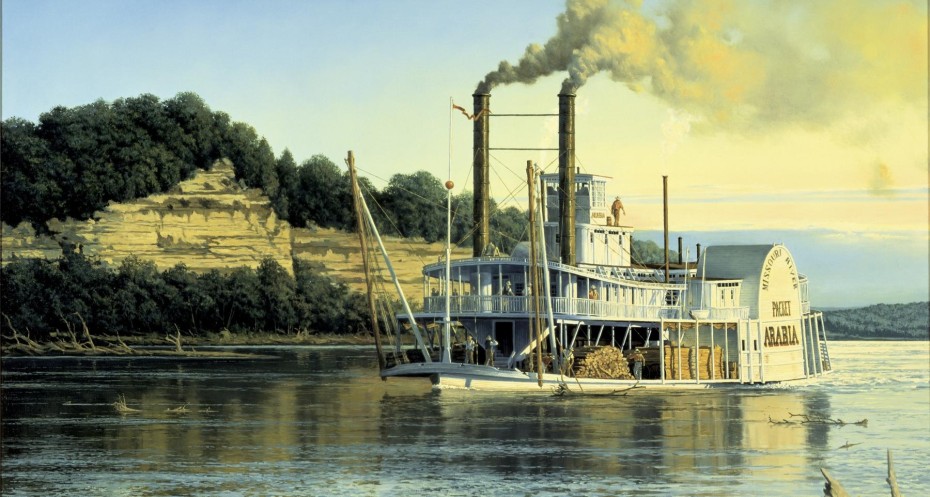
I am reading about the riverboat Arabia that sank on the Missouri River back in the 19th Century. The wreck was discovered about 30 years ago in a field. On Google's satellite images you can see that there is some kind of industrial establishment near the site of the wreck, but Google doesn't tell you what it is.
Lat 39.182206 & Lon -94.680390, Wikimapia
The little golden blob is the site of the Wreck of the Arabia
The industrial establishment in lower left hand corner is the Nearman Creek Power Station
Maybe Wikimapia can tell us. It might if we can get it to accept the coordinates. It doesn't like negative numbers, it wants direction letters (N, E, S, W) appended to the numbers, but even with those letters tacked on it wants to quibble. It seems like a fairly straight forward problem of interpretation. Google has mastered it, why hasn't Wikimapia? So I decide to file a complaint with the authorities.
The polite thing to do in these cases is to see if this is a known problem, so I go looking and I find someone asking about UTM coordinates. What's UTM? More searching and I find the Universal Transverse Mercator coordinate system. UTM was developed by the United States Army Corps of Engineers in the 1940s. Ah-ha! WW2 field artillery! I love the smell of cordite in the morning.
Calculating the distance between two points on these maps could be performed more easily in the field (using the Pythagorean theorem) than was possible using the trigonometric formulas required [using] latitude and longitude. - Universal Transverse Mercator coordinate system
The Wikipedia article about UTM has a bunch of complicated math, but no real explanation of what's going on, so more searching. I turn up a NOAA document that sounds promising. It doesn't really help, it's full of jargon, but it does contain this little bit:
Events occurring at Iowa State University, Ames, IA, in the late 1930's and the University of Pennsylvania in the early 1940s would effect nearly everyone in the world in the ensuing decades. These events led to the construction of the first automatic electronic digital computer (EDC), the Atanasoff-Berry Computer (ABC) by John V. Atanasoff and Clifford Berry in 1942. - Geodetic Surveying 1940-1990
While it might have been the first electronic digital computer, but it wasn't programmable, i.e. it was built for one purpose, to do map calculations. Getting it do anything else would have meant reconstructing it, kind of like trying to turn a forklift into school bus. The computers that showed up later, like ENIAC were reprogrammable. That way everybody gets to claim some kind of 'first'. And then I find this:
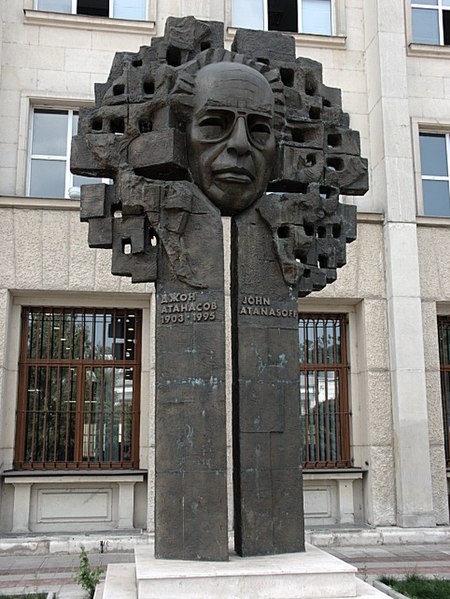
Monument to John Atanasoff in Sofia, Bulgaria
I can understand someone putting up this monument, people do that all the time. But why is it in Bulgaria?
John Vincent Atanasoff (October 4, 1903 – June 15, 1995) was a Bulgarian-American physicist and inventor. John's paternal grandfather was killed by Ottoman soldiers after the Bulgarian April Uprising.
The Order of Saints Cyril and Methodius, First Class, Bulgaria's highest scientific honor, was bestowed to him in 1970.
In 1990, President George H. W. Bush awarded Atanasoff the United States National Medal of Technology, the highest U.S. honor conferred for achievements related to technological progress. - paraphrased from Wikipedia
In 1915, a German submarine torpedoed and sank the RMS Lusitania; 128 Americans were among the 1,198 dead. The event outraged McCay, but the newspapers of his employer William Randolph Hearst downplayed the tragedy, as Hearst was opposed to the US joining World War I. McCay was required to illustrate anti-war and anti-British editorial cartoons for Hearst's papers. In 1916, McCay rebelled against his employer's stance and began to make the self-financed, patriotic Sinking of the Lusitania on his own time.
Alfred Gwynne Vanderbilt I. A fat wallet won't protect you from a watery grave. Or people making fun of your middle name. No wonder everybody calls him G.
No longer applies: [Photos are arranged in chronological order. The first few photos are from its career prior to this ignominious event. Most of the pictures were taken since then. The last third depict the salvage operators dismantling the ship in order to remove it from the reef.]
The reef is in the middle of the Sulu sea in the Philippines a hundred miles from land in any direction. The reef is a National Marine Park and World Heritage Site and the Philippines are understandably ticked off that we managed to get our ship stuck there, so the U.S. Navy is trying to minimize the damage to the reef as they try to remove the ship. Photos from Military Photos dot net.
Update June 2019 replaced dead Picasa slideshow with image and link to Google Drive album.
TUBBATAHA REEF (Jan. 22, 2013) The mine countermeasures ship USS Guardian (MCM 5) sits aground on the Tubbataha Reef. Operations to safely recover the ship while minimizing environmental effects are being conducted in close cooperation with allied Philippines Coast Guard and Navy. (U.S. Navy photo by Geoffrey Trudell)
Tubbataha Reef is in the Philippines in the middle of the Sulu Sea, a hundred miles from land in any direction. I'm wondering how they managed to managed to get themselves in this fix.