We Went Inside an Elephant Cave I Underground Salt-mining
Terra Mater
![]() |
| Mount Elgon |
![]() |
| Mount Elgon |
Silicon Forest
If the type is too small, Ctrl+ is your friend
![]() |
| Mount Elgon |
![]() |
| Mount Elgon |
![]() |
| A pair of male elephants in the Okavango Delta, Botswana [Mike Hutchings/Reuters] |
Botswana, a largely dry nation which is home to 2.3 million people, has more than 130,000 elephants, nearly one-third of all elephants in Africa. The African continent is home to some 415,000 elephants of the world’s 460,000 elephants. The rest of the world’s elephants are in Asia.In 2019, the government lifted a five-year moratorium on elephant hunting to keep the elephant population in check and help generate revenue from trophy hunters for rural communities.A preliminary government draft indicates that the quota for trophy hunting for 2026 has been raised to 430 elephants, up from 410 in 2025.
The move reflects Botswana’s general approach to the conservation of elephant herds.
In 2014, the country imposed a complete ban on trophy hunting but reversed that decision five years later, saying elephant numbers had risen too high and were threatening farmers’ livelihoods.
Now, the government allocates annual hunting quotas for more than a dozen species, including elephants, rhinos, and hippopotamuses.
Other African nations, including Namibia, Zimbabwe and Tanzania, also have trophy-hunting quotas to manage their elephant and other wildlife populations.
![]() |
| Arlit Niger |
What? Where? Very close to the middle of nowhere, that's where.
![]() |
| Arlit Niger |
![]() |
| French Uranium Mine Arlit Niger |
His assertion, which he lays out thoroughly if you watch the whole video, which I recommend, is that the Africans had never seen a functioning country. Prior to colonial rule, they'd never experienced anything other than primitive, tribal society. Here's an excerpt. I have edited this transcript for clarity. Her dialog is in italics.
We had tribal wars. And you must understand, even though the only thing African tribes have in common is skin color. Once we go to this tribe is a different language, different religion, different everything. Food, everything. It's like you've been to China, in France, except the way in the same region. Let people get this picture clear. It was a continent with only tribes.
(When the Europeans arrived in Africa) there was no republics. There were no countries. No modern day concept of what country means. There were no formal boundaries and borders. So let's talk about Benin itself. How many tribes were in Benin at that time? About 50. 50 different tribes or more... But you can't say Benin because there was no Benin. You can say the region. You see what I mean? It was a region that stretched all the way from the Nile River in Nigeria, all the way to Ghana, just a region. That's no name for anybody. There was nothing like Benin, Nigeria, Ghana.
No. But there was a concept of Dahomey.
That's correct. That's a tribe ... That's one tribe of very brutal guys. Guys with potbelly married 200 wives, and they call them chiefs. And the foreigners named them kingdoms, because that is the only way they know from where they were coming from Europe. But there was no kingdom. We are not kingdoms.
It's any pot belly guy married to many women with his family making war on the other small tribes, and they were describing them based only on the word they know. The Europeans say, oh, this people's kingdom. It was only chiefs. We never had kings in Africa.
Explains a lot.
![]() |
| 10 Big Rivers |
The sources of the Niger River, the Gambia River, and the Senegal River are all found in the Guinea Highlands. - Wikipedia
![]() |
| Ethiopian men gather in Addis Ababa, heavily armed with captured Italian weapons, to hear the proclamation announcing the return to the capital of the Emperor Haile Selassie in May 1941. © Wikipedia |
asdasdd
![]() |
| Alliance of Sahel States (AES) (Red) and ECOWAS (Gray)* |
I keep hearing about largish numbers of people being killed in Africa due to terrorist attacks or tribal warfare or something. I've never heard any coherent explanation of the overall situation, so I kind of just wrote them off as just crazed third-worlders running amok. I mean, what can you expect from such backward savages?
Today I came across this piece and the author lays it out pretty clearly. Here's the first couple of paragraphs. Follow the link to read the whole thing.
Russia’s Aims in Africa by Robert Bergkvist
As the 2022 invasion of Ukraine sparked international outrage, a different picture was being drawn half a world away. Bangui, the capital of the Central African Republic, hosts a peculiar, life-sized statue . Honoring the defense of the city against attacking rebels in 2021, it portrays a woman and two small children, huddled together behind a line of armed defenders: Central African and Russian soldiers, holding assault rifles. Around the time that Wagner Group mercenaries were taking part in the invasion of a sovereign European state, that same group was being lauded as a protector and liberator by a crowd of Central Africans, carrying flowers and Russian flags. How did Russia’s influence in Africa grow so strong and what are its aims going forward?
One recent example is eye-catching. In the beginning of this year, Mali, Niger and Burkina Faso announced their withdrawal from the Economic Community of West African States (ECOWAS), instead forming an “Alliance of Sahel States” (AES). Having undergone coups in the 2020s, all three countries are now run by military juntas. There are massive security concerns: the trio is locked in a brutal struggle against trans-African terrorists. Jihadist organisations to the North with al-Qaeda and ISIS affiliations conduct lethal attacks on military and civilian targets, leading to massive fatalities. As such, Mali, Niger and Burkina Faso are all on the top 10 list of countries affected by terrorism, according to the 2024 Global Terrorism Index . Burkina Faso is considered the most terrorism-affected country in the world with over 2,000 deaths, placing it above states like Israel, Afghanistan and Iraq.
It will be interesting to see how this plays out. I suspect the Islamic Jihadists that are causing trouble are being funded by Iran. Russia is cozying up to Iran on account of their being neighbors and both are declared enemies of the West. They may not like each other, but they both dislike us more. It's a fine example of the old saw "the enemy of my enemy is my friend", at least until our common enemy is defeated, then you and I can fight.
Or it might be that the Jihadists are followers of some heretical version of Islam and so in Iran's eyes they are infidels and deserve to be destroyed. But if that's the case, who's funding them? Saudi Arabia? Who else could it be? It could be some rich man, but war is an expensive hobby. Far as I know the only people can afford the cash to pay for a war are places (like countries) that have a regular, sizable income, from either taxes, oil, or drugs. Might be Qatar, they have oil.
Are all wars religious wars? Or maybe religion is applied like a blanket over the crowd that is bent on going to war and somehow this makes everyone feel better? Anyway, we've got Eastern Orthodox (Russia), the Catholics (Europe), the Protestants (USA), Islam (Shia in Iran, Sunni in Saudi Arabia, who knows what in Qatar). Thank God for the Himalayas are we would have even more wars going on.
It just occurred to me after I wrote that last paragraph, that if the Catholics are really the dominate religion in Europe, it might explain the elites plan to fucking destroy the European economy by fomenting this war in the Ukraine. Pretty sure most of the elites are either Protestant or atheist. The only way you destroy the Catholic church would be if you destroyed their base, and killing their economy just might do the trick.
*Note about the map: I like the map, because it shows members of the two, regional, competing blocks. Guinea isn't technically part of AES, but the page where I found this doesn't acknowledge the existence of the AES.
Wikipedia refers to the Alliance of Sahel States as ASS which makes sense in English, but French is the second most popular language in that region, after the native gibberish, so in French it's Alliance des États du Sahel which is how you get E instead of S.
![]() |
| 1919 Savage Rifle Advertisement |
CHARLES COTTAR'S SURPRISE AT THE .250-3000Is anything much harder to kill than the rhinoceros? His temper is bad, his skin is inches thick, and he weighs close to a ton. He charges on sight, and he will hunt a man as a terrier does a rat.Mr. Cottar has killed a number of charging rhino with his little .250-3000 Savage rifle. He has learned to expect it to kill them.But when he killed one that ran away-killed it with one shot-striking in the ham and ranging clear forward through the lungs at 175 yards he was really surprised. He didn't think any rifle could do that.Mr. Cottar has been killing leopard, lion, rhino, hippo and elephant with the 250-3000 Savage for four or five years. He has found it the most generally useful rifle for African hunting.It is a six-shot, seven-pound, lever-action take-down repeater, with checked extra-full pistol-grip stock and fore- arm and corrugated steel shot-gun butt-plate and trigger. It has the lines, beauty and feel of an expensive shot-gun. And it shoots a vicious little 87-grain Spitzer point bullet 3000 feet a second, straight enough to make possibles onthe 800-yard target and hard enough to penetrate 5/8" boiler-plate or Mr. Cottar's rhino.Look at it and later on buy it at your dealer's, and write us for a detailed description.SAVAGE ARMS CORPORATIONUTICA, N. Y.Sharon, Pa. Detroit, Mich.Executive and Export Offices50 Church St., New York CityManufacturers of Hi-Power and Small Calibre Sporting Rifles, Automatic pistols and Ammunition
![]() |
| Djibouti |
![]() |
| LNG Tanker |
|
| USS Vella Gulf |
Page 77
![]() |
| USS Bainbridge |
![]() |
| Maersk Alabama Hijacking |
Page 199 'the Song telling us "The sweet things in life to you were just loaned. So how can you lose what you never owned?"' - Rudy Vallee
![]() |
| Statue de Foch Place du Trocadero, 75016 Paris France |
Page 202 We have this passage:
Cars came around to take different streets off the Place Verdun, circling past the statue of Marshal Ferdinand Foch, 1851-1929, on a pedestal in the center of the plaza, the single word J'Attaque below his name.
Xavier said, "Ferdinand was asked what he'd do if surrounded by Germans and he said he'd attack. I believe it was at Verdun he lost somethin like eighty thousand men j'attackin." He said, "There's your man there."
So I go looking for Place Verdun and a statue of Marshal Foch in Djibouti but all I find it this poster:
![]() |
| Commandant Marchand - Across Africa Book Cover |
"In 1896, Captain Marchand was appointed to lead the Congo-Nile mission to the White Nile River, with the aim of establishing a French protectorate in southern Egypt. Marchand led a team of eight French officers and 150 Senegalese skirmishers up the Congo, Ubangi and Bahr el-Ghazal rivers, arriving in Fashoda on 10 July 1898. They built a fort and raised the French tricolour flag. In September, the Anglo-Egyptian army under General Kitchener arrived at Fashoda. French and British colonialist ambitions came face to face at Fashoda, a standoff that ended in December 1898 when the French government ordered its troops to retreat to Djibouti."
Eventually I realized Xavier was just giving an example of a particularly bull-headed soldier to describe Buck, the soldier they were meeting. Although the French were in Africa, Marshal Foch was not.
![]() |
| Dar es Salaam |
![]() |
| Dar es Salaam, Zanzibar, Mombasa |
![]() |
| A 1729 map showing the Slave Coast |
'From your experience, would you say that this vessel was in a very bad condition? He asked.'
Oh no, not at all, " said Whewell." For a ship 14 days out of whydah, I should say she was doing rather well. No. It is ugly of course. And I believe the Commodore was sadly shocked; but there was little dysentery, and that in an early stage and it can be far, far worse. Perhaps the ugliest ever saw was a brig called the Gongora when that we chased for 3 days, off the coast. All that time the slaves were of course kept below - no food, precious little air with her running before the wind and went at last we took her and opened the hatches there were 200 dead below: dysentery, starvation, suffocation, misery, and above all fighting before they grew too weak to beat one another to death with their irons. The wretched brig carried almost equal numbers of Fantis and Ashantis, mortal enemies who had been at war, each side selling prisoners in the same market and they crammed in together. "
P. S. More research:
From the American Dictionary of the English Language we have the last definition of condemn:
6. To judge or pronounce to be unfit for use or service; as, the ship was condemned as not sea-worthy. To judge or pronounce to be forfeited; as, the ship and her cargo were condemned.
Forfeit, that's the term we want.
![]() |
| North Africa |
|
| Propaganda poster by Viktor Koretsky. First prime minister of the Democratic Republic of Congo Patrice Lumumba, who was killed in 1961. Inscription reads: “He carried Africa in his heart.” |
The Woman King is a historical action drama film about the Agojie, the all-female warrior unit that protected the kingdom of Dahomey during the 17th to 19th centuries. It is set in the 1820s.
The Kingdom of Dahomey was a West African kingdom located within present-day Benin that existed from approximately 1600 until 1904. Dahomey became a regional power in the 18th century by expanding south to conquer key cities on the Atlantic coast.
For much of the middle 19th century, the Kingdom of Dahomey became a key regional state, after eventually ending tributary status to the Oyo Empire. European visitors extensively documented the kingdom, and it became one of the most familiar African nations to Europeans. The Kingdom of Dahomey was an important regional power that had an organized domestic economy built on conquest and slave labor, significant international trade and diplomatic relations with Europeans, a centralized administration, taxation systems, and an organized military.
The Agojie, also know as Dahomey Amazons, were a Fon all-female military regiment of the Kingdom of Dahomey (in today's Benin, West Africa) that existed from the 17th century until the late 19th century. They are one of the few documented female armies in modern history.
The emergence of an all-female military regiment was the result of Dahomey's male population facing high casualties in the increasingly frequent violence and warfare with neighbouring West African states. This led to Dahomey being one of the leading states in the slave trade with the Oyo Empire, which used slaves for commodity exchange in West Africa until the slave trade in the region ended. The lack of men likely led the kings of Dahomey to recruit women into the army.
![]() |
| Grand Ethiopian Renaissance Dam |
With a planned installed capacity of 5.15 gigawatts, the dam will be the largest hydroelectric power plant in Africa when completed, as well as among the 20 largest in the world. - Wikipedia
They started building it in 2011 and it started generating electricity this year.
I was thinking about putting up a post about this, just because I had never heard of this project before. Seems like I should have heard something about a big deal like this, but no. A couple of days ago I started reading Maelstrom by Peter Watts and somewhere in the first few dozen pages he mentions this dam. Well, I can't ignore a coincidence like this, so this post. I've read a couple other books by Peter Watts and he's pretty great.
Looking for information, I dug up some maps.
![]() |
| River Nile Map |
Google Maps doesn't do a good job of portraying waterways. Can't say as I blame them, only a small fraction of the population gets out on the water, and the government has a whole army of people devoted to mapping water. So if you want to look at maps of rivers, search for images of maps using your regular browser.
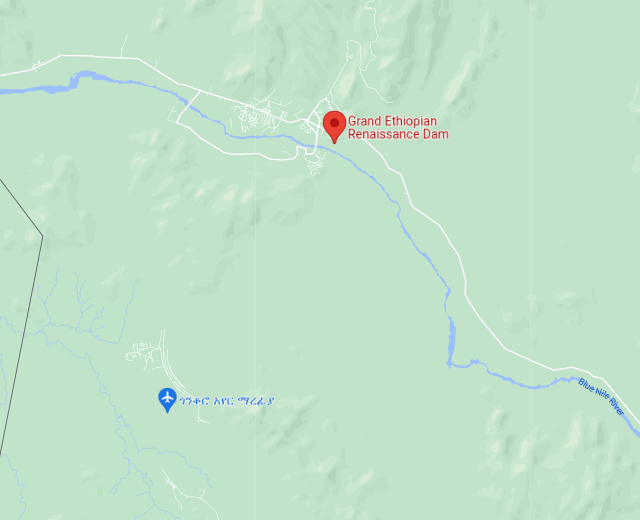
Still, Google Maps is terrific. Here we have two views of the area being inundated by the water being held back by the dam. Both maps are about 14 miles across. First is the map view:
![]() |
| Map View of Blue Nile Dam area |
No sign of any lake. The black line along the left hand side is the border with Sudan. Now look at the satellite view:
![]() |
| Satellite View of Blue Nile Dam area |
Update two days later.
![]() |
| Main Dam and Saddle Dam of GERD (Source: Hydro World, 2016) |
Looking at the satellite view of the lake I noticed a large, curved line in the lower left quadrant. A little digging reveals this is a three mile long saddle dam. The water hasn't reached it yet, but it means the lake is going to get a whole lot bigger in the coming years. The saddle dam is 160 feet tall. Not giant, but still substantial.