Intel's Ronler Acres Plant

Silicon Forest
If the type is too small, Ctrl+ is your friend

Showing posts with label Nickel. Show all posts

Tuesday, July 12, 2022

Nickel

London Metals Exchange Building
It's the one with the wavy front and the oval-ish top floor

Bayou Renaissance Man reports on the fallout from the London Metals Exchange disaster that happened earlier this year. It's an entertaining story.

Turns out the London Metals Exchange is actually in London, not Hong Kong. It is owned by some outfit in Hong Kong which is where my confusion originated. The field in back of the building belongs to the Honorable Artillery Company and was originally used for archery. Now it is also used for cricket.

Sunday, March 20, 2022

Dudinka - Norilsk

Norilsk, Russia

A big Chinese nickel producer got caught in a short squeeze that severely disrupted the London Metals Exchange (otherwise known as LME) which, for some reason, is based in Hong Kong. They were trying to make some money by gambling, a time honored tradition amongst gamblers and financial whiz kids. They were betting that the price of nickel was going to drop, but then Russia invaded Ukraine, the US threw up a bunch of sanctions and the price of nickel skyrocketed because, don't you know, Russia is one of the biggest producers of nickel in the world.

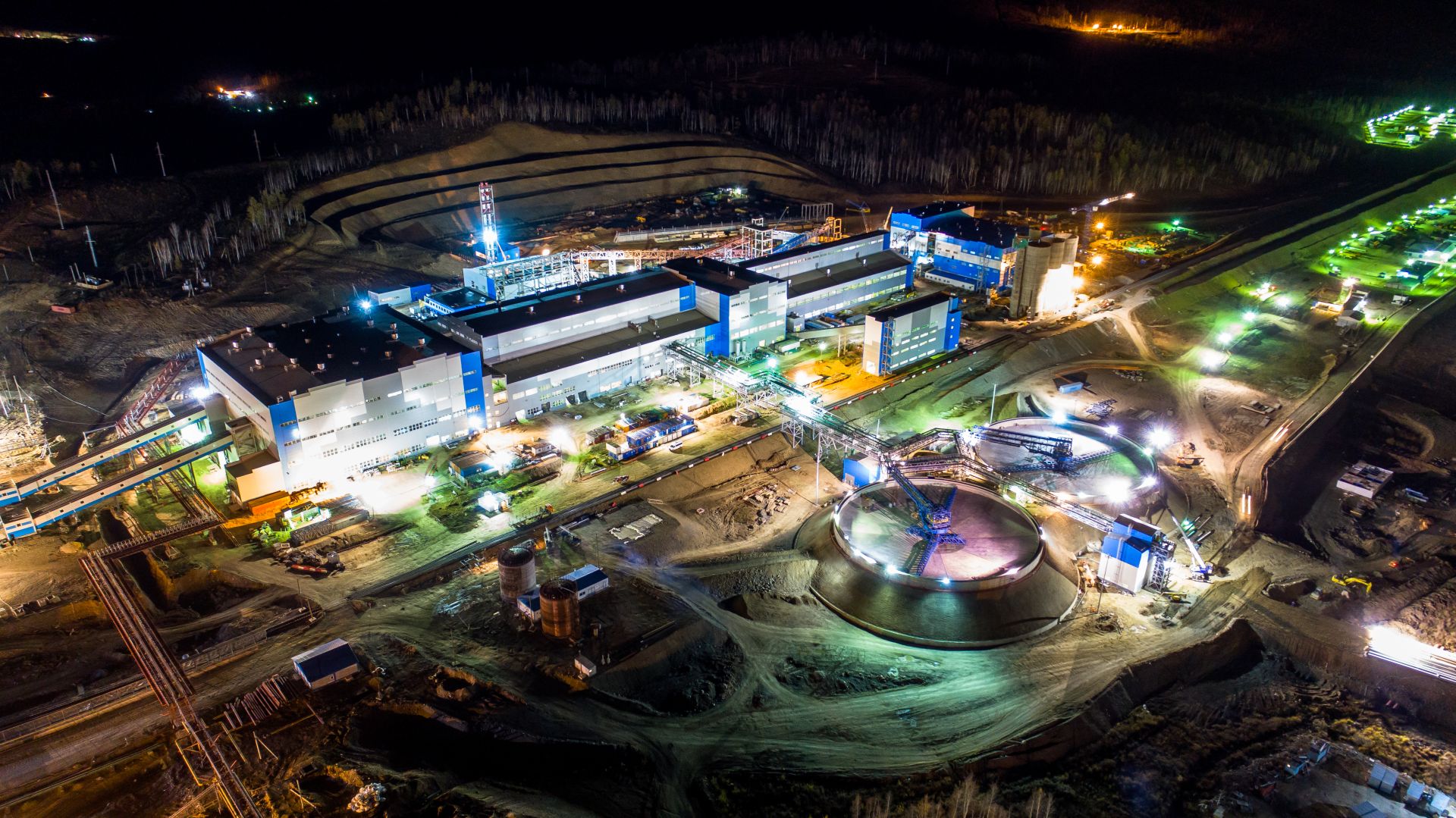
Nornickel's Bystrinsky Mine and Concentrator

Rising prices are very bad for someone who is betting that the price is going down, especially when the time for settling the bet is coming due, so they tried to buy up a bunch of nickel to cover their bets, which drove the price up even higher and eventually the London Metals Exchange said this is crazy and shut down all nickel trading. It looks like the Chinese producer is going to be out $8 billion which is no small amount, even for a Chinese oligarch.

Norilsk - Dudinka Railway

Norilsk is the site of Russia's biggest nickel mining and smelting operation. It is pretty well landlocked, so their product is shipped to 50 miles to Dudinka where it is loaded onto ships on the Yenisei River.

Arctic Express loading at Dudinka, Russia

Dudinka is 1.5 degrees north of the Arctic Circle, so the Yenisei River is a river of ice, which makes shipping a challenge, to put it mildly.

Liebherr crane unloads the massive heat exchanger from the ship in Dudinka Seaport

Marine Traffic near Norilsk, Russia

All those colored dots on this map are big ships. Norilsk is near the right hand edge of the map and the green dot about a half of an inch to the left is at Dudinka. Left of center in the image is another river of ice but it has quite a bit more traffic. I wonder what they are doing over there. I imagine more resource extraction, but that's going to have to wait for another time.

MV Federal Yamaska Bulk Carrier
198 piece jigsaw puzzle

I did this puzzle a couple of days ago and I wondered where the photo was taken. Didn't find anything, I suspect it's in Alaska, but who knows. I'm tacking it on here just because it seems to fit.

Monday, January 9, 2017

Psyche


Psyche and Spacecraft

Video is an artists concept, but a very cool one. The asteroid is Psyche 16 and this is some real Star Trek shit: we're sending a probe to investigate an anomaly:
The Psyche mission will explore one of the most intriguing targets in the main asteroid belt - a giant metal asteroid, known as 16 Psyche, about three times farther away from the sun than is the Earth. This asteroid measures about 130 miles (210 kilometers) in diameter and, unlike most other asteroids that are rocky or icy bodies, is thought to be comprised mostly of metallic iron and nickel, similar to Earth's core. Scientists wonder whether Psyche could be an exposed core of an early planet that could have been as large as Mars, but which lost its rocky outer layers due to a number of violent collisions billions of years ago. - JPL
An asteroid that is mostly iron and nickel should have a stronger gravitational field than one made of rock, as iron is denser than rock. I suspect that a planet half the diameter of Earth, but made entirely of iron would have a surface gravity as great as we have here on Earth. Wouldn't make much difference in this case, Psyche is only about hundred miles in diameter, not a couple of thousand.

If this thing is really solid metal, it would make prospecting for metallic ore asteroids moot: here is all the metal we'll ever need. Of course, we would need some new mining techniques. There are big chunks of solid copper buried up in Northern Michigan that no one has dug up because how do you cut up a 100 ton chunk of solid copper into pieces small enough to handle?

Back to the video. Watching the probe 'fly' over the surface was mesmerizing. I'm thinking we need a live feed from the ISS (International Space Station). Set up a big screen TV somewhere where you would like to have a window and just let it play all the time. Star Trek @ home.

Friday, June 3, 2016

Moa, Cuba

If Cuba is going to join the world economic community, they are going to need to produce something besides colorful entertainment. They do produce sugar and tobacco, but producing only agricultural crops pretty much relegates you to 'colony' status. Then I find that there is a good sized nickel mine in Moa. Along with the mine there is an ore processing plant, which needs electricity. 50 years of Fidel has pretty much destroyed the countries infra-structure, so the first thing they needed was a new electric plant.

ABB generators arriving at the new Moa power plant. Photo: Courtesy Harren & Partner
Faced with an electricity crisis caused by aging thermoelectric plants, an obsolete grid and hurricane damages, Cuba in 2006 decided to decentralize part of its electric system by deploying hundreds of fuel-oil generators that run 24 hours a day, and thousands of backup generators that kick in during peak hours or emergencies. The decentralized approach — which is part of a larger program dubbed “Energy Revolution” — helped Cuba eliminate extended blackouts in a matter of months, at a relatively low cost, and made the system more resilient to hurricane damage. - The Cuban Handshake, 2014

Sunday, August 23, 2015

Rip, Tear, Crack, Split, Fracture

I ask a simple question and down the rathole we go . . .

SS Schenectady
Why is it so hard to start a tear in plastic film?
Once you have a tear started, it is easy to continue tearing.
I think it is derived from their long-chain molecular structure. Most plastics used in films will tend to deform when placed under tension, spreading the stress over a wider area. Once a tear is started, the stress becomes localised, and will exceed the limit quite easily. AndyTheGrump
Starting a tear, er, fracture. Figure by N. Bernstein & D. Hess, NRL
It's sort of the same reason that it's easier to pull apart a zipper [starting at one end but near impossible if you try and separate the whole thing at once]. Basically, at the onset, the force you apply is distributed throughout a line or plane. Once the tear is initiated, all of that force gets focused directly into the weak spot. Tearing is basically an example of fracture mechanics, and the details can get very complicated! A decent overview can be found here. Note that the ductile case of plastics works a bit differently than the brittle case. SemanticMantis
Part of the reason is already in the name: See Plasticity (physics). Just as when you're tearing on the cheese on your pizza, it just gets thinner and thinner, instead of breaking. — Sebastian
Then in the PDF from The University of Virginia, I found this:
Low temperatures can severely embrittle steels. The Liberty ships, produced in great numbers during the WWII were the first all-welded ships. A significant number of ships failed by catastrophic fracture. 
Ships failed? You're kidding, right? No, we're not. See the picture at the top.

Low Temperature Properties
Charpy Impact Resistance tells you how tough a material is. Nickel (the top line in the graph) doesn't much care about the temperature, but steel gets brittle when it gets cold. Fancy steel (the middle line) does better at all temperatures likely to be found on the surface of the Earth, but peasant steel (the line in the lower right quadrant) can become brittle in a mild West Coast winter, or more significantly, in the Middle of the North Atlantic.

Liberty ships were welded together, not riveted, as had been the standard practice up till that time. When they started breaking, it was assumed that the problem arose from the welding. The Brits called in Constance Tipper to look into the matter, and she found the problem was with the steel they were using. NewStatesman has a short story about her.

The SS Schenectady (shown at top) was built at the Swan Island Shipyard here in Portland, Oregon. Wikipedia has the story:
On 16 January 1943, she was moored at the fitting dock at Swan Island, in calm weather, shortly after returning from her sea trials. Without warning, and with a noise audible for at least a mile, the hull cracked almost in half, just aft of the superstructure. The cracks reached down the port and starboard sides almost to the keel, which itself fractured, jackknifing upwards out of the water as the bow and stern sagged to the bottom of the river. Only the bottom plates of the ship held. This was not the first of the war-built merchant fleet to fracture in this way – there had been ten other major incidents, and several more would follow – but it was perhaps the most prominent; it occurred in full view of the city of Portland, and was widely reported in the newspapers even under wartime conditions.

Thursday, June 6, 2013

Super Creep

Super refers to Superalloys, and creep is what Superalloys do when they get really hot, like in a jet engine, which is where you need superalloys, the lack of which was one of the main stumbling blocks in developing the first jet engines, and which are still giving engineers fits.


I'm reading about the TU-160, Russia's giant supersonic nuclear bomber. It uses four Kuznetsov NK-32 turbofan engines.

KUZNETSOV Factory. I'm guessing early 20th Century.

 Kuznetsov NK-25 engine. No, not the engine from the TU-160, but similar.

I'm looking for pictures and I stumble over a Portuguese language blog with a story about the Kuznetsov NK-12 turboprop engine. Same company, similar large turbine engine. The Google translation was interesting enough that I stole the story and polished it up a bit. The Portuguese story mentions an alloy called Nimonic. (Wait, what? You mean mnemonic? No, not Johnny.) Nimonic leads me to Wiggin, which leads to Inco, which leads to Special Metals, which leads to Precision Castparts, which leads to union organizers, which leads to commies, which is where we started. Full circle in one paragraph. Marvelous.


Nimonic was the original high temperature alloy. A person by the name of L. B. Pfeil, working at the Henry Wiggin company came up with it when they were first trying to build jet engines back in 1941 in England. It was 50% nickel. It has evolved over the years and is still being used in the latest Rolls Royce hi-bypass turbofans and for the valves in your ordinary automobile engine. Henry founded the Wiggin company, on Wiggins Street, in Hereford, England. He eventually sold out to Inco, which used to be called International Nickel, and which used to be an important company in it's own right: Paraphrased from Wikipedia:
Prior to 2006, Inco was the world's second largest producer of nickel. It was also a charter member of the 30-stock Dow Jones Industrial Average formed on October 1, 1928. It is now part of the Brazilian mining company Vale.
Inco sold their foundary business to Special Metals, which was recently acquired by Precision Castparts. Precision Castparts is an Oregon company that has been making great strides making parts out of exotic alloys, much of which is going into military hardware. Union organizers are trying to organize the workers at Precision. I don't know how much luck they are having.

Update: Stu challenges us to identify the five aircraft shown in silhouette in the Nimonic ad above. Only two of them looked familiar, and even after spending some time with Google and Wikipedia, I only managed to identify four of them. Stu supplied the last one, #4. Highlight to read, or click to follow the link. From left to right:

  1. Gloster Meteor
  2. de Havilland Vampire
  3. Supermarine Attacker
  4. English Electric Canberra
  5. Grumman F-9 Cougar