Intel's Ronler Acres Plant

Silicon Forest
If the type is too small, Ctrl+ is your friend

Showing posts with label RF. Show all posts

Monday, April 28, 2025

RECCO Backpack Rescue Reflector


Why This Is Always On My Pack - RECCO Backpack Rescue Reflector
HikingGuy.com

People are always going off into the wild, well, some people are, and sometimes they get in trouble.  When they get in trouble, we often mount massive search operations to try and locate them. There are beacons (like EPIRB) and there are satellite radios, but they are considerably more expensive and they require someone to press the go button, something this gizmo doesn't need.

Negative Nancy's over on Reddit don't like them for finding skiers buried under an avalanche because if you aren't found within ten minutes, you are likely dead. I dunno, a radar unit could cover a bigger area faster than an army of trolls with poles, but you'd need to have a radar unit on hand. How likely are you going to have an army of trolls on hand, especially if you are outside the ski areas boundaries? I wonder if a claymore would be more useful. Point it upwards and blast the snow away? Lots or problems with this idea, but I kind of like it. Explosive thrills, you know.

I am impressed with how simple this device is and how light the handheld detector is (1 kilogram).

I wonder if they would work in an urban environment.

Saturday, May 25, 2024

Energetic Radio Waves


AM Radio Tower
jrcstudios

Pretty spectacular.  I've never heard of such a thing, much less seen one. I suspect the two big steel balls are there to provide a path to ground in case of a lightning strike. Makes me think all radio towers should be so equipped, and if they don't, why not?

Friday, November 8, 2019

Speed of Light

What we have here are a set of animations that show the speed of light relative to our nearest neighbors in space.


Around the Earth


Between Earth and Moon


Between Earth and Mars

Via The Silicon Graybeard and Business Insider. They paint a dismal picture of the future of space exploration, but they don't consider time dilation, which makes all things possible. Traveling anywhere in space will still mean being trapped in a metal box for months or years on end, which is sort of similar to the sea voyages made when people first set out to explore our planet.

Wednesday, January 2, 2019

Old Radios


Steve Earle - Copperhead Road

Listening to this tune reminded me of a guy I knew back in Ohio who claimed that he used to run moonshine down in Kentucky.

1962 Pontiac Catalina Super Duty
He drove a big ol' Pontiac, looked something like this one (above), though it was a little scruffier. He'd also taken the back seat out, supposedly so that when the trunk was loaded with moonshine, the back end wouldn't sag, which would have been a dead give away to them dad burn revenoors. He was out drinking and shooting shotguns with a friend of his one Saturday night and he let the weight of the shotgun rest on his trigger finger. It went off, aimed right at his foot. Didn't lose his foot, but screwed it up pretty bad.

So I go looking for pictures of moonshine runner's cars and I find this one in a collection of photos.

A well equipped moonshine runner. (photo courtesy of Evan Klein)
I've never seen a radio like that one. I thought the staggered double row of knobs on the upper right side of the faceplate were knobs, but Jack thinks they are pushbutttons used to select the channel.

Coincidentally, Posthip Scott sends me this photo of a fancy antennae.

Washington, D.C., 1929. "Radio with wire-loop antenna." Harris & Ewing Collection glass negative.
It's a little hard to make out until you look at the full size image, but there are a whole series of wires strung around the ends of the X frames. I am not sure what these antennaes were for, but this was still early days of radio, so they probably didn't know either.

Another old radio here.

Monday, July 30, 2018

CT Scanner


CT at max speed

I had a CT scan done once. From the shape of the machine and from the noise it makes, I deduced that the innards must be rotating around the hole in the center. It's nice to have some confirmation. The medical profession is a lot like NASA. All their technical explanations are designed for little children. It means getting any real information requires digging.

Friday, May 25, 2018

Morse Code

Telegraph Key

Talking to the gang at lunch yesterday about radios. Morse Code is great for use in remote locations because you can get more range with less power. But Morse Code is kind of a pain, all those dots and dashes, but mostly because of the amount of time you have to spend to get good enough so that it becomes second nature.

It would not be too difficult to write a computer program that could turn text into Morse Code, and many programs have been written to do just that. But typing for some people is as alien as Morse Code. Well, we have pretty good speech recognition software now, my wife uses it to send text messages on her smart phone. We might have a solution. Or maybe not. Rumor has it that speech recognition is not done right in the phone. The rumor I heard is that your voice message is transmitted to a server, the server translates your message and then sends the text back to you, and then your phone sends the text message out. A cumbersome and horribly inefficient way of getting a message out, but hey, this is America, and if more power will solve the problem, then more power it is. If this is indeed the case, it is not going to work in a remote location, i.e. a location without cell phone service.

The other end (translating Morse Code to text) is another issue. Stephen C. Phillips has written a web based version. I don't know how many other people have attempted it.

Thursday, March 22, 2018

How hot can a microwave heat something?


"Unwise" Microwave Experiment

A question on Quora got me started. An answer to the same question on Reddit pointed to the above video. I remember staying at my parents apartment in Austin about a zillion years ago. I woke up in the middle of the night (not unusual) and thought to fix myself a cup of tea, so I put a cup full of water in the microwave to heat it. I didn't heat it that long, maybe a minute or two, but when I reached in and picked it up by the handle I discovered that the cup was red hot and I wanted to yell and drop the cup but everyone else is sleeping and I don't want to wake anybody, so I stifle myself until I could put the cup down. The water still wasn't hot. So. Some materials get hot in microwaves and some of them do it very quickly. The cup was Corning Ware of some sort. We have some and I heat food on it in the microwave, but I am careful when I take it out, especially when I use the reheat button. I kind of like having a hot plate.

If you heat up your food in a microwave safe bowl, which I presume means that it doesn't get hot in a microwave, then when you pull it out of the microwave, the relatively cool bowl is going to suck the heat out of your food, and it's going to be even worse if you pulled it out the fridge. So I like using Corning Ware.

Wednesday, March 21, 2018

Radio


Frankie Laine Rawhide Original Stereo

Out running errands this morning and this tune comes on the radio. Can't remember if I have ever heard this version before. It's pretty spectacular, or at least it was in my car. Sitting here at my computer it's not quite the same. I remember that when I was a kid there was a TV show called Rawhide, but I don't think I ever got to watch it, I was too little or it was on too late or my parents were ogres. I do remember the Blues Brothers singing it, over and over again, at that little watering hole that showcased both kinds of music: Country and Western.

I was tuned in to KQRZ 100.7 FM, a low power station. They are run by radio amateurs, something I haven't come across before. I might have to listen to them a little more.

Kenwood KDC-X494
No longer available
My car radio is a Kenwood faceplate model and while the sound is fine, getting it to do what I want varies from annoying to impossible. There is one big knob on the front panel. Turning it controls the volume as you might expect, but it also works like a joystick. Pushing it to the left or right takes you to the next station on the dial. Pushing it up or down takes you to la-la land from which there may be no recovery. There are half a dozen other buttons on the faceplate. I know what two of them do. One is the power switch and the other is to eject the faceplate from the radio. The others take you to la-la land. I suppose I could sit down and puzzle out what these buttons do, or (god forbid) download the manual and read the instructions, but where's my motivation? Finding a radio station to listen to is a bit of a crap shoot. The advertising on the commercial stations is beyond annoying, and I can only listen to so much jazz before I have to turn it off. So I tap the joystick to the right until I find something worth listening to, or I get tired of this game and turn it off, or I am not precise enough in my tap and the faceplate demon interprets my tap as up or down and sends me to la-la land.

More complaints about my car's radio: the volume control is not a real volume control, it's some kind of digital position sensor, and while it has fine position sense, its speed sense is poor. Trying to spin the knob to turn the volume all the way down only results in turning it down about the same amount you would get from a quarter turn, so to get it to shut up you have to turn it and turn it and turn it. Criminently. I think this radio was designed by and for digital geeks.  The alternative is to turn it off, but that requires pushing on the power button and holding it for 2 or 3 seconds, which, when you are driving can be an eternity. And the power button is right next to the eject button, so if you mis-stab the faceplate falls off. I've learned to be careful with the power button, but when quiet time is over and you want to hear some tunes and you carefully press the power button again (it only takes a fraction of a second to turn it on), then you get to wait while the radio wakes up and goes through it's morning calisthenics even though it was just blasting away a minute ago. Stupid radio.

While I am pulling into the garage, I wonder if having an attached garage means you get to shoot prowlers stealing the radio from your car. I mean, they are in your house, so to speak. The garage is part of the same structure as your house, so you could consider breaking into the garage the same as breaking into your house. Anyway, this is something for the legal beagles to quibble over. I doubt whether the issue had any effect of the decision to start combining garages and houses into one structure. Once they decided that a tank full of hydrocarbons wasn't going to explode every time somebody looked at it cross-eyed, it was probably more a question of lot size and economics.

The whole point of having a faceplate radio is to discourage prowlers from stealing your radio. Whenever you park your car, you take off the faceplate and put in your pocket and take it with you. Any prowlers looking for a radio to steal will pass by your car because a radio without a faceplate is worthless, though I would consider the one I have to be just one step above that, and that is only because the rendition of Rawhide I heard this morning was so spectacular.

Update December 2018 replaced missing video. The tune is from 1958.
Update June 2019 replaced missing video.

Saturday, March 10, 2018

Squirrel or Not


Squirrel fills Antenna with Acorns
Not actually a squirrel...Microwave antenna filled with acorns by suspected Woodpecker - apsparky
Via Don, no, not that Don, another Don.

Wednesday, October 4, 2017

Pic of the Day

Svabard Satellite Station
SvalSat is a satellite communications facility in Norway. Svalbard is an island about 500 miles north of mainland Norway and about 750 miles from the North Pole.

Friday, September 29, 2017

Radio Waves

Big Antennaes
I am always surprised when I come across a new-to-me giant radio antennae. You'd think I'd learn, but for some reason it is always a bit of a shock. This week's shocker is the Jim Creek Naval Radio Station, which is just north of Seattle, which puts it in my proverbial backyard. Why haven't I heard about this place before? Probably because I'm not hanging with the right crowd, i.e. the extreme radio conspiracy nuts. Well, I'm busy, there are just too many conspiracy theories running around loose out there for me to be able to keep track of them all.


Naval Radio Station Jim Creek

Jim Creek is a VLF station that is used for communicating with our submarines, which reminded me that I came across another one of these on the west coast of Australia a while back. That in turn prompted me to extract all of the radio antennaes I had recorded in my Big Science Map and make up the map you see above.

Talking to Jack at lunch the other day about my new discovery, he tells me that he had an old VLF war surplus receiver, which prompted to wonder if anyone was picking up these VLF signals.


Receiving VLF with PC and software only

Why, yes, there are a whole bunch of people playing with this, which isn't too surprising since all it takes is a PC and a sound card.

So now I'm wondering if anyone has been able to decrypt these signals. Rooting around I find that since the data rate is so low, the Navy sends out short code words, like five letters long, that stand for prearranged commands, like surface so we can talk to you, or serve mashed potatoes for dinner, or something. So even if you could decrypt these signals, you would still need the code book to interpret them, and then all you might learn is what's on tonight's menu.


Thursday, June 2, 2016

Solid State Microwave

Ampleon Solid State Microwave Module
Something new, sort of: solid state microwave ovens. Monolithic microwave integrated circuit (MMIC) is Wikipedia's term for the device, which explains why I had a hard time tracking it down.

Regular microwave ovens employ magnetrons, which are large, complicated vacuum tubes, to generate the mircowave radiation they use to heat your coffee. A Magnetron requires high voltage electricity, which is provided by a big, heavy, electrical transformer, which is why the control panel end of the microwave oven is so heavy.

Now some guys have come out with an MMIC that can produce enough microwave energy that it could be used for cooking. Solid state microwave devices have been around for years, but they are generally very low power, like your cell phone. Yes, that's right, your ear gets warm when you hold the phone up it because of that whole watt of microwave radiation being beamed into your head. NOT. Your ear gets warm because the phone is keeping the air from circulating past your ear and carrying off the excess heat being produced by your ear, which is much greater than that one watt being produced by your cell phone.

The military has probably been using them for years, but we haven't heard anything because 1) they're secret, and 2) we can't afford to buy one anyway.

While I was looking for an explanation, I did find these little bits:
Passive electronically scanned array (PESA) radars, introduced in the 1960s, used a single microwave source and a series of delays to drive a large number of antenna elements (the array) and electronically steer the radar beam by changing the delay times slightly. The development of solid-state microwave amplifiers, JFETs and MESFETs, allowed the single klystron to be replaced by a number of separate amplifiers, each one driving a subset of the array but still producing the same amount of total power. Solid-state amplifiers can operate at a wide range of frequencies, unlike a klystron, so solid-state PESAs offered much greater frequency agility, and were much more resistant to jamming. - Frequency agility
To meet the marketplace demands on cost, size, and power consumption of monolithic microwave integrated circuits (MMICs), research continues in the development of mainstream digital bulk-CMOS processes for such purposes. The continuous scaling of feature sizes in current IC technologies has enabled microwave and mm-wave CMOS circuits to directly benefit from the resulting increased unity-gain frequencies of the scaled technology. This device scaling, along with the advanced process control available in today's technologies, has recently made it possible to reach a transition frequency (ft) of 170 GHz and a maximum oscillation frequency (fmax) of 240 GHz in a 90 nm CMOS process. - Distributed amplifier
Microwaves have a wavelength between one and ten centimeters, which means thay are actually longer and lower frequency than millimeter waves, never mind the nomenclature.

Via Bayou Renaissance Man

Monday, May 16, 2016

Swan Island Radio

Swan Island Radio was started by the CIA in 1960 as part of the U.S. Government's effort to dislodge Castro's Communist regime.

Radio America QSL card from 1966

Radio Americas Map

Swan Island Postcard 1961

Swan Island Radio eventually became The Voice of America and moved to Miami. Since then ownership of the island has been transferred to Honduras, which maintains a navigation beacon, or at least did. A few scientists and cruisers visit occasionally.

Rotating Navigation Beacon Light 1986 Edwin P. Cutler

Dr. Sylvia Earle Explores a coral reef at Swan Island, (c) Kip Evans Photography 2011

Aerial View of the Swan Islands, (c) Kip Evans Photography 2011
We are looking east. Big Swan is in the foreground, Little Swan in back.

cGPS site CN18 on Swan Island, Honduras. Photo by Michael Fend, UNAVCO 2014
Used to measure Caribbean plate movement

Aerial view of Swan Island, Honduras. Photo by Michael Fend, UNAVCO 2014

Living quarters for the Honduran navy while stationed on Swan Island
2015 Barbara Duhn

Honduran sailors on the wharf


Radio Havana had a page with this map, but it's been deleted.

Thursday, December 10, 2015

Channel 1

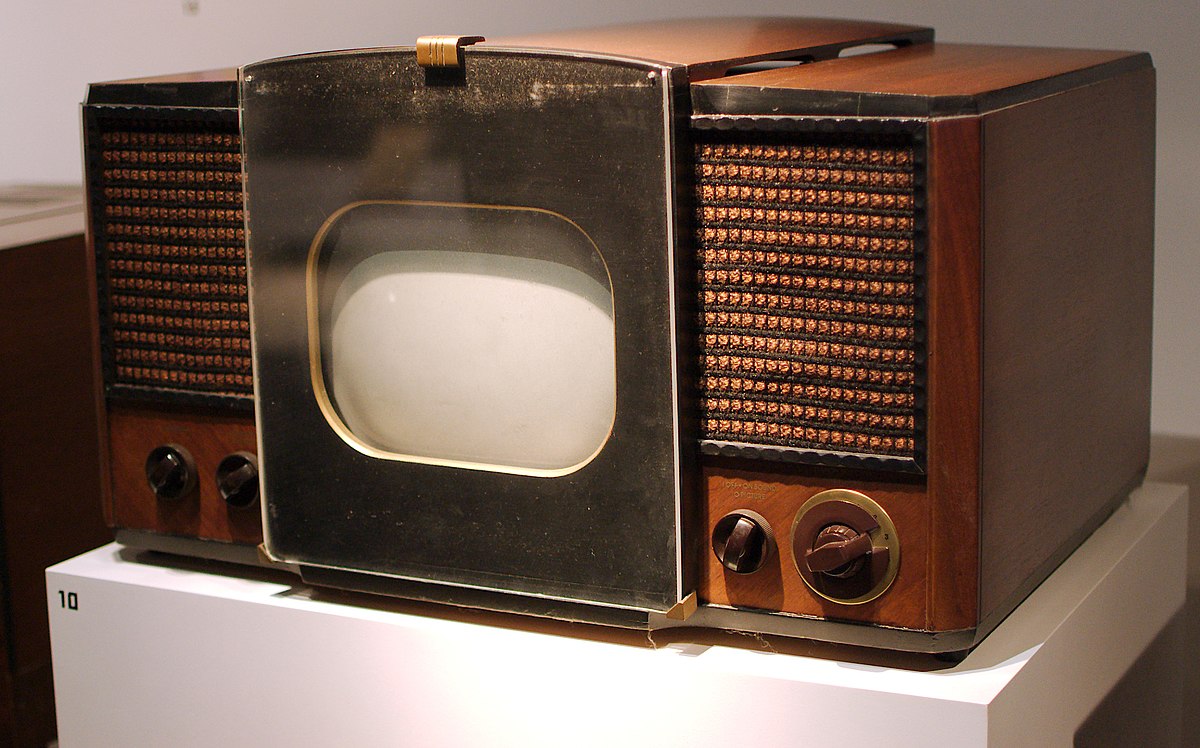
RCA 630-TS, the first mass-produced television set, 1946–1947
Detroit Steve sent me a link to a story by J. W. Reiser on Tech-Notes dot tv about why our television sets start with channel 2 instead of channel 1. Television got started back in 30's. A lot of people were very excited about it, but the manufacturers needed a standard for the signals so TV sets could receive signals being transmitted by commercial broadcasters. As you might expect there was a bunch of pushing and shoving involved, and then WW2 came along and disrupted things six ways from Sunday. Anyway it's good story. Here's an excerpt about the early history:
During the first few months of 1933, the Radio Corporation of America (RCA) demonstrated the first successful all-electronic television system.  Broadcasts were made from the RCA experimental television transmitter, W2XBS, located at the top of the Empire State Building in New York City.  The characteristics of that early all-electronic television system were modest:
Lines:
Frames:
Scanning:
Bandwidth:
Video carrier:
Audio carrier:
240
24 per second
Sequential (no interlacing)
2 MHz
AM modulated, full sideband
Yet, the results were far better than any mechanical television system had ever accomplished.  For those experiments, the video carrier was approximately 45 MHz.

It may be hard for us to appreciate fully what RCA had accomplished in 1933.  But to give you an idea: Many of the experimental television broadcasts were still using frequencies in the 2 to 3 MHz range, and bandwidths of 100 kHz.  In addition, the earlier systems were mechanical using gears, motors, mirrors, etc.  As television advanced, each step pointed towards non-mechanical systems, and higher bandwidths and carrier frequencies.

The Federal Communications Commission (FCC) was established by an act of Congress on June 22, 1934.  It was about that time that a portion of the VHF radio spectrum was allocated to television for the first time (see Table 1).
Table 1
The colors are just so you can see how various frequencies got moved around. 

You can see from the table that there used to be a Channel 1, but since was a 'community' channel, it got squoze out by the big boys.


Saturday, November 7, 2015

Wiki Wander

144 Tall Fiberglass Pyramid in Russia built by Dr. Alexander Golod.
I'm not a great believer in the mystical properties some people, like Dr. Golod, attribute to pyramids, but having a positive mental outlook can help one overcome all kinds of difficulties, and if a pyramid can help you with that, well, then, I'm all for it.

Palace Of Peace And Reconciliation. Astana, Kazakhstan  2004 - 2006.
Looking for more pictures of Russian pyramids turned up the Palace Of Peace And Reconciliation in Astana, Kazakhstan. It was designed by Sir Norman Foster. Okay, who's that? Wikipedia tells us that he is one of Britain's most prolific architects of his generation. He grew up in Manchester, England:
Manchester was 'one of the workshops of the world' and 'the embodiment of a great city'; his father, Robert, worked at Metropolitan-Vickers at Trafford Park [a suburb of Manchester] which fuelled Foster's interest in engineering and design.
Metropolitan-Vickers? Vickers I have heard of, big British industrial outfit, widely known for their machine gun, but this branch made their own name, not that I had ever heard of it:
Metropolitan-Vickers, Metrovick, or Metrovicks, was a British heavy electrical engineering company of the early-to-mid 20th century formerly known as British Westinghouse. Highly diversified, they were particularly well known for their industrial electrical equipment such as generators, steam turbines, switchgear, transformers, electronics and railway traction equipment. Metrovick holds a place in history as the builders of the first commercial transistor computer, the Metrovick 950, and the first British axial-flow jet engine, the Metrovick F.2. Their factory in Trafford Park, Manchester, was for most of the 20th century one of the biggest and most important heavy engineering facilities in Britain and the world. - Wikipedia.
I've heard of Eniac, the world's first computer, but it was built with vacuum tubes. Vacuum tubes are great devices, but when you are using mass quantities their reliability begins to make life difficult. Using one tube means you need to keep one spare on hand. Using a zillion means you need to keep a bunch of spares on hand and you need to a small of army of technicians whose sole job is to run up and down the aisles of the computer (it's big) and replace burned out vacuum tubes. So making a computer out of transistors was a huge step up. Metrovick built 6 of the things and used them in their business for several years. Couldn't find
any pictures.
    A little farther on in the same article, I came across this:
On 15 November 1922 the BBC was registered and the BBC's Manchester station, 2ZY, was officially opened on 375 meters transmitting from the Metropolitan Vickers Electricity works in Old Trafford.
375 meters? What's that in Hertz? 800K. That put's it in the commercial AM broadcast band, meaning you can pick it up with your car radio.  800KHz is a "Clear Channel" frequency, which is whole 'nuther can of worms.
    I'm going to stop now as my wife is telling me I have chores to do.

Sharon got me started by sending me a link to an article about Dr. Golod.
Title from Tam.

Tuesday, October 6, 2015

FAST - Five hundred meter Aperture Spherical Telescope - Big Chinese Radio Telescope

The Chinese are building a big radio telescope. All anyone seems to be talking about is how they can look for alien civilizations (radio broadcasts) from the other side of the universe. What they don't mention is that it could also be used as a RADAR transmitter. With something this big they should be able to detect a soccer ball a thousand miles away, should anyone put a soccer ball a thousand miles up. Via Robert Scott Ladd.

Artist's rendering of completed reflector.

Satellite view of FAST site. They have made some progress since this photo was taken.
They are installing the triangular reflector panels starting from the center.

Satellite view of Arecibo Radio Observatory in Puerto Rico, done at the same scale as the one in China. You can see that FAST is considerably larger.

Sunday, April 12, 2015

Precision Attitude Determination Subsystem (PADS)

A Marine fires a TOW (tube-launched optically-tracked wire-guided) anti-tank missile during a live-fire demonstration, March 30, 2015, as part of a military exercise at Camp Adazi, Latvia.
Cool photo, looks like it could be some kind of Sci-Fi death ray weapon. Then I notice the odd bar-shaped box on top of the site, the one with the two rounded ends, the thing that looks like it could be a film magazine for a movie camera. Turns out it is a Precision Attitude Determination Subsystem (PADS). Supposedly it uses GPS. If that's the case, I'm guessing the two round compartments on the ends hold GPS antennaes and the length is there to give them enough separation so that their difference in altitude is measurable. Why do you need something like that? Because you could be shooting at something that was 5 miles away.

Looking for info about this device is what led me to the Orion Attitude Control Motor.

Wednesday, March 26, 2014

Origins of Cable TV

Government Weather Radio Coverage Map for Astoria Oregon and the surrounding area. The big blank area on the left hand side of the map is the Pacific Ocean. Radio signals like the clear air you find over flat ground and water. They don't like the ground so much, especially when it's in the form of hills and mountains.

Cable TV is ubiquitous now, but I didn't realize that it got started way back in 1948. There were only a few TV stations back then, but already the masses were becoming TV crazed. Astoria didn't have a station, but they had a wise guy who was able to pick up signals from the station in Seattle and pass them along to his "friends". Full story here. Via Post-hip Scott .