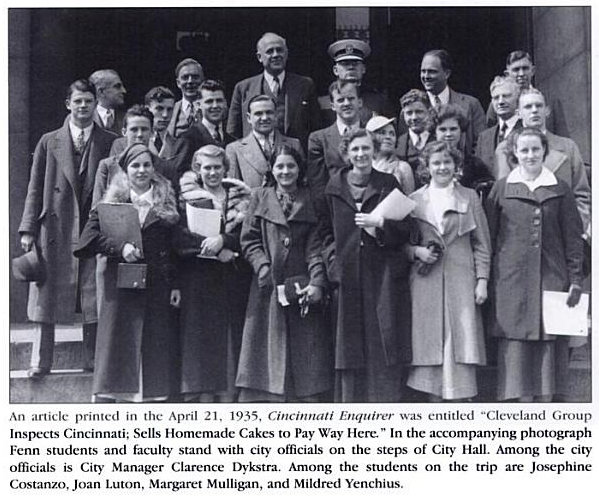
This is about my Aunt Milly, my mother's sister. I think she is in the second row, second from the right, no hat, dark hair.
I've been looking at Cuba and Iran and it occured to me that she was stationed in both places. She worked for the U.S. Department of State. I saw her rarely when I was a kid, no surprise since I never lived in Cuba or Iran. She was nice enough, but she was an adult and not really part of my world. She brought us some things from Iran. I remember a big copper tray, a copper pitcher, a couple three Persian rugs and best of all, a couple of camel saddles that we could actually sit on. I spent a little more time with her when we both lived in Phoenix. My new family and I would go over to her house for Sunday dinner on occasion. She was a little daffy by this time.
So I did a little searching on the internet. I turned up the picture up above, and this cryptic little memo:
United States Department of State / Foreign relations of the United States, 1951. Asia and the Pacific (in two parts)(1951) Ceylon, pp. 2013-2084 PDF (27.4 MB) Page 2023 A memorandum of April 4 by Mr. Frederic G. Ranney of the Office of British Commonwealth and Northern European Affairs, addressed to the Director of that Office, Mr. G. Hayden Raynor, and to Mr. Robert D. Coe, also of that Office, read in part as follows: "I have discussed the attached telegram [telegram 4900 from London, March 13] with Miss [Mildred M.] Yenchius of SOA, who tells me that the whole question of military communication facilities in the Indian Ocean area is undergoing reconsideration in the Defense Department. It is now felt that further efforts to persuade the Ceylonese to grant us these facilities would be fruitless, in view of the fact that our negotiations have already dragged on for two years, even though the British have given us support throughout. Present thinking is to increase the establishment which the British have agreed to grant us at Aden." (711.56346E/3-1351)
Aunt Milly worked for the SOA, the School of the Americas? I didn't know that. The School of the Americas is likely the most infamous of all government agencies. Ranks right up there with the KGB. Back then the "Red Menace" was seen as a big threat. The awful things the KGB did were probably used to justify what the SOA was, and still is, doing. They changed their name is 2001 to Western Hemisphere Institute for Security Cooperation (WHINSEC). [begin sarcasm] I wonder why. [end sarcasm]
"How many children have to die?" Piers Morgan emotes the phrase with telegenic anguish. He's such a sincere little fellow and he asks so often that I've been giving the matter considerable thought and I've figured out the magic number:
All of them. Every last one and more besides.
If Piers is serious about wanting a perfectly just and even-handed world, a world where where no man ever raises his hand against his fellows, he needs to realize there's only one way of bringing that state of affairs about: we've all got to be dead. All of us; all the little children, all the great big grotty adults -- TV presenters, too! -- and everyone in between.
Then and only then will Piers' dream be realized.
There's a reason the story of Cain and Abel is one of the oldest parts of the Bible; there's a reason archeologists find signs of violence on ancient human remains; there's a reason our closest cousins, the chimps, steal, fight and go to war: we're a violent species. It's written into our genes.
To be sure, we're more than that. To be sure, much of the story of Progress is the story of violent impulses turned to good ends, sublimated in exploration, in research, in art-- But we can no more stop being violent than a lion can give up hunting and survive eating grass.
And in a violent species, there are always some who are nothing but violent; some for whom the attraction of initiating force cannot be resisted. There are even more who will respond to quell such behavior. The first group generally feels no restraint from law or custom; the second does.
If you attempt to "outlaw" violence or the tools of violence, the only group you hinder is the second one.
Stolen Entire from Roberta X, and I don't even know who Piers Morgan is. Some TV dude, I suppose.
First there was the story about Iran's new jet fighter. Then there was a story about an underground explosion at the Fordo uranium enrichment facility. Lastly there was the story about launching a monkey into space. The story about the jet fighter might be true, but I still don't know where they are getting engines for it. The other two stories seem to be tall tales. Lies, if you will. The story about the underground explosion comes from some dude who has a reputation for reporting unverifiable events. The story about the monkey, well, it's pretty well told, but it's not convincing, and because we're talking about Iran, there's no way to verify it.
Since the only thing I hear about Iran is from Western sources, and all they talk about is the bunch of nut cases (President Dinner Jacket and the Muthas of Mohammud) running the country, I imagined Iran as another Afghanistan, full of towel-headed camel jockeys carrying AK-47's and living in mud huts. As you can see from the picture above, that is not the case, well, at least not in Tehran. It's a modern city on par with any other modern city in the world, full of cars, freeways, skyscrapers and pollution. It was a bit of a shock when I found out.
I got really depressed yesterday evening for no real good reason. I had come across a story about a murder trial in the Ukraine and no one had commented yet, so I thought I would comment. I mean it was a pretty good story and I thought it deserved a comment, but mostly because no one else had commented yet. Some big time web sites get hundreds of comments. I won't comment there, I mean who's going to read 300 hundred comments just to get to my pearl of wisdom? Shoot, I will seldom comment if there are more than a dozen comments. So anyway I commented on this story, and then a couple of trolls dumped all over me, and then I got really depressed. Like I said, no good reason. I hate trolls. If they identified themselves it would not be so bad, at least then I would have somewhere to focus my anger, but trolls by definition are anonymous. Stupid trolls, hiding behind their stupid handles, spewing insulting garbage. Death to trolls! Allah Akbar!
Anyway. The story is about how a court in Kiev sentenced former Police General Oleksiy Pukach to life for murdering journalist Georgiy Gongadze. The General claims he did it under orders from higher ups, but the court wasn't interested in that part of the story. I thought it was pretty good that they persevered (13 years!) long enough to get this conviction. The trolls took exception to my comments, which, after I got over being depressed, got me to thinking.
The higher ups never get caught, much less indicted, convicted or punished. That's the way it's always been and that's the way it probably always will be. Oh sometimes they suffer a fall from grace, but it is usually for some politically motivated nonsense, not a real crime.
The thing is, the court, by convicting the actual perpetrators is sending a message to all those who might consider committing a similar crime on "orders from above". They might be loyal to the higher ups, and they might get paid well, but if they get caught they are going to suffer the consequences. Their superiors, protected as they may be, will not be able to help them. That should give the thugs a little something to think about. It might even dissuade them for committing a crime.
Corruption is contagious. Western civilization operates as well as it does because it is constantly striving to stamp it out. That's why we come down hard on petty criminals. We need an honest base to build on. If you have an honest base, you can build on it. If your base is corrupt, well, you look like Haiti or Afghanistan. You can't build anything substantial on mud.
The weird part is that when I went looking for the trolls comments just now they had disappeared. Did I imagine the whole thing?
E. B. Misfit's post prompted me to tell this old-ish story. It has been told many times before, perhaps even by me, but evidently it's worth repeating because every day there are new people showing up who have never heard of, much less seen, a punch card. So I'll tell it again.
I studied Computer Science at the University of Texas in Austin from 1977 to 1980. This was in the days before the PC. All your programming assignments were run on the mainframe. The mainframe was a giant CDC machine in a glass walled basement room in the administration building. You had to search it out if you wanted to see it. You could do all your programming without ever knowing where it was. Everything ran on the mainframe: student programs as well as University business applications. Well, everything except for a few projects being done on a mini-computer by graduate students. Note that was a mini-computer. There were no micro-computers.
Student programs were run in batch mode. In the computer science building there were two rooms: a keypunch room and the I/O room. The keypunch room had maybe eight keypunch machines. They were usually busy, sometimes you had to wait for one to open up. In the I/O room was the card reader and the printer. The I/O room (I don't think that's what we called it, but for the life of me I can't remember just what we did call it) was divided roughly in two by a counter. You took your stack of punched cards to the counter and handed them to the operator, who fed them into the card reader, and when they had been read, handed them back. Then you stepped back and waited for your program to run. Actually, you waited for the results of your "job" to be printed.
Turn the volume way up to get the full effect.
The printer was always busy, hammering away from dawn to bedtime, spitting out a continuous stream of green bar printer paper. The printer operator would watch for job headers to appear, tear off the preceding stack of paper and file the output in a folder hanging in a rack. The rack was accessible from two sides. The operator put the output files in on one side and the students pulled theirs out from the other side. The folders were arranged alphabetically by user code, so you waited and watched for your printout to be deposited in your folder.
To run a program first you had to write it. This you printed by hand on paper. When you were satisfied, you took your hand written copy and a stack of blank punch cards to the keypunch room and found yourself a machine. Load your cards into the machine and then type your program in, one line to a card. If you made an error, the card went in the trash. Since programs in those days were about equal parts letters, numbers and punctuation, and errors meant the sacrifice of a card, it was slow going.
In addition to your program you needed a job card. There may have been more than one, and there may have been an end-of-job card as well. These had a cryptic string of characters that the professor supplied at the beginning of the term. I never even tried to decipher their meaning. Writing my assigned programming tasks was enough of a challenge.
So now you have your completed stack of punch cards, your "job", and you can hand it over to the operator and wait for it to run. When you get printout back you find out what became of your job. Most of the time it came back with an error of some sort. You forgot to put in a punctuation mark, or you misspelled GOTO. These were syntax errors, which meant your program did not actually run. Once you got all of these nitpicky little errors fixed, then you could move on to what happened when your program ran. Again, most of the time it didn't. The computer failed to understand your logic and tried to do what you told it instead of what you meant, which resulted in a crash or a nonsensical output. This is when it got interesting.
Now you get to try and puzzle out what happened. Sometimes it was obvious. Once you had gotten to this point (no mean feat), and you actually looked at your program, it became perfectly obvious what you had done wrong. Sometimes you got to repeat this sequence several times:
run the program
read the output
start reading your program
exclaim "Oh!" when your foolish mistake jumps out at you
correct the program
At this point sometimes you got lucky and the program ran as it was supposed to. This happened more in the early days, when your program was a stack of maybe 20 cards. As time went by and I stared taking more advanced classes my programs got longer. Now we start running into logic errors, things that might cause your program to go into an endless loop. This meant your program ran until your allowed time expired, which meant the only feedback you got was a notice that you ran out of time. Put that in your pipe and smoke it. My longest program was about a thousand cards which meant a thousand lines of code. It filled a box the size of a shoebox.
These cards are blank, just waiting for you to engrave the wisdom of the ages.
I wonder how many boxes I went through. A dozen? Two dozen?
The operations room in the Computer Science building (Painter Hall, maybe?) closed up in the early evening. If your program was due tomorrow and it still wasn't running, this meant going down to the street to the engineering building. Things were not quite so hospitable there. For one thing it was full of engineering students whose smallest programs were one box of cards. Some of these guys had programs that comprised a stack of boxes. Also, I don't think they were any keypunch machines there, but that doesn't make any sense. How could you get anything done? In any case, I can picture the operations room but I cannot picture any keypunches there.
I had a couple of job interviews after I graduated with companies (defense contractors) that used punch cards. I was horrified. By this time I had been exposed to video terminals (text only CRT's) and punch cards were obviously going away. Fortunately neither one these companies offered me a job. Actually, one was even worse. You handed your program to the secretary who typed it in using a typewriter. The typewriter was connected to a modem, which was connected to mainframe on the other side of town via a phone line. I think it was an IBM electric typewriter. I think they mailed the results of your job back to you.
Update November 2017 replaced one dead link & deleted another. Fixed problems with picture and video.