Intel's Ronler Acres Plant

Silicon Forest
If the type is too small, Ctrl+ is your friend

Showing posts sorted by date for query Oak Ridge. Sort by relevance Show all posts

Friday, August 23, 2024

Deserts


Dune | Official Main Trailer
Warner Bros. Pictures

I watched the movie Dune this week. This is the first of the pair of recent movies. I've read the book and I've seen an earlier movie version, but I'm watching this movie and it's nothing like I remember. Oh, I remember some of the characters, but I remember this story being a science fiction thriller, and this movie wasn't that at all. This time the thing that struck me is that the Atreides family packs up their entire company, including their army and their families and all their associated baggage and moves to the most hostile planet in the universe. Okay, on an absolute scale it's not all that hostile, it's got gravity similar to Earth and breathable air, but when you look at it using a human scale, the place is inimical to human life. It's covered with sand. The sun will fry you, the sandstorms will strip the flesh from your bones, and if that's not enough there are giant worms that will swallow you whole. Hell might be a better name for this planet than Arrakis. You would have to be a very loyal follower of the Emperor to accept an appointment to Dune.

But you think about it for a minute and Dune really sounds a whole lot Iran, Iraq and Saudi Arabia. Very hot, unpleasant places covered with sand, governed by tyrants, but we still have people willing to pack up everything and move there, and the reason is the same: money. On Dune, it's the spice. In the Mideast, it's oil.

Baiken Uranium Mine in Kazakhstan

Today I came across a story about how Kazakstan is a world leader in the uranium mining business. Above we have a picture of one of their uranium mines. Looks like a nice place with lots of green. On the edge of a desert, but still pretty nice. Then I look on the map:

Baiken Uranium Mine in Kazakhstan

and I see it's surrounded by a desert. Just how big is that desert? Big:

Baiken Uranium Mine in Kazakhstan

The area shown is about 900 miles across, so the mine is at the edge of the desert. The Caspian Sea is at the left hand side of the map and what used to be the Aral Sea is the greenish-white blob near the top center. The Baikonur Cosmodrome is about half way between the mine and the Aral Sea.

What I didn't find is whether the Kazatomprom (the Kazakhstan uranimum mining operation) is enriching uranium, which is what you need to do if you want to use the uranium for anything besides being dense. This led me to Wikipedia's page about Enriched uranium, which was a real eye-opener. Seems the whiz kids have busy cooking up any number of techniques for enriching uranium. There is gaseous diffusion that was used at Oak Ridge during WW2. Then we have second generation gaseous diffusion that uses high speed centrifuges that is many times more efficient. This is the one Iran was using when somebody (Israel?) hacked their centrifuges and caused them to speed up to the point where they destroyed themselves. And that's just the start. People are working on plethora of techniques involving chemistry, lasers and microstructures.

Friday, December 1, 2023

The RaLa Experiment: Key to the Atomic Bomb


The RaLa Experiment: Key to the Atomic Bomb
Our Own Devices

I've heard parts of this story before, but there's a lot I hadn't heard. I knew about the gaseous diffusion process at Oak Ridge, but I hadn't heard about the other two methods. I'd heard about the spherical implosion design and the bridge wire detonators, but never any explanation of why it was necessary. And fizzle, as in a bomb that sort of blows up but doesn't really, was new to me as well.

Tuesday, January 26, 2016

The Manhattan Project

The K-25 gaseous diffusion plant: the single largest and most expensive Manhattan Project site.
Roberta's been watching Manhattan on the tube, which got me to wondering if anyone had done a timeline on the project and of course, this being the internet and all, several people have. I like the one on Atomic Archive.
    When WW2 started, there were only a few crackpots (like Albert E.) who thought it might be possible to build an atomic bomb. Basically, they knew almost nothing about the subatomic world. Oh, they knew about neutrons and protons and electrons, but they only had vaguest ideas about how all these things played together. That little bit of knowledge and the idea that a bomb might be possible along with the impetus of war was enough for the powers to be to jump in with both feet. Okay, they started with one toe, but it quickly ramped up.
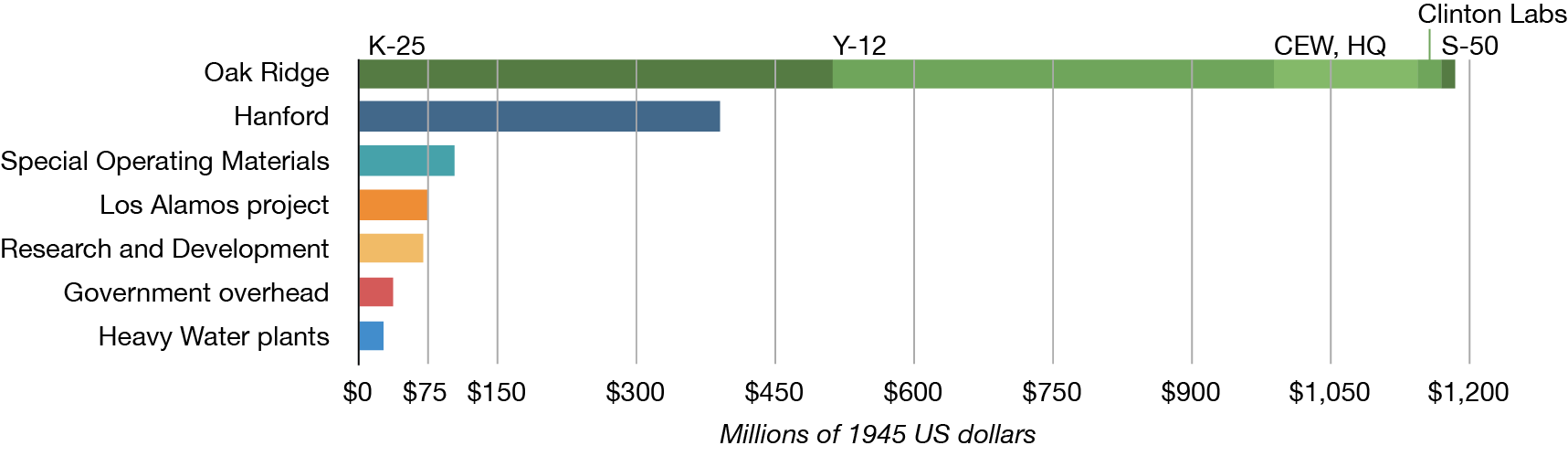
Expenditures for the Manhattan Project sites, through the end of 1945
    The biggest investment, money wise, as you can see from the graph above, was for the construction of the uranium isotope separators in Oak Ridge, Tennessee. Y-12 wasn't started until February 1943 and K-25, the big one, wasn't started until September. They didn't know if they would work, and they still didn't know if they could make a workable bomb from the stuff these plants produced, but they charged on anyway.
    They dropped the bombs in the August of 1945, two and one-half years after they started construction of the biggest factories in the world.

I am having a hard time getting my head around the idea that these guys went ahead with this project to the tune of billions of dollars when they didn't even know if it would work. I guess we can chalk one up for science, and the religion thereof.

P.S. Why are some people writing Manhattan with the 2nd A in parentheses, like this: Manh(A)ttan? Is that supposed to look like a bomb? Several sites have done this, but no one has offered an explanation. I think it's dumb. YMMV.

Monday, March 31, 2014

Workplace Dream

Operators at their calutron control panels at Y-12, the electromagnetic separation plant in Oak Ridge Tennessee. Nothing like where I was, I mean where are the red and blue lights? A very cool photo regardless.

I'm debugging a computer program. I am in some giant office space, much like a cube farm at Intel, except it is broken up by areas that are blocked off with walls that go to the ceiling. I am sitting at a table with some kind of antiquated computer terminal. I don't have a computer, this terminal is all I need, though it is connected by a cable to some kind of computer somewhere. I am stepping through the program, making notes, writing down addresses as I go. I look up from a particularly involved calculation and notice that someone has moved the terminal. What the heck? Another man sitting at the same table looks up from his work and tells me that --woman's name-- needed to use it to look up something for second. She slid it over to the edge of the table so she could use it. She is long gone, so I slide it back.
     Now I realize I need to make use of the facilities, so I get up and head to the nearest walled in block, where last time I checked there used to be a restroom. I go inside the block and there is a work area / hallway and several walled in offices, but no restrooms. I ask one of the people there and they confirm, that yes, last week, or whenever, there used to be restrooms here, but they have been removed to make room for their offices. And, no he doesn't know where they put the restrooms. Bah and humbug.
    So now I'm off looking for the restrooms. The situation isn't panicky (yet), it's just annoying that I have to go look for them. It's a big room with all kinds places along the walls. I come across some rooms that look like some kind of scientific / industrial process labs: control panels by the doors with red and blue lights. I finally come across something that looks like it might be a break room or a snack bar, and that gives me hope, but then I wake up.

Tuesday, October 30, 2012

Titan Supercomputer

Oak Ridge got a new supercomputer this week. Actually they just got new guts for it. They had a similar supercomputer there before. They replaced all the computer bits, but all the infrastructure, like the building, powers supplies, cabling and cooling all remained the same. Oh, and they got some new, flashy graphics for the front panel.


Running simulations of complex processes (things like weather, nuclear reactions) is what makes this thing useful. It allows us to peer a little bit into the future. The more detail we can include, the more accurate our predictions and the farther into the future we can see. No, we still can't model financial markets, but we can do a heck of a job with fluid dynamics, which is where we get cool pictures of the power turbine from a GE jet engine.


NPR has a good story about that includes some solid information like :
  • Titan would not have been possible were it not for the massive market for video games.
  • The room is where it is housed is very large, about a half acre.
  • This machine cost $100 million. Its electric bill will total $9 million a year.