Operation Safed Sagar: The Untold Story of the Kargil War | Official Trailer | Netflix India
Netflix India
Indus River explained in under 3 minutes
FactSpark
![]() |
| Indian Air Force MiG-21 |
Led Zeppelin - Kashmir (Remaster) (Official Audio)
Led Zeppelin
Silicon Forest
If the type is too small, Ctrl+ is your friend
![]() |
| Indian Air Force MiG-21 |
Specifications (MiG-21bis) | ||
| Length | 50 | feet |
| Wingspan | 24 | feet |
| Weight: 10 tons | 19 | tons |
| Maximum speed | 1,350 | mph |
| Landing speed | 160 | mph |
| Range | 410 | miles |
| Service ceiling | 57,000 | feet |
| Guns | 1 | internal 23 mm Gryazev-Shipunov GSh-23L autocannon with 200 rounds |
| Hardpoints | 4 | underwing |
| Hardpoints | 1 | ventral, reserved for fuel droptanks |
![]() |
| Lavochkin La-9 |
I had never heard of Lavochkin before. I've heard of Antonov, Beriev, Ilyushin, MiG, Sukoi, Tupolev & Yakovlev, but not Lavochkin. The company is still in business and is kind of a big deal.
The Lavochkin La-9 (NATO reporting name Fritz) was a Soviet fighter aircraft produced shortly after World War II. It was one of the last piston engined fighters to be produced before the widespread adoption of the jet engine.
The Lavochkin La-9 descended from the La-7 which descended from the La-5. The Soviets built many of these aircraft:
| Model | Year | Quantity |
| La-9 | 1946 | 1,600 |
| La-7 | 1944 | 6,000 |
| La-5 | 1942 | 10,000 |
![]() |
| Ilyushin Il-2 - Romain Hugault Romain Hugault is a comic book artist |
In early 1941, the Il-2 was ordered into production at four factories, and was eventually produced in greater numbers than any other military aircraft in aviation history, but by the time Nazi Germany invaded the Soviet Union on 22 June 1941, only State Aviation Factory No. 18 at Voronezh and Factory No. 381 at Leningrad had commenced production, with 249 having been built by the time of the German attack.
Production early in the war was slow because after the German invasion the aircraft factories near Moscow and other major cities in western Russia had to be moved east of the Ural Mountains. Ilyushin and his engineers had time to reconsider production methods, and two months after the move Il-2s were again being produced. The tempo was not to Premier Stalin's liking, however, and he issued the following telegram to Shenkman and Tretyakov:
You have let down our country and our Red Army. You have the nerve not to manufacture IL-2s until now. Our Red Army now needs IL-2 aircraft like the air it breathes, like the bread it eats. Shenkman produces one IL-2 a day, and Tretyakov builds one or two MiG-3s daily. It is a mockery of our country and the Red Army. I ask you not to try the government's patience, and demand that you manufacture more ILs. This is my final warning. — Stalin
As a result, "the production of Shturmoviks rapidly gained speed. Stalin's notion of the Il-2 being 'like bread' to the Red Army took hold in Ilyushin's aircraft plants, and the army soon had their Shturmoviks available in quantity."
A glass tower is growing inside this building - Domino Sugar Building in Brooklyn
You Can’t Kill the Dancing Crab Robot
May 8, 2026 - Bending steamed wood rods to make chair frames
How do you deal with excess MIG wire? The eternal battle between ease and conservation.
Would You Fly the 1956 Gyro-Boat?
THE BRIDGE AT TYRNYAUZ, Russia, collapsed by glacial mudflow
NASA Is Bringing Real Mars Wind to Earth
The vengeance of Olga of Kyiv
The Pistol That Saved Winston Churchill - Sudan 1898
Get it away from me pal - Sam Alkhatib
![]() |
| Four MiG-17s 2025 Defenders of Liberty Air Show at Barksdale AF |
The Mikoyan-Gurevich MiG-17 (NATO reporting name: Fresco) is a transonic fighter aircraft produced in the Soviet Union from 1952 and was operated by air forces internationally. The MiG-17 was license-built in China as the Shenyang J-5 and Poland as the PZL-Mielec Lim-6. The MiG-17 is still being used by North Korea's air force in the present day and has seen combat in the Middle East and Asia.
It wasn't used in the Korean War, but it was used in the Vietnam War. The Soviet Union built 10,000 of them.
![]() |
| U.S. and Egyptian aircraft over the Pyramids during Exercise Bright Star '83 Click to embiggenate |
This photograph is phenomenal. Whoever managed to get all these aircraft to fly together and then managed to capture this photo as they flew over the pyramids deserves a medal.
The Bright Star exercises started in 1981 and are still going on every couple of years.
![]() |
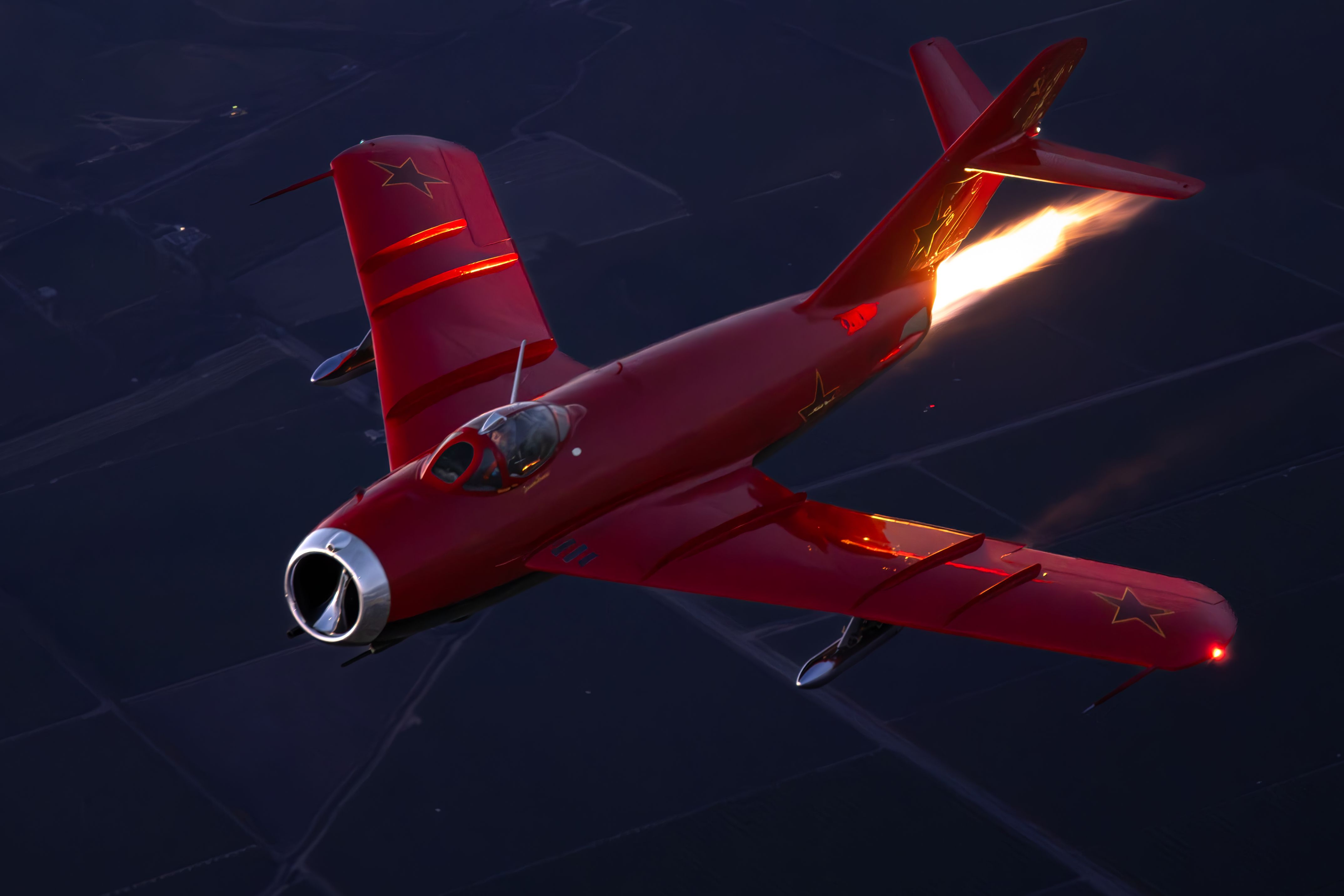
| MIKOYAN MiG-17 - Carson Zabel |
![]() |
| MiG-17 - Tumbling Goose showing off his 17’s burners. |
The Mikoyan-Gurevich MiG-17 (Russian: Микоян и Гуревич МиГ-17; NATO reporting name: Fresco) is a high-subsonic fighter aircraft produced in the Soviet Union from 1952 and was operated by air forces internationally. The MiG-17 was license-built in China as the Shenyang J-5 and Poland as the PZL-Mielec Lim-6. The MiG-17 is still being used by the North Korean air force in the present day and has seen combat in the Middle East and Asia.The MiG-17 was an advanced modification of the MiG-15 aircraft produced by the Soviet Union during the Korean War. Production of the MiG-17 was too late for use in that conflict and was first used in the Second Taiwan Strait Crisis in 1958. While the MiG-17 was designed to shoot down slower American bombers, it showed surprising success when used by North Vietnamese pilots to combat American fighters and fighter-bombers during the Vietnam War, nearly a decade after its initial design. This was due to the MiG-17 being more agile and maneuverable than the American F-4 Phantom and F-105 Thunderchief, which were focused on speed and long range combat, as well as the fact that MiG-17 was armed with a gun, which initial models of the F-4 Phantom lacked.
I've been wanting to put together a timeline of Russian jet fighters. I have a hard time keeping all the various model numbers straight. I mean, what are we up to now? 23? 55?
![]() |
| MiG 29UB taxi at Bozeman, Idaho |
![]() |
| Pair of Fulcrums |
![]() |
| A Russian MiG-31K carrying a Kinzhal hypersonic cruise missile - Russian Defence Ministry/AFP |
We've been hearing about hypersonic missiles for a while (years?) now, but it's always been tests or prototypes or designs or funding. This might be the first time I've seen a picture of an operational missile. Aljazeera has the story.
First flown in 1955, the MiG-21 is the most produced supersonic airplane in the world.
The "type 458" gyro block (Russian: 458МКС-15-32) in combination with the AGD-1 1122A/B (Russian: АГД-1) type attitude indicator/artificial horizon is a part of the inertial navigation system used in the Mikoyan-Gurevich MiG-21 supersonic jet fighter aircraft. The same gyro block is also used on a big variety of other Russian aircraft still flying today. The shown gyro block was kept in storage for almost 40years after being rejected, this is the third startup after the storage. The current setup yet lacks the matching AGD-1 1122A/B type HSI instrument, instead the pitch indicator block (syncro resolver and AC servomotor with servo amp) of a AGB-3K type attitude indicator is wired up for operation. Power requirement of the system is 27V DC and 3x36V 400Hz AC. Steady state total power consumption of the system is around 60W off the 27V bus (with a solid state 3phase 400Hz sine-wave inverter with 80% efficiency). Video quality is rather poor as usual :)
Just the coolest thing I've seen today. The way it jerks into position and the way it takes forever to get to full speed are just very cool. Evidently they are still in use, though I think new designs all use MEMS and can fit inside your smartphone. Previous inertial navigation post here.
![]() |
| Polish Air Force MiG-29s by Krzysztof Kocierz |
Found this image on Defence Blog. I am not sure whether it is a painting or a photograph. Krzysztof is a photographer, but the shadows and the rainbow are fantastic.
![]() |
| Albanian Air Force Chengdu F-7A |
![]() |
| MiG-15 at airport outside Piešťany, Slovakia |
![]() |
| Rossiya Special Flight Squadron IL-80 |