Intel's Ronler Acres Plant

Silicon Forest
If the type is too small, Ctrl+ is your friend

Showing posts sorted by relevance for query Iran. Sort by date Show all posts

Thursday, May 9, 2024

Land of Paradoxes

Sheraton Plaza Ufa - Congress Hotel
Site of Fourth Central Asian Conference of the Valdai Discussion Club

Someone trying to make sense of Iran's behavior:

Land of Paradoxes by Timofey Bordachev

The strongest impression from Iran is the paradox that accompanies almost all aspects of public life. On the one hand, the state strictly monitors order on the streets and compliance with religious requirements. On the other hand, there are no excessive security measures. Moreover, sometimes I even want these measures to be strengthened. For example, at airports, where the random movement of people creates the impression of easy accessibility for terrorists. The ban on all foreign instant messengers is combined with the universal use of VPNs. The conflict with the United States, which has been going on for almost half a century (Iran is one of the few countries where there is not even an American embassy), does not prevent the elite and representatives of the academic environment from fluently speaking English and often publishing in overseas journals.

This paradox is fully inherent in Iranian foreign policy, as one could see after spending several days in the country during the pause between exchanges of drone and missile strikes with Israel. General impression: Tehran is completely satisfied with the results achieved and is not at all eager for an all-out war with its main regional enemy. What from the outside looks like an insufficiently powerful response to Israel is, in Iranian paradoxical logic, exactly optimal. Because it allows you to solve a foreign policy problem without creating unnecessary risks. Everyone understands perfectly well that a big war in the Middle East is beneficial only to Israel? This means that the response to even his most aggressive attack should not serve the interests of Benjamin Netanyahu’s government. For Tehran, the main thing is not to give Israel what it wants, and not at all to try to impress anyone.

This unique approach to foreign policy and solving internal problems is the result of the special conditions in which Iran has developed since the Islamic Revolution of 1979. Its main consequence was the strategic confrontation with the West, which unfolded at the very peak of world dominance of the United States and its European allies - in the 1980s - 2000s. At first, Tehran’s enemy was also the USSR, which supported the government of Saddam Hussein during the Iran-Iraq War. By the way, people in Iran remember this well. But this does not mean that the attitude towards the Soviet Union is transferred to Russia - here Iranian strategic logic easily accepts that yesterday’s enemy can be a reliable ally today. The conflict with the West, despite the possibility of tactical deals, has an ideological character: the Iranian state is built on the independence of internal decisions, which the United States and Europe deny to everyone else.

The price of this Iranian independence is very high. First of all, there is a constant outflow of educated young people, dissatisfied with the restrictions of private life. The price also includes a significant number of poor people and air pollution in cities due to the use of old cars and poor quality gasoline. The answer to these challenges, as should be typical of a Grand Strategy, is paradoxical: it consists in a constant increase in the number of students and large universities with their own research laboratories (mainly in the natural sciences). Now Iran is probably the country with the most rapidly growing educational programs, including those aimed at international cooperation. At the same time, no one is preventing the return of those who have left, if they have not committed any offenses. Collaborative research with Iranians living abroad is also encouraged. And Iran’s consistent efforts in developing the natural sciences allow us to think that over time it will be possible to solve the economic and technological problems of development. Under the conditions of the American blockade and UN sanctions, results are coming slowly, but the alternative is a renunciation of independence, which is not part of Iran’s plans.

When assessing Iran's foreign policy, we must first understand that this power has fought against all odds for several decades, outnumbered and alone. And therefore, she may, like few others, be characterized by the paradoxical logic that distinguishes the owners of a real Grand Strategy. And every decision of the Iranian authorities - tactical or more ambitious, such as joining BRICS in January of this year - should be assessed precisely as a manifestation of a paradoxical, completely devoid of linearity logic. Predicting behavior within the framework of such logic is almost impossible, but it is precisely this logic that makes relations with Iran interesting and instructive.

Monday, December 17, 2012

Iranian Tomcats

First squadron of Iranian Pilots of F14 tomcats of Islamic Republic of Iran Air Force (Iranian Revolution) at Shiraz Air Base. 12 September 1979

The Internet is a strange and wonderful place. Who knew that Iran had American F-14 Jet Fighter Aircraft? Not me, and how did they get them anyway? Isn't Iran our arch-enemy? Are arms orders that important that we are selling our supposed enemies military aircraft? It seems that the F-14 is kind of an old airplane. Back in the 1970's, when the Shah was still in charge, and Nixon (!?!) was President, we cooked up a deal to sell them 80 Tomcats along with everything they needed to operate them, including an airbase with dual three mile long runways. The whole shebang was worth $2 billion dollars. Two minutes after we delivered the 79th airplane the Shah was overthrown and we quit talking to Iran.

Iran put the Tomcats to good use in their war with Iraq: "Overall, Tom Cooper claims that Iranian F-14s shot down at least 160 Iraqi aircraft during the Iran-Iraq War, which include 58 MiG-23s, 23 MiG-21s, nine MiG-25s, 33 Dassault Mirage F1s, 23 Su-17s, one Mil Mi-24, five Tu-22s, two MiG-27s, one Dassault Mirage 5, one B-6D, one Aérospatiale Super Frelon, and two unknown aircraft."

On the other hand Tom Cooper (whoever he is) also says: "It is impossible to tabulate, for example, how many air-to-air victories were scored by Iranian F-14s because air force records were repeatedly tampered with during and after the war for political, religious, or even personal reasons.

One of the F-14's big jobs during the Iran-Iraq war was protecting Kharg Island, their main oil export terminal. Iran still has a couple of dozen F-14's that are operational.

Iran Airbases

Tehran is the violet marker near the top, Baghdad is the green marker near the left side, the orange markers are giant air bases in the middle of nowhere, Kharg island is indicated by the red ship icon, and Kish island, marked with a yekkiw sun, is near the bottom. The satellite view does not make the place look at all appealing, does it?

These are US planes over Iraq, but they are F-14's and it is a pretty good show.


Update July 2016 replaced missing photo.
Update June 2017 replaced missing map.

Sunday, April 11, 2021

Tyranny, Science and Stupidity

Iran's Natanz uranium enrichment plant on April 10, 2021 © AFP / IRANIAN PRESIDENCY


Whenever something like this happens in Iran, I am divided over whether it was stupidity, sabotage or Israel. We all know Iran's avowed objective of destroying Israel, so I wouldn't be surprised if the Jews were behind this 'attack'. Sabotage is equally likely, there is a sizable contingent in Iran that is not happy with the current theocracy. But then I am also reminded of this quote:
"Dictatorships foster oppression, dictatorships foster servitude, dictatorships foster cruelty; more abominable is the fact that they foster idiocy." - Jorge Luis Borges 
(I like this quote so much this makes the fourth time I've posted it.)

While we can be reasonable certain that the people working on Iran's nuclear project are imbued with the correct ideology, but they might not be sharpest, technically speaking, and they just made a mistake.

Meanwhile, back at the ranch, we've been watching this South Korean series on Netflix. It's about equal parts drama and action. There are big dramatic pauses (that seem to be the stock in trade of soap operas) that make our heroes look like idiots, but they manage to mostly succeed (thanks to the script). The villains on the other hand are constantly reassuring the big-wigs that the situation is under control, the problem will be taken care of, and then in spite of having all the resources you could possibly need, failing. Does 'curses, foiled again' ring any bells. It's great to see them fail, but it makes me wonder, could any organization be that stupid? The answer is yes, which means this show might be more realistic than I think.

So tyranny fosters stupidity. How is it then that the Soviets manage to outpace the USA in science and technology during the cold war? Maybe their recent experience in WW2 bound them more tightly to their socialist religion. Iran has been a divided country ever since I don't know when, maybe when the first Shah came to power? Or maybe Iran's secret police are not as zealous as the KGB.


Sunday, April 19, 2026

Strait of Hormuz

Far Side 1987

This whole business about the Strait of Hormuz isn't making a lot of sense. Supposedly, we (the USA) launched a devastating attack on Iran. That should have knocked out all their offensive capability but evidently it didn't. An empty oil tanker can be worth $100 million so I can understand why people would not want to send their ships through the strait if there are still hostile forces operating in the area. 

Strait of Hormuz

Anyway, I'm hearing a lot of noise, but no good explanations, so I asked Google and this is what I got back:
Based on reports as of April 2026, Iranian forces around the Strait of Hormuz have not been fully destroyed despite significant damage from U.S. and Israeli strikes because of the asymmetrical, dispersed, and unconventional nature of Iran's maritime capabilities, which are designed specifically to withstand such an onslaught.
While U.S. and Israeli airstrikes have destroyed key Iranian missile launchers, ships, and infrastructure, several factors prevent complete neutralization:
  • Asymmetric "Mosquito Fleet": Iran's primary threat comes from the Islamic Revolutionary Guard Corps (IRGC) Navy, which relies on a massive, dispersed network of fast attack boats, drones, and uncrewed vessels. These small assets are hard to target compared to large, conventional naval vessels.
  • Geographical Advantages & Hiding Spots: Iran uses its rugged coastline, small islands, and underground naval facilities to hide launchers, making them hard to completely wipe out.
  • Mobile and Low-Cost Drones: Many of Iran's disruptive weapons, such as sea drones and missiles, are launched from mobile platforms on land, making them difficult for intelligence to track and destroy in their entirety.
  • Persistent Naval Mines: Iran has deployed acoustic mines that are challenging to detect. Clearing these would require an extensive and slow-moving mine clearance operation, even while IRGC forces are hunted.
  • The "Human Shield" of Shipping: The Strait is extremely narrow, with shipping lanes running close to Iran's coast. Full-scale destruction of all Iranian capabilities risks civilian collateral damage or catastrophic, immediate oil market shocks.
  • "Destroyed" vs. "Deterred": While US officials aimed to destroy the Iranian navy to remove the threat, the IRGC continues to operate in a guerrilla-like fashion.
As of mid-April 2026, despite a US naval blockade, Iran still maintains a "strict control" posture over the waterway, using the threat of its remaining capabilities to disrupt traffic.

Sunday, February 14, 2016

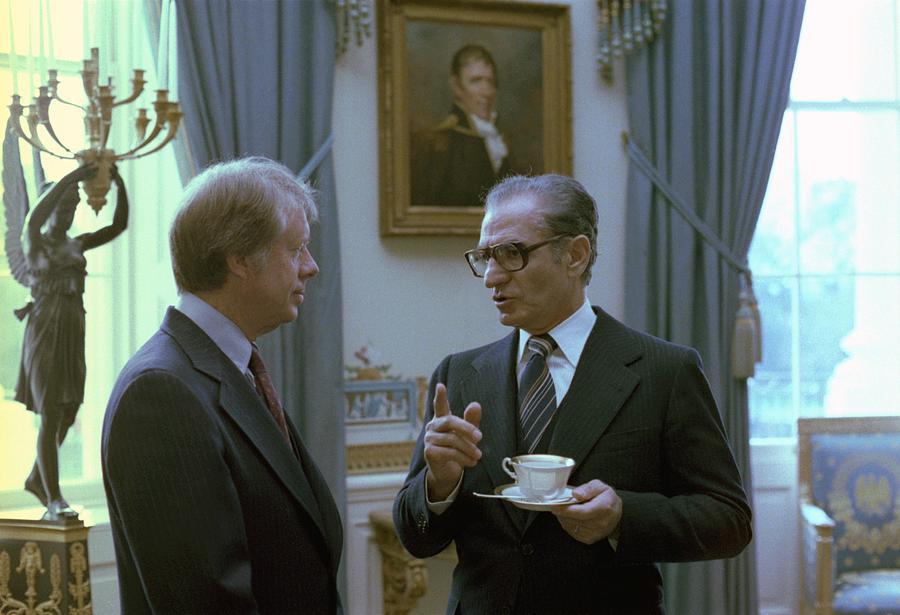
Jimmy Carter & The Shah of Iran

Jimmy Carter and The Shah
There is a notion that superpowers have, well, super powers, and can bend history to their will. There is never a shortage of conspiracy theories involving foreign agents. The reality of course is that even great powers are constrained, and the idea that Carter's appearance in Iran sparked a revolution is at the very least too Carlylian for my taste.
If Carter had a role to play, I would say that his administration placed too much faith in the shah's government, then was indecisive in its support. Carter managed to disappoint reformers even as he failed to provide unambiguous support for the-devil-we-know, and left the regime to its devices in the critical year of 1978 while his administration focused on SALT II and the Camp David Accords. Ultimately, forces in Iran, not a few provoked by the shah himself, are responsible for what followed.
The OP refers to New Year's Eve 1977. On a 16-hour visit, Carter became the first and only U.S. president to visit Iran, and at dinner made an infamous toast:
Iran, because of the great leadership of the Shah, is an island of stability in one of the more troubled areas of the world. This is a great tribute to you, Your Majesty, and to your leadership and to the respect and the admiration and love which your people give to you. The transformation that has taken place in this nation is indeed remarkable under your leadership.*
With that, Carter seemed to dash hopes that his administration would put real pressure on the shah, while at the same praising the very policies which had angered much of the Iranian public— inviting the scorn of the liberal, Marxist, and Islamist opposition alike. But to claim that this was the spark of the revolution is an overstatement.
In the early 20th century, as Persia was caught in the endless machinations of the British and Russian empires as they jockeyed for position, the U.S. may have been seen as a potential third power which would put a stop to the meddling. But the U.S. had no interest in Iran (it was cultivating influence with the Saud family on the other side of the Gulf) until after World War II, when Cold War politics came to dominate foreign policy. It was vital to keep the largest and wealthiest state in the Middle East out of the sphere of the Soviet Union. American and British involvement in the 1953 coup d'etat against the Mossadegh government was widely suspected, and later confirmed to be true.
Mohammed Reza Pahlavi by all accounts proved to be soundly anti-communist and pro-Western ally. To the West, he was abolishing feudal institutions, industrializing the economy, and secularizing Iranian society. The U.S. even curtailed intelligence-gathering in Iran in the 1970s, trusting his government to supply it. Internally, however, the shah managed to alienate large segments of the population with increasingly arbitrary rule (e.g. replacing the calendar): first clerics and landlords in the White Revolution of 1963, then the intelligentsia, and after he tried to blame the souring economic conditions of the 1970s on merchants, both the commercial classes and the unemployed.
The Carter administration did admonish the shah on human rights concerns early on, resulting in the token release of some political prisoners, but public protests began months before Carter's visit. Mustafa Khomeini, son of Ruhollah Khomeini, was killed while in exile in Iraq in 1977. The shah's secret police were widely believed to be responsible, leading to protests and a harsh crackdown. Secular intellectuals issued a challenge in October 1977, and citing this letter, Khomeini encouraged clerics to step up their opposition citing the letter. So the protests of January and February 1978 were the culmination of years of resentment against the regime, its secret police, and its propaganda machine, not a spontaneous critique of American foreign policy.
Some do blame Carter for later events. He had been elected partly on the promise of a government that practiced its high ideals. In contrast to the realpolitik that led previous administrations to turn a blind eye to human rights issues and social justice, his would not intervene in the affairs of other countries, and would take an active interest in disarmanent and peace. At the same time, however, Carter had the reality of serving a superpower's interests during the Cold War, in a period when the West had seen a succession of humiliations in Southeast Asia and Africa, and the U.S. was reeling from Watergate, Vietnam, and stagflation.
These competing interests played out at the very top of the administration. From the early months of the crisis, Zbigniew Brzezinski, the National Security Advisor, advocated for ardent support of the shah as in the best interests of the U.S. The State Department under Cyrus Vance (and the U.S. ambassador, William Sullivan) believed that the shah was a lost cause, and that supporting democratization would serve U.S. interests better.
By February 1979 Iran was in a state of civil war, but the U.S. dithered. Brzezinski was assuring the shah of unwavering support, the State Department was reaching out to the liberal opposition to try to smooth transition to a democratic government, but the government refused to support a coup d'etat or other action that could have replaced the shah with someone other than Khomeini, much less any direct military intervention. When the shah was admitted to the U.S. for medical treatment in October, students stormed the embassy and published documents showing that U.S. officials had met with moderate leaders. This helped turn public opinion against the moderates and raised fears of direct U.S. intervention, which Khomeini extracted for maximum propaganda value for years to come.
choster
August 16, 2012

Sunday, August 30, 2026

Death to Iran

Peace Through Annihilation

I hope it doesn't come to that, and I don't think it will, but Iran really needs to smacked down and smacked down hard.

Stolen entire from Bravo Blue:

HOW NOT TO GUARANTEE STRATEGIC DEFEAT by retired Colonel Jim McDonough

No sooner had the levers of economic sanctions against Iran been strengthened when cries from the left and the right turned up the volume to call for our surrender.

The left’s are better orchestrated, essentially an almost frothing set of talking points that the current engagement with Tehran has been a needless and unsustainable departure from what recent Democrat administrations had already solved with skilled diplomacy. The right’s positions, as usual poorly organized, offer a mixed bag of regrets that so much has gone badly (list of horribles to follow) it is now time to throw in the towel. Both, however, stem largely from political and ideological motivation.

Oddly enough, they have a common objective. They want to get out of the conflict – and to get out fast, at any cost. In essence this would be a guarantee of strategic defeat.

Bringing war to a conclusion is always dicey. Often, great slaughter is undertaken even when it is foregone how it is going to end. Consider the final months of the Civil War, the last day of WW I (more than a thousand doughboys were killed before 11 a.m.), and the closing campaign to take Berlin (by the Soviets) in WW II. How to end a war when you have the upper hand is always a problem for national leaders. They are torn between the temptation to increase the killing or to diminish the efforts to achieve the original goals of the war. Such is the tension today for us as the Administration faces a stubborn and fanatical foe in Iran determined to fight to the end. What is the road to surrender, and who surrenders?

Insights to the answer may lie in the final days of the war against Japan. By the summer of 1945, the allies were unchallenged in the skies (save for kamikazes), the Japanese navy was at the bottom of the sea, and the Soviets were about to unleash their armies into Japanese territories. Yet Japan’s military leaders were determined to carry on, mobilizing the entire population to fight on with whatever they had at hand. They ‘bravely’ referred to it as the One Hundred Million campaign, meaning the numbers they expected would die --most of them Japanese civilians (see Evan Thomas’s excellent book, Road to Surrender: Three Men and the Countdown to the End of World War II).

The Americans had their own estimates of military casualties it would likely suffer (hundreds of thousands to millions) and spoke in terms of facing endless replicated battles on the scale of Okinawa and Iwo Jima. In lieu of that, we elected the option of the atomic bomb, the first on Hiroshima on the 6th of August and Nagasaki on the 9th. Even then, the Japanese hardliners (read military leaders) held firm, advancing their plans for a political coup should the peacemakers (referred to as ‘traitors’ by them) prove dominant. Nonetheless, despite surrender terms offered that allowed for the emperor to remain in place unharmed, the Japanese would not budge.

This impasse led the Americans to begin moving forward to drop a third bomb (then being assembled), this one on Tokyo. Our leaders were reluctant to do so (aghast at the demonstrated destructive power of the first two) but saw no other option. The Japanese did not know we had only three bombs, so they expected more were coming. This threat of more atomic bombs and the continued saturation of fire-bombings mattered to Emperor Hirohito, however, and to aother peace advocate — Foreign Minister Togo. Both knew how terrible the war had been for Japan (its people now in the early phases of starvation, the military being the only ones adequately fed) and had had enough. Their military, however, was dismissive of the reality, and divorced from any empathy for the suffering of their own people.

In the end, as the third bomb was being uploaded, Hirohito and Togo gathered their courage, denied the generals and admirals their idiocy, and signaled their readiness to surrender.

We did not know then what was going on in the Royal Palace just as we do not know now what is happening in the corridors of power in Iran. But we do know that we have great leverage over the conditions that can influence their decisions.

The first of these is our military prowess amply demonstrated in Operation Epic Fury in the spring and in the Straits of Hormuz now. The second is the economic stranglehold which has been greatly enhanced in recent days.

We also know that the Iranian people are suffering. Their economy is staggering and the rial has become virtually worthless. Everywhere (save for the political elites) deprivation is worsening.

Containing the internal unrest that might otherwise rear up has been a major concern of the fanatical IRGC leadership. So far, they have repressed it after a short but bloody uprising in the spring, but have the seeds of that rebellion gone away? Only time will tell.

We need to take that time, using the threat (and actual use) of military power when necessary and the application of severe economic sanctions to continually increase the pressure on Iran and its leaders. Now is not the time to seek an ‘exit ramp’ and surrender the goals with which we entered this conflict. Iran’s efforts to become a nuclear armed nation cannot be allowed to continue. Its endless terrorism by its regional and worldwide operatives must be dismembered.

The arguments to cease and desist using the levers we have at hand — many of them motivated by short term political objectives — are not the way ahead. Patience, strength, and calibration are what is needed. Conditions will change constantly, the power centers in Iran will bluff and deceive endlessly, and factions within our own political structures will cry out “enough” repeatedly. None of these should become a call for retreat.

Many believe the IRGC is too fanatical to fold. That was also thought to be the case with Japan’s military leadership in 1945. But when the pressure becomes so great that it is impossible for leaders to demand that their subjects ‘bear the unbearable’ any longer, those leaders start to think about their own skins.

Stay the course; apply the pressure. That is a more certain path to bring strategic positives from this trying but necessary face-off.

Sunday, November 24, 2013

Iran Facts?

Iran is the big blue blob in the middle. The dark read circles with the white stars are military bases.

Just ran into an ad on YouTube that uses a bunch of the Iranian 'Death To America' rhetoric to argue that we should keep the sanctions against Iran in place. I'm not too concerned one way or the other about this. As far as I am concerned the guys running the Iranian government are a bunch of whack jobs, but I do wonder just who is putting these ads up. A little pointy and clicky and I turn up their YouTube page which has an About section, which is totally blank. You don't suppose Saudi Arabia is behind this, do you?
    One side effect of our imposing sanctions on Iran is that it could make the Russians look like their friends. Russia may not be particularly fond of Iran, but anytime they can gain some advantage they will certainly take it, and if they manage to poke us in the eye while they are at it, so much the better. We had a chance to do something with Cuba when the Soviet Union collapsed, but we stuck to our guns, and now Russia is back on their feet, and setting up operations in Cuba again.
    This is beginning to look like a warmed over version of the cold war. We support the Saudis and Russia supports Iran. The Saudis support the President of Syria and the Iranians support the rebels, or did I get that last part backwards?

Tuesday, February 3, 2015

Iranian Satellite Launch February 2, 2015

Iran. February 2, 2015. Iran’s Safir rocket lifts off Monday with the country’s fourth satellite. Credit: Iranian Defense Ministry
Iran claims to have launched a satellite into orbit. Iran makes many claims about their technical prowess. Not all of them are what you would call factually accurate. So I go poking around on the web to see what I can find and everything I find points back to Iran as the source. However, I did come across this statement on the SPACEFLIGHT NOW website:
"Tracking data from the U.S. Air Force’s Space Surveillance Network indicated an object associated with the launch in an orbit with a perigee, or low point, of about 139 miles and an apogee, or high point, of about 285 miles. The Fajr satellite is flying in an orbit tilted at 55.5 degrees to the equator."
More poking around on the web leads me to REAL TIME SATELLITE TRACKING AND PREDICTIONS which points to a NASA satellite locator page, which reports "There were no spacecraft returned."
So now I am wondering if Iran's satellite launch even happened.

Wednesday, February 4, 2015

Iran launched a satellite, or did they?


Imam Khomeini Space Center - Iran

A couple of days ago Iran supposedly launched a satellite. Being a suspicious kind of guy I went looking for confirmation and couldn't find any. I checked again this morning and still nothing. Digging a little deeper I started finding stuff related to Iran developing ICBM-s (Inter Continental Ballistic Missiles). This is understandable. If you can put something into orbit around the Earth, you can certainly hurl a similar sized chunk of metal halfway around the world. The requirements for both kinds of rockets are very similar.

Iran's Space Launch Center. Zoom out to see nearby associated sites. I think Point 9 was used for the Monday's launch, it's the only one without any tall buildings.


Working from an Israeli news video, I was able to locate Iran's space center. It would have been easier if I had found NTI's video (top) sooner.
    Meanwhile, REAL TIME SATELLITE TRACKING AND PREDICTIONS told me about Space-Track dot org, which is US Government website which is the font of all active satellite tracking data. It requires signing up, which entails agreeing to their terms, and since it's the US Government, you probably should read what you are agreeing to. I looked at it and decided I didn't want to know all that, so I didn't sign. Besides, if automatic posting services like NASA's can't get the info, am I going to have any better luck?

P.S. Embedding a Google map requires more hand work these days. This forum post explains the magic codes you need to make it work. I did this one by trial and error and it took a while. If I had been able to find the latitude and longitude, it would have gone much quicker. That's a medium size 'if'. Besides, I wanted to see if I could do it. Kind of like playing solitaire, but with a purpose.

Monday, November 3, 2014

Zahedan, Iran

Colorful buildings in the light industrial suburb southeast of town.

Seems Iran is having their own trouble with ISIS, which is either ironic (Iranic?), funny, or disturbing. I'm not sure which. The dateline on the story says Zahedan, Iran, which is 25 miles from the point where Iran, Afghanistan and Pakistan all meet. When you look at the satellite image of most towns that are in the desert the terrain looks pretty bleak. But if you zoom in enough eventually you find evidence of water and some green crops. Not so here. Sand, rocks and buildings was all I could see. Then I notice these blue dots south of the airport. That's weird. What are they? Could they be swimming pools in a rich folk's enclave? Zoom in closer and I see that they are the brightly colored roofs of buildings, which strikes me as really weird. Even weirder than the US and Iran being on the same side. There are half a million people living here and the amount of irrigated cropland is miniscule.

Monday, August 24, 2026

Death to Iran

1943 Tehran Conference

Left-to-right:

  • Soviet leader Joseph Stalin
  • American president Franklin D. Roosevelt
  • British prime minister Winston Churchill


[Treasury Secretary Scott] Bessent, channeling WWII, compared the Trump administration’s economic strategy to the 1943 Tehran Conference where Allied leaders plotted the downfall of Nazi tyranny. But this time around, the target is Tehran.

“For 47 years, the Islamic republic of Iran has been a malignant force in the world,” Bessent declared. “Within Iran, a corrupt regime has consigned what would be one of the world’s strongest economies to ruin and its enterprising people to repression. Beyond its borders, the Iranian regime maintains a network of proxies that perpetuate its terror.”

Bessent then turned to the nations that have covertly or overtly supported the despotic Iranian regime.

“The regime’s final refuge now lies in the self-deception of fearful nations that still believe accommodating aggression can secure a durable peace,” he wrote. “Iran’s enablers purchase and transport its petroleum. They facilitate the flow of its finances through exchange houses and free trade zones. They welcome Iran’s flights and maintain registries on its behalf. They turn a blind eye to seaborne fuel transfers and the illicit use of their banks, all while concealing the extent of their complicity.. In short, these countries calculate appeasement of the regime to be the safer course. But they would do well to consider the consequences of sustaining it.”

However, the world is full of shitheads who would sell their mother for mess of pottage, so excising the Iranian mullahs is no doubt going to take longer than anyone expects.

Thursday, July 31, 2025

Iran Assassination Plots

Iran plotting to kill people in the West? Well, of course they are. 'Death to the USA' has been their line since forever. What got me is that this story appeared in Aljazeera, that bastion of Palestinians-good-Israel-bad since forever. Is the Emir of Qatar (where Aljazeera comes from) having a tiff with the Ayatollah?
UK, US and allies accuse Iran of cross-border assassination plots

UK and 13 allies have accused Iran of plotting killings and kidnappings on Western soil.

The United Kingdom and 13 allied nations have publicly accused Iran’s intelligence services of orchestrating a wave of assassination attempts, abductions and intimidation campaigns against individuals residing in Europe and North America.

In a joint statement issued on Thursday, governments including the United States, France, Germany and Canada denounced Tehran’s alleged extraterritorial operations as a flagrant breach of national sovereignty.

What's even odder is that other countries joined in on these accusations, other countries that are well known for denouncing Israel if not outright coddling terrorists. 

Thursday, May 21, 2015

Casey Jones Goes to War

Veresk Bridge

Mazandaran Savadkooh: View from the Veresk Bridge.
I don't remember what exactly got me started on this, possibly one of Comrade Misfit's posts about steam locomotives. Anyway, I got started rummaging around and discovered this little bit on Schenectady History dot org. Alco is the compact version of "American Locomotive Company".
Alco was also on time in the kind of war story most satisfying to railroad men. The story was told in "Casey Jones Goes to War," by Amy Porter, in Collier's magazine, May 20, 1944:
The Trans-Iranian railroad gave America's soldier railroaders one of the hottest, coldest, toughest jobs they ever had to do. In the critical days of late 1942, Russia called for more supplies. Nazi submarines were crippling the Murmansk convoy route. The Mediterranean was closed to Allied shipping, and although generous supplies were being brought around the tip of Africa and landed at Persian Gulf ports, only a feeble trickle got through to Russia. The inadequately powered Trans-Iranian Railway was the bottleneck.This 650-mile road bisects a 150-mile stretch of desert before it struggles to heights of more than 7,000 feet in the Elburz Mountains. Temperatures range from 170 degrees Fahrenheit in the desert to 40 below in the mountains... There are 225 tunnels, thousands of bridges.
British steam locomotives and even America's 2-8-0's were not powerful enough to negotiate this tortuous road and haul much freight. It took most of their power to carry the coal and water on which they ran. Something had to be done.
At this point American Locomotive Company representatives were called to Washington... Could P. T. Egbert of Alco, Washington wanted to know, get some diesel-electrics over to Iran quick? Mr. Egbert could. And could Alco, by the way, convert the diesel axle arrangement somehow so the Iran road could bear their 120-ton weight? They could.
In the first week of December, twenty-nine diesels with six axles instead of the standard four were delivered at the Persian Gulf-along with a newly recruited American Locomotive shop battalion, eight hundred strong, to play nursemaid to the thousand-horsepower giants. The M.R.S. (Military Railway Service) took over operation of the road, and shipments increased until in May, 1943, Russian requirements in munitions and supplies were exceeded by 18 per cent...
Now a great fleet of diesels and a grand division of M.R.S. troops have the Iran situation well in hand.
Wikipedia has a story article about the Trans-Iranian Railway.
Odd old film, in French, no subtitles: Reza Shah of Iran inaugurates the Trans Iranian Railroad

Costain built 11 miles of the Trans-Iranian Railway, seven tunnels and two viaducts in isolated mountainous terrain - for £1 million.


The Veresk Bridge is right in the center of this map. You will notice how the rail line doubles back, loops around and even crosses itself here. This explains how we can see the viaduct in the second picture from the bridge in the first picture.
    The map is about 9 miles top to bottom. Iran has a green fringe along the shore of the Caspian Sea. This area is right at the southern edge of this green fringe which makes it about 50 miles from the coast.
    I made this map by tracing the railway line in the map version and then changing the base map to the satellite view. The little white blobs are tunnel entrances. There are more tunnels but Google Maps ran out of ink, or memory, or something.