Intel's Ronler Acres Plant

Silicon Forest
If the type is too small, Ctrl+ is your friend

Showing posts sorted by relevance for query Norrell. Sort by date Show all posts

Friday, December 25, 2015

Jonathan Strange & Mr. Norrell

Jonathan Strange & Mr. Norrell

Picked this book up at Powell's at the airport the other day. It's really quite wonderful. I've been thinking about belief and culture and how some cultures appear to be suffering from a bad case of mental illness, and then I came across this passage which I thought was remarkably telling.


Cathedrals were like the cell phones and rocket ships of their day. It's unbelievable that a bunch of peasants armed with pitchforks and shovels could have built such things, yet there they are.


I like going to the big Powell's store in downtown Portland, but going downtown is a colossal pain, mostly because of the parking. Meanwhile, I go to the airport perhaps a dozen times a year, so I may as well make the most of it. This month alone I will make five trips. This book cost me $9, dinner for two at Stanford's cost me $45 and I think parking ran about $9. We went early because my wife likes to shop, and because we were early, younger son's flight was an hour late.
     The short-term parking garage at PDX might be the best parking garage in Portland. There are spiral entrance and exit ramps so you don't have to drive up and down aisles of parked cars to get to a floor with open spaces. The floors are marked as being full or not at the entrance, so you don't need to cruise looking for a spot. Each row is marked with the number of available slots, and each open space is marked with a green light. Occupied spaces are marked with a red light. Very festivus (for the rest-ov-us). The charge is $3 an hour which is exorbitant given that parking used to be free and would still be if the cowards in government had imposed a dollar-a-gallon tax on gas fifty years ago like they should have.

Update March 2026 corrected spelling errors.

Monday, February 8, 2016

Goya paints Jonathan

I've been reading Jonathan Strange & Mr. Norrell by Susanna Clarke. This evening I came across a passage that mentions a sketch by Goya, so I thought I would try and find it. Easier said than done. I don't know if this is the painting the author was referring to, but it's the closest one I found. Actually, I know it's not, Susanna mentions a sketch, this is a painting. Goya made a bunch of pictures, both sketches and paintings and it would take a while to sort through them all, so we'll go with what we have.

"La Conjuration (Les Sorcières)" (1797-1798) de Francisco Goya

Jonathan Strange & Mr. Norrell, Page 358

Update March 2026 replaced missing image.

Tuesday, February 16, 2016

Magicians & Priests


Sts. Cyprian and Justina


Reading Jonathan Strange & Mr. Norrell by Susanna Clarke, and on page 521 I came across this line:
"There used to be a proverb - quite defunct now - something about priests sowing wheat and magicians sowing rye, all in the same field.4
I enjoyed the accompanying footnote:

Footnote regarding heresy and magic.

Saturday, February 20, 2016

Wiki-Wander 1814

Ada Lovelace, daughter of Lord Byron by Margaret Sarah Carpenter
because we need a picture and I like Ada much more than his Lordship

Jonathan Strange (a character in the novel Jonathan Strange & Mr. Norrell) has become acquainted with Lord Byron in Venice, Italy. They both enjoyed playing billiards. Lord Byron, as you may know, was a real life poet and cad. I was never much for poetry, but some people seem to think the world of this guy.
    People originally got titles in England by doing something great, or at least good, for the King and country (at least I think that's how it worked). Their descendants inherit the titles, which is how most of the existing lords and such got their titles, but back in the 1800's it might still have been possible to get one on merit. So I'm wondering how this effete, intellectual, metro-sexual get his title? Wikipedia knows:
When Byron's great-uncle, the "wicked" Lord Byron, died on 21 May 1798, the 10-year-old boy became the 6th Baron Byron of Rochdale and inherited the ancestral home, Newstead Abbey, in Nottinghamshire.
Okay, he got his title the old fashioned way, he inherited it.

Meanwhile, back at the ranch .  .  .
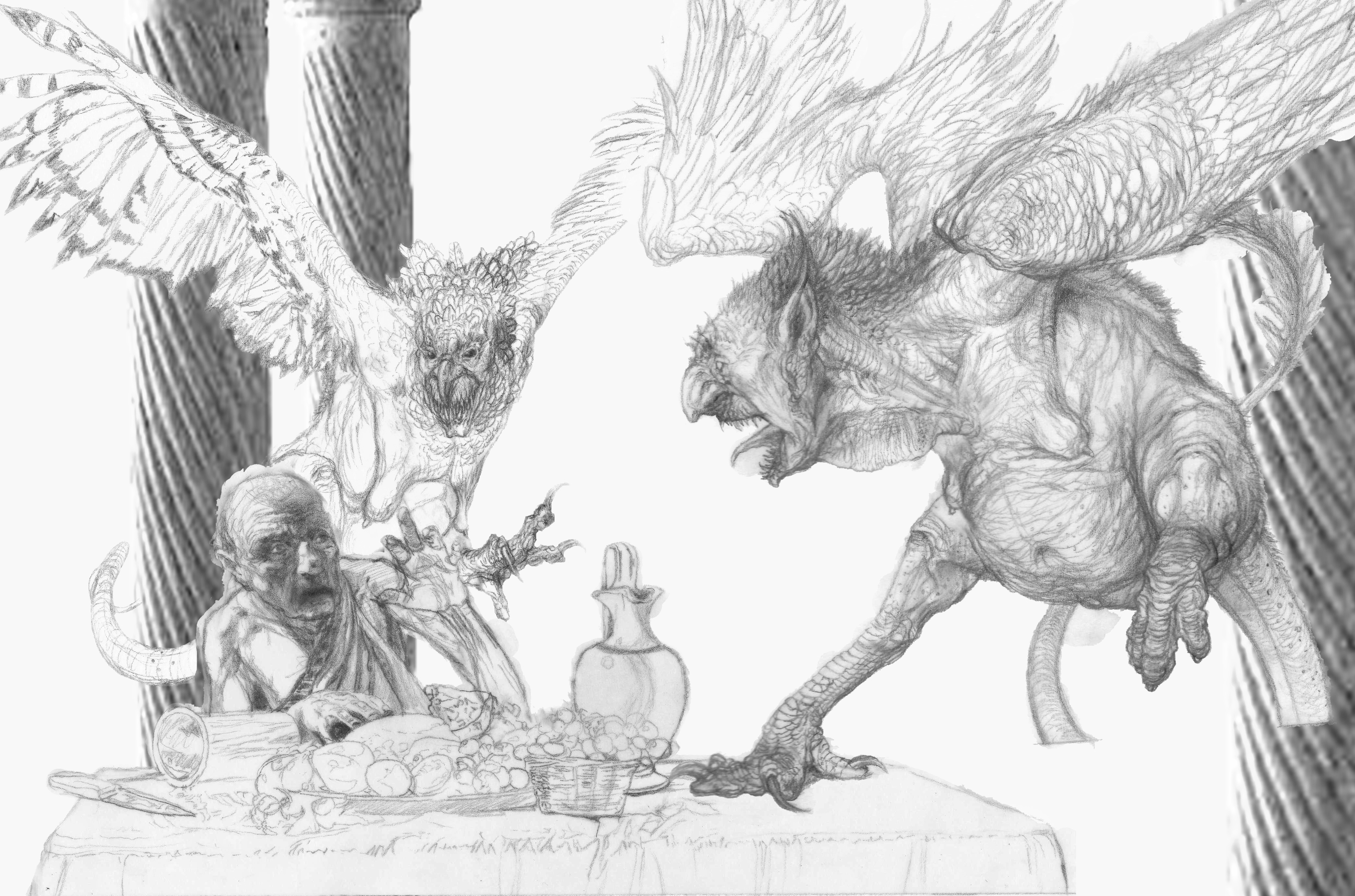
Phineus & The Harpies by Russell Marks

Marcel puts up a post about Phineas today. I think he's making a comment on some current event, but I don't really know what he is talking about. Shoot, I'm not even sure who Phineas is, so a-wandering I go. First thing I find is that it's spelled Phineus. Then the article confirms Marcel's story about the Harpies. The story mentions a couple of locations in the Eastern Mediterranean, so I look them up.

Symplegades
Strofades
And then I find this:

Lord Byron refers to the Symplegades in the concluding stanzas of Childe Harold's Pilgrimage:
And from the Alban Mount we now behold
Our friend of youth, that ocean, which when we
Beheld it last by Calp's rock unfold
Those waves, we follow on till the dark Euxine roll'd
Upon the blue Symplegades …

That Lord Byron guy sure gets around.

Update March 2026 replaced missing picture.

Monday, January 25, 2016

Belief

Krysten Ritter as Jessica Jones
We've started watching Jessica Jones, a TV series on Netflix. It comes to us from the Marvel comic book universe, so some characters have some supernatural abilities. It's an entertaining story about a young woman working as a private investigator in Manhattan, who just happens to be as strong as ten men, never mind that she has the physique and pallor of a genuine New York junkie. The story has some interesting characters, but the key one right now is a guy who can control people's minds. He does this by planting ideas in their heads. Sometimes they are fairly innocuous suggestions which will appear to be the most natural thing in the world. Other times they are compulsions that will cause them to commit horrific crimes even while they are aware that they are doing things against their will.

    The magic practiced in the novel Jonathan Strange & Mr Norrell is often of a similar bent. It involves people seeing absolutely bizarre apparitions and accepting them as completely normal. Occasionally it involves people seeing things that aren't really there, and as we often say, seeing is believing.

    I have some friends who sometimes send me articles from the fringe: tales of UFO's, alien encounters, government conspiracies, chemtrails, stuff that I am apt to dismiss out of hand (except for the government conspiracies, those are all absolutely true). Now you might think that my friends are ignorant, uneducated yokels who might be a couple of bottles short of six pack, but they aren't. The people who are sending me this stuff are all intelligent, educated people who are living normal lives. How can this be?
    For a long time I just dismissed their beliefs. I couldn't understand how they could be reading this trash, much less believing it. But now I think I have a clue.

    Recently I came across a story by a guy who was wondering the same thing about people who weren't toeing the mark on issues like Global Warming and Genetically Modified Organisms. It's almost impossible to get to the truth of the matter on subjects like this without spending years of your life researching it, so we listen to what the experts have to say and make our decisions based on what they tell us.
    They could be telling us the truth, or it could all be bullshit, and how would we know? So basically we are basing out opinion on whether we believe them or not. If you are old enough, you know that big organizations, government or otherwise, have no compunction about lying and if you've been bitten by their bullshit once you are going to be very leery of believing anything they say now, which might make you inclined to listen to people who don't have a track record of lying to you, or at least they haven't been lying to you about important stuff.

Sunday, December 27, 2015

The Foreign Secretary

George Canning
British Foreign Secretary
March 25, 1807 to October 11, 1809
The picture is of the actual British Foreign Secretary from the time in question, which happens to be during Britain's war with Napoleon. The following quote is from a fictional story which also has a war going on with Napoleon at this same time. Imagine that.
Jonathan Strange & Mr. Norrell by Susanna Clarke, first page of Chapter 6.
Change a few terms: substitute the 'voting public' for 'country gentlemen', pick some other bogeyman to replace Napoleon, and this could apply to our current state of affairs.
     Suspicion of cleverness puts me in mind of the phrase 'too clever by half', which is an English expression which I take as a slight against anything most people cannot easily comprehend, which is why most good ideas are never implemented.
    There are situations where a clever person comes up with a solution to a problem, but the solution either is so complex that it cannot be successfully implemented, or it fails because of some unforeseen side effect. Hence, the preference for simple, understandable solutions, even if they are crude, inefficient and expensive. Some people have other, incorrect ideas of the meaning of this phrase.

P.S. Previous post on this book.

P.P.S. Notice how Napoleon is spelled with two O's, not two A's which was my tendency. I'm not the only one to get it wrong.

P.S. #3 Wiki pertaining to this book.

Saturday, January 23, 2016

Jonathan Strange & Mr Norrell, Page 302

There seem to be a great many historical figures in this book, but I wasn't sure, so tonight I decided to check on the names I found on two pages.


High Wycombe
, often referred to as Wycombe, is a large town in Buckinghamshire, England. It is 29 miles west northwest of Charing Cross in London; this information is also engraved on the Corn Market building in the centre of the town. - Wikipedia


Robert Banks Jenkinson, 2nd Earl of Liverpool KG PC (7 June 1770 – 4 December 1828) was an English politician and both the youngest and longest-serving Prime Minister (1812–27) since 1806. - Wikipedia


The Prince Frederick, Duke of York and Albany
 KG GMB GCH (Frederick Augustus; 16 August 1763 – 5 January 1827), was the second son and child of King George III of the United Kingdom and a member of the House of Hanover. From the death of his father in 1820 until his own death in 1827, he was the heir presumptive to his elder brother, King George IV, both to the United Kingdom and the Kingdom of Hanover. - Wikipedia


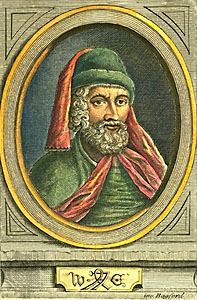
William Caxton
 (c. 1422 – c. 1491) was an English merchant, diplomat, writer, and printer. He is thought to be the first English person to work as a printer and the first to introduce a printing press into England, which he did in 1476. He was also the first English retailer of printed books; his London contemporaries in the trade were all Flemish, German, or French. - Wikipedia

Floors Castle, in Roxburghshire, south-east Scotland, is the seat of the Duke of Roxburghe. - Wikipedia

John Ker, 3rd Duke of Roxburghe KGKTPC (23 April 1740 – 1804) was a Scottish nobleman and bibliophile.
Born in Hanover SquareLondon, on 23 April 1740, Ker succeeded his father to become the 3rd Duke of Roxburghe in 1755. During his Grand Tour in 1761 he fell in love with Christina Sophia Albertina, oldest daughter of the Duke of Mecklenburg-Strelitz.[1] This would have been a perfect match of social equals. Shortly afterwards a younger sister, Charlotte of Mecklenburg-Strelitz, became engaged to King George III. It was considered bad etiquette for an elder sister to marry someone of lower rank than a younger sister. For whatever reason, both John Ker and Christina separated and remained single for the rest of their lives. If George III recognised the sacrifice that Ker had made, it was rewarded with a high position at court. He was Lord of the Bedchamber from 1767, was appointed a Knight of the Thistle in 1768. In 1796 he was appointed Groom of the Stole and made a Privy Counsellor. He was appointed a Knight of the Garter in 1801.
While in Italy, Ker saw a first edition of Boccaccio's Decameron, often called the Valdarfers edition. This was a fabled book, which many said did not exist. He paid 100 guineas for it and showed it to his friends in London to huge acclaim. For the next 40 years he collected ancient and curious books, particularly editions of Shakespeare's works and other works which merely mentioned Shakespeare. At his death in 1804 there were 10,000 items. Most were books, but there were also pamphlets and broadside ballad sheets. His library was auctioned in 1812, leading to the formation of the Roxburghe Club. His collection of ballads were later published as the Roxburghe Ballads.
He died unmarried and childless, and the titles Earl Ker and Baron Ker, which had been created for his father in 1722 in the Peerage of Great Britain, became extinct. His cousin William Bellenden, 7th Lord Bellenden succeeded to the dukedom and all of its other subsidiary titles. - Wikipedia

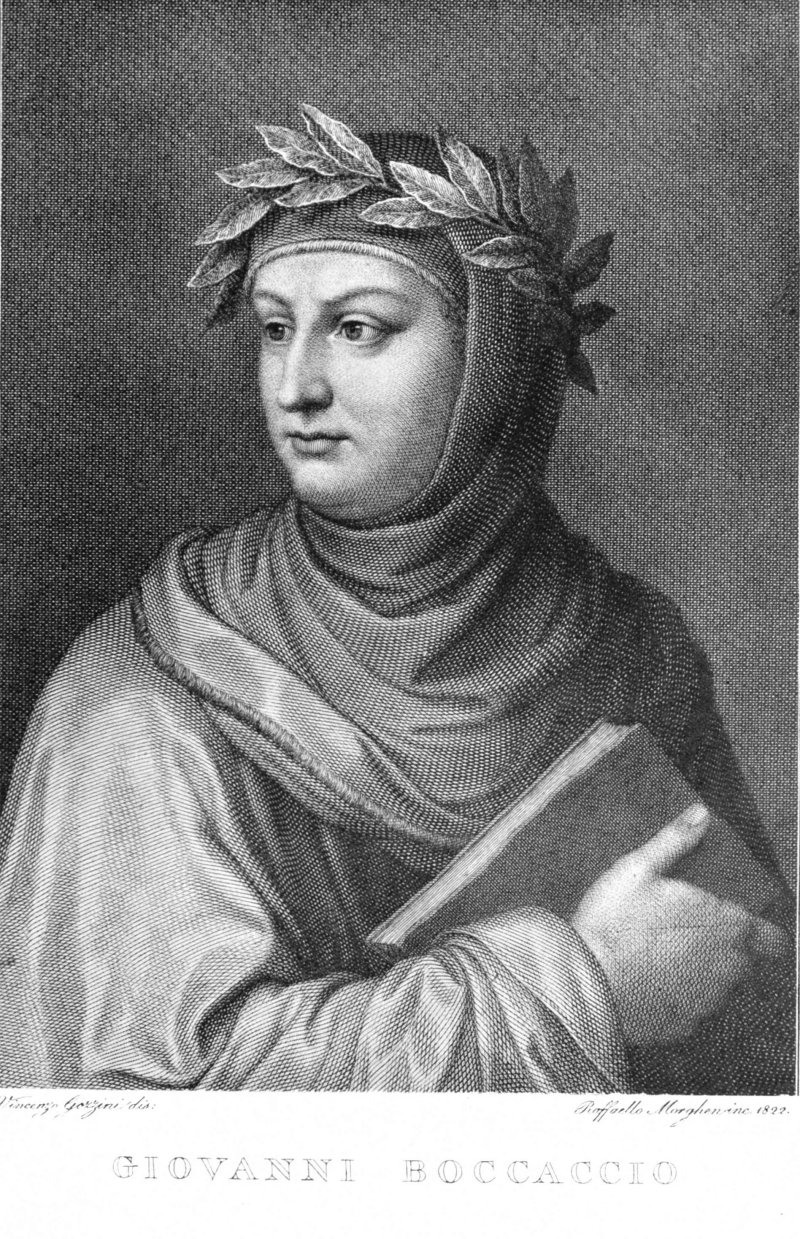
Giovanni Boccaccio
Giovanni Boccaccio 1313 – 21 December 1375)[1] was an Italian writer, poet, correspondent of Petrarch, and an important Renaissance humanist. Boccaccio wrote a number of notable works, including The Decameron and On Famous Women.

Christophorus Valdarfer was an early printer, active in Venice and Milan in the second half of the fifteenth century. - Wikipedia


The Decameron
 . . . is a collection of novellas by the 14th-century Italian author Giovanni Boccaccio. The book is structured as a frame story containing 100 tales told by a group of seven young women and three young men sheltering in a secluded villa just outside Florence to escape the Black Death, which was afflicting the city. - Wikipedia

Update April 2016 replaced missing picture.
Update March 2026 replaced missing images.