Intel's Ronler Acres Plant

Silicon Forest
If the type is too small, Ctrl+ is your friend

Showing posts sorted by relevance for query Forever War. Sort by date Show all posts

Thursday, October 9, 2008

The Forever War

Soldiers in the Forever War
"The Forever War" is one of the great Science Fiction novels of all time, written by Joe Haldeman sometime in the 20th Century.

You could use that title to describe the war between the sexes, to wit: roughly 2700 years ago Hesiod wrote:
"From her is the race of women and female kind, of her is the deadly race and tribe of women who live amongst mortal men to their great trouble, no helpmeets in hateful poverty, but only in wealth."
Geez, think he was a little down on women when he wrote that? I got here by following a link to Wikipedia from Stu Savory. I found the picture while I was looking for book covers, and I just really like it.

Update December 2016 replaced missing picture.

Tuesday, July 26, 2022

War

Charles V, Holy Roman Emperor (1500-1558)
Bernard van Orley, 1519

I just finished reading The Verge by Patrick Wyman. The subtitle is Reformation, Renaissance, and Forty Years that Shook The World 1490-1530. It's about how Martin Luther, the printing press, firearms and financing all came together to launch Europe on a trajectory that would see them take over the world. He talks about some prominent people and all the goings-on, and the goings-on was basically war. It's basically a chronicle of the wars fought in Europe during this time period.

I'm reading this and I''m thinking this is exactly the same kind of shit we've got going on know. Fucking morons shooting off their mouths, throwing their weight around and going to war. We worship peace, or so we say, but we keep going to war. I'm beginning to think peace is an anomaly. Don't waste any time hoping for peace because it ain't gonna do any good. We're going to war whether we want to or not. I'm beginning to think it's congenital.

You can pray for peace. Praying is good, it helps get your mind right. But hoping, that is just a complete waste of time and energy. Instead, figure what you need to do in order to survive. I suspect for most people that means holding down a job and building up your bank account. I think this means becoming part of the mesh of society. It's like you are spread-eagled and hooked hand to hand and foot to foot with a whole wall of similarly arranged people. You are restrained by these links, but at the same time they make you much stronger because we are all working together. Things like fire protection, running water, power, automobiles are all very difficult to procure on your own, but we have all these things at our finger tips because we work together. Of course for most of us, our sole contribution to these things are the taxes and the monthly utility bills we pay.

Perhaps our continued entanglement with society causes a build up of frustration that has to be released and the way we do that is we go to war. I don't know that anyone is consciously controlling this. It might just be instinct. If it is instinct then that raises the question of how is this a survival skill? War kills a lot of people, job lots of people. So going to war means you've got a good chance of dying. Young men are famous for being careless of their lives. I suppose it's just an outgrowth of aggression and aggression comes from hunting. Kind of weird.

The human race is synonymous with The Forever War

P.S. I'm not sure about the use of goings-on. Should it be hyphenated or not? Can you use it as a noun? Should be it be plural, goings-ons? Enquiring minds want to know.


Thursday, July 6, 2017

The Forever War

Is it time to end the war on drugs?
There was a big article in The Wall Street Journal today, full of nonsense about the War On Drugs. This got me to wondering who are these people who support this war? I do a little digging and I find this quote on Quora, which links to an article on Harper's:
“You want to know what this was really all about? The Nixon campaign in 1968, and the Nixon White House after that, had two enemies: the antiwar left and black people. You understand what I’m saying? We knew we couldn’t make it illegal to be either against the war or black, but by getting the public to associate the hippies with marijuana and blacks with heroin, and then criminalizing both heavily, we could disrupt those communities. We could arrest their leaders, raid their homes, break up their meetings, and vilify them night after night on the evening news. Did we know we were lying about the drugs? Of course we did.” - John Ehrlichman, interviewed by Dan Baum
Now this thing, this War On Drugs, is so firmly entrenched in the global economy that I doubt anyone short of the messiah will be able to rescind it. Possibly if this country goes broke, the government might be persuaded to legalize drugs so they can tax them, but I wouldn't hold my breath. The government has been on the verge of going broke for years, but somehow it manages to keep schlepping along.

The War On Drugs brings us a whole raft of problems, but the biggest one by far is that a large segment of the population no longer trusts the government to do the right thing.

Monday, April 19, 2021

A Pinprick in the Scheme of Things


B-52 Busters - Vietnam War Communist Commando Raids
Mark Felton Productions

I've kind of been avoiding the Vietnam War. Emotions are still pretty raw from that disaster, so it's a little difficult to get any perspective on the subject. It's been fifty years, so maybe we can start to get a clearer view, if only because we aren't constantly having to wipe the mud off the windscreen.

World War Two is great. It almost qualifies as ancient history and I have heard enough about it to  satisfy my curiosity, so let's move on to more recent history.

I knew we were using B-52's to bomb Vietnam, but I wasn't quite sure whether we were bombing North Vietnam or just portions of South Vietnam where we suspected the Viet Cong were hiding. I didn't know they were based in Guam or in Thailand. And why was that? Didn't we have multiple, big fat, air bases in South Vietnam? Something doesn't add up here. I smell bean counter economics, or bullshit political wrangling.

I suspect Genghis Khan is the root cause of Asia being the way it is. We've been fighting the Communists all around the border of Asia. First there was Taiwan (I'm not sure just what happened there, but it must have been a pretty big deal). Then there was Korea, Vietnam and now there is Afghanistan. It's like the Forever War. And all we've got to show for it are South Korea, Taiwan and Singapore. I suspect there might be something in Asian DNA that makes them more susceptible to authoritarian rule. Or maybe not. Maybe it's just the luck of the draw. Some Jackass manages to become the leader, boosts his security service and clamps down on the opposition. Or maybe that's the only way to keep a lid on things so it doesn't just boil over into perpetual civil war. Whatever.

B-52's are almost 70 years old. That's crazy. I wonder how much fuel the combined fleet has burned over their lifetime. A couple of zillion gallons at least. All this reminds me of the stories in Command and Control about the mishaps that occurred with B-52's carrying atomic bombs.

You need to be real careful when you ask the military to do something because they will find the most effective way to get the job done. It might not be efficient and it might result in a great deal of collateral damage, but that's not really a concern when your objective is to kill the other guys and not get kilt yourself.

B-52's in the Vietnam War
Hanoi is the top placemark, Guam is at the far right.


Friday, January 3, 2020

Wars Update: Empires Versus The Rest Of Us

The Forever War
StrategyPage has a summary of the current state of wars worldwide. Here is the opening paragraph:
January 2, 2020: This is our annual (formerly twice-a-year) summary of current war zones and an overview of where it is all heading. Doing this once a year rather than twice is a reflection of the decline in the number and severity of wars since the 1990s. After the overview, there is the alphabetical list of the war zones and a quick summary of how the local mayhem has been proceeding. Since we have been covering this sort of thing for twenty years now there are some war zones that have gone quiet. We left most of those in summary, with a note that those wars had gone dormant, and maybe extinct. History shows that dormant is more common than extinct. Forever (at least multi-century) wars are an ancient tradition.
Me thinks Joe Haldeman knows more about history than I do.

Via daily timewaster

Thursday, October 26, 2023

Five Came Back


Five Came Back | Official Trailer [HD] | Netflix
Netflix

IAman reports he stayed up till 2AM watching this.

Excerpts from the Wikipedia page:

Synopsis
Five Came Back explores the experiences of five U.S. film directors – John Ford, William Wyler, John Huston, Frank Capra, and George Stevens – and their frontline work during the Second World War.

Referenced films:
    • The Battle of Midway (1942, John Ford)
    • Prelude to War (1942, Frank Capra)
    • The Battle of Russia (1943, Frank Capra)
    • Undercover: How to Operate Behind Enemy Lines (1943, John Ford)
    • Report from the Aleutians (1943, John Huston)
    • The Memphis Belle: A Story of a Flying Fortress (1944, William Wyler)
    • The Negro Soldier (1944, Stuart Heisler; produced by Frank Capra)
    • Tunisian Victory (1944, John Huston)
    • Know Your Enemy: Japan (1945, Frank Capra)
    • The Battle of San Pietro (1945, John Huston)
    • Nazi Concentration Camps (1945, George Stevens)
    • Let There Be Light (1946, John Huston)
    • Thunderbolt (1947, William Wyler)
Episode 1 The Mission Begins
The series looks at the backgrounds of the five directors as World War II begins and their motives for helping the war effort. John Ford's The Battle of Midway was approved directly by President Franklin D. Roosevelt while Frank Capra fights to get Why We Fight made.

Episode 2 Combat Zones
The directors learn their vision for the films is not always permissible by the U.S. government. Wyler is shocked by the racism he encounters against African American soldiers and refused to make a film recruiting black soldiers. Meanwhile, the films' racist depiction of the Japanese versus human depiction of the Germans causes worry for the War Department, which at that time planned to redistribute the Japanese-American population from internment camps into towns across the United States.

Episode 3 The Price of Victory
The five directors return to Hollywood after the war but are forever haunted by what they saw. Ford goes on a drinking bender after filming the carnage at D-Day. Stevens is wholly unprepared for the horrors of Dachau and realizes he is not there to film propaganda but to capture evidence of crimes against humanity. Wyler, who lost his hearing during the war, fears his career is over. Huston chronicles soldiers suffering from posttraumatic stress disorder in the film Let There Be Light, only to have it suppressed by the U.S. government.

Not to be confused with the 1939 melodrama starring Lucille Ball.


Wednesday, May 8, 2024

Economy

The news is full of stories about people with non-traditional sexual orientations, the wars in Israel and Ukraine. I am tired of those stories. Ukraine looks like another Forever War much like our adventures in Afghanistan and Vietnam. Israel seems to be dealing with their neighborhood terrorists, and the combatants in the gender wars will continue to provide fodder for social media.

But all that is small potatoes compared to our national debt. Some people don't think it's a problem, they think things will continue to sail smoothly along just like they have been. I am not one of them. I think  the whole thing is going to run off the cliff and we will plunge into the abyss. I suspect that more and more people are getting pushed into poverty. Poverty can lead to desperation, and desperation can cause things to turn very ugly.

But I don't see many stories about that, so I was gratified to find one on RT today:

Tsunami of Dollars

Drowning in debt: The paralysis at the heart of the US fiscal crisis by Henry Johnston

Washington is doing nothing about its deteriorating finances because there is nothing it can do without risking major upheaval

It can appear puzzling why at certain times in history a government facing a looming crisis simply does not address it. The problems accumulate in plain view while little is done to actually solve them. The human imagination being what it is, this inaction is inevitably attributed to some mix of corruption, malfeasance, and incompetence. And certainly the road to any system-level crisis is strewn with missteps and short-sighted policies. But there comes a point when the horizon of possibility has closed and there is simply nothing a government can do without unleashing forces that could easily overwhelm it.

In the strange and torpid final years of Tsarist rule in Russia, the unfolding crisis that would eventually result in the Russian Revolution seemed immobilized in a state of suspension as the country’s major actors recoiled from taking decisive actions for fear of detonating the very cataclysm they had sought to avoid. Much has been made of the weakness and indecision of Nicholas II, but by those fateful last years the anachronistic Romanoff dynasty was collapsing and little could be done to stop it. 

Henry goes on for a couple of pages. It's the best description of our situation I have read.

P. S. Wikipedia has a page about Perpetual War.

Monday, March 13, 2017

Quote of the Day #2

Coca Plantation
EL TARRA, Columbia - The coca leaf used to make cocaine has made such a dramatic comeback in this country that plantings now cover more territory than they did before a multibillion-dollar U.S.-sponsored campaign began 16 years go, U.S. and Colombian officials said. - Juan Forero writing in The Wall Street Journal (paywall)
The War on Drugs is never going to go away, it is our very own Forever War. There are too many people on both sides of the fight with a vested interest in keeping things the way they are. Rational discussion has no place in an argument dominated by money.


Thursday, July 4, 2013

4 July

     Today's the day when I'm supposed to commemorate the formal launch of one of the few successful revolutions in all of history.
     One of the most successful and, at least in the home country, poorly understood.  It was not a war won by winning battles, it was a war won by avoiding too-expensive losses.  It was not a war won by beating the the Crown's forces to their knees but by making continuation too costly for them (at the time, they had other troubles, elsewhere).  It was won, in fact, by refusing to give up, even though it appeared unwinnable over nearly the entire course of the war.
     And, much as we'd like to think it was fought for the very highest ideals expressed in the Declaration of Independance, it was mostly fought to get the Crown's hand out of our pockets, to get the Crown's men out of our homes, and to generally be left alone.  --Or are those the highest ideals expressed in the Declaration, after all?
     The document [that] this day marks the adoption of was not at the time and has never been a part of the actual law or foundational documents of the States, united; it is not The Law Of The Land.  If you're after the first of those, you want the Articles of Confederation and Perpetual Union, used for four years prior to ratification in 1781.--Some perpetuity: it was replaced a dozen years after first use.
     Along about 1787, either the fed.gov established by the Articles of Confederation was too puny to work, or it hadn't grabbed enough power to satisfy the social engineers, depending on who you believe.  The reality appears to be both and motivated more by pragmatism than idealism: things were falling apart and a baker's dozen of squabbling States stood no more chance against the Great Powers of the day than it had in 1776.  Thomas Jefferson being safely out of town, the drafting of our present Constitution began, ostensibly as a "revision" of the Articles of Confederation.  Instead, the delegates threw them out and started over.
     That is the first example of what came to be a classic pattern for popular revolutions: the old order is tossed out, there's a relatively brief period of great freedom, followed by a consolidation of power or formal reordering.  Best case, there's just the one and things get back on track; worst case, um, see French Revolution.  It appears inevitable; perhaps it's just theory hitting reality and the only variable is the size of the splat.
     If so, we were fortunate; but no luck runs forever and I'm half-convinced we have already passed the point where future historians will draw a line, saying, "Here the Republic ended; here the Empire began."
     It's still a good place, compared to most, and a great life, compared to most.  The present and the past that led to it are worth celebrating.
     That past is worth remembering and worth analyzing.  What happened?  Why did it work?  What did they get wrong?  What short-term compromises lead to long-term failure?
     What did it all mean and what does it mean today?  Something more than "BANG!" and a puff of bight sparks and colorful smoke, I hope.
Stolen entire from Roberta X

Monday, April 12, 2021

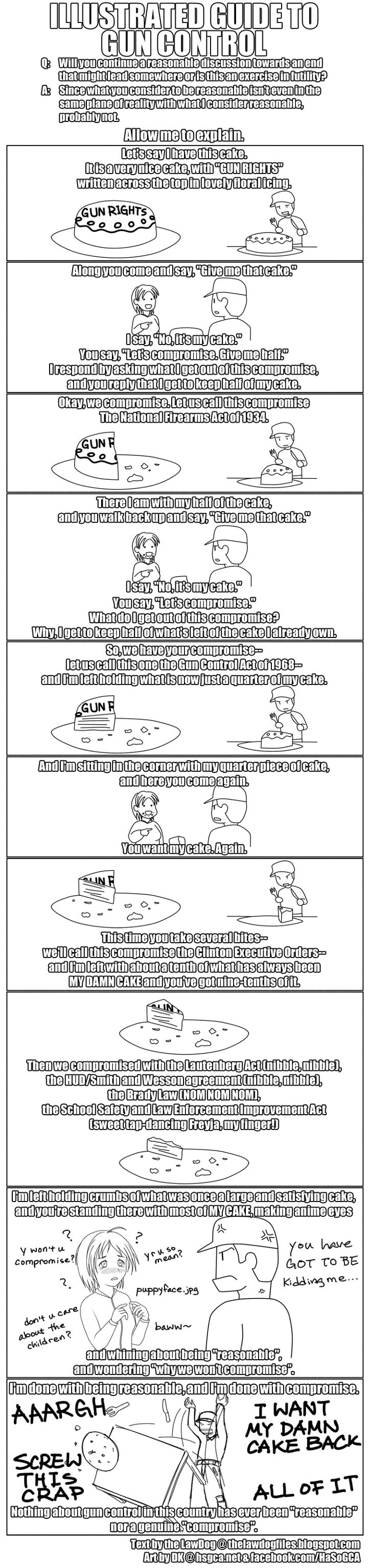
Gun Rights Cake

Handwaving Freakoutery has posted the Gun Rights Cake cartoon. I tried to steal it and post it here, but Blogger can't handle long images and I am too lazy to cut it up an post it in pieces. You can see the cartoon all by its lonesome here. It's pretty great. You can read his post as well, but it doesn't really contain anything new. And it doesn't matter anyway, because the battle is not being fought over ideas, but with emotions. The other side doesn't really care if they win or not as long as they can get their faces on the news along with stupid little sound bites about how they are for gun control and abhor violence. It's a stupid fight and it is going to continue as long as emotional people are easily manipulated, which means forever. Great. Another Forever War. I for one will welcome our new robot overlords, if they ever bother to show up.

A little digging reveals that LawDog authored Gun Rights Cake:

I hear a lot about "compromise" from your camp ... except, it's not compromise.

Let's say I have this cake. It is a very nice cake, with "GUN RIGHTS" written across the top in lovely floral icing. Along you come and say, "Give me that cake."

I say, "No, it's my cake."

You say, "Let's compromise. Give me half." I respond by asking what I get out of this compromise, and you reply that I get to keep half of my cake.

Okay, we compromise. Let us call this compromise The National Firearms Act of 1934.

There I am with my half of the cake, and you walk back up and say, "Give me that cake."

I say, "No, it's my cake."

You say, "Let's compromise." What do I get out of this compromise? Why, I get to keep half of what's left of the cake I already own.

So, we have your compromise -- let us call this one the Gun Control Act of 1968 -- and I'm left holding what is now just a quarter of my cake.

And I'm sitting in the corner with my quarter piece of cake, and here you come again. You want my cake. Again.

This time you take several bites -- we'll call this compromise the Clinton Executive Orders -- and I'm left with about a tenth of what has always been MY DAMN CAKE and you've got nine-tenths of it.

Then we compromised with the Lautenberg Act (nibble, nibble), the HUD/Smith and Wesson agreement (nibble, nibble), the Brady Law (NOM NOM NOM), the School Safety and Law Enforcement Improvement Act (sweet tap-dancing Freyja, my finger!)

I'm left holding crumbs of what was once a large and satisfying cake, and you're standing there with most of MY CAKE, making anime eyes and whining about being "reasonable", and wondering "why we won't compromise".

I'm done with being reasonable, and I'm done with compromise. Nothing about gun control in this country has ever been "reasonable" nor a genuine "compromise".

LawDog

Sunday, January 5, 2020

Sheepfarmer's Daughter by Elizabeth Moon

Sheepfarmer's Daughter by Elizabeth Moon
I've exhausted all of the books in Elizabeth Moon's Serrano series, so I thought I would try some of her earlier 'sword and sorcery' stuff. It's not bad, not great, but not bad. The story has a young woman running away from her father (and a future as a farmer's wife) to join the army where she learns to wield a sword and becomes a proficient killing machine, aka, a warrior. Sounds a bit improbable, but it's fiction, and she's a big girl, so we'll cut her come slack.

Much of the story is the day to day life of a foot soldier, and it's not much different from Captain Coignet's experience as a soldier in Napoleon Bonaparte's army. A lot of marching, training, standing guard and doing camp chores. I'm reading along and it suddenly struck me that we (people) have always been fighting wars. History lessons in school seem to emphasize big battles and the effect they supposedly had, and I somehow got the impression that otherwise life was peaceful. That wasn't the case. War has been a constant fixture of life since forever. Only a small percentage of people were actually soldiers, but wars and armies and weapons were always there, and for thousands of years it was basically unchanged. Only since the invention of firearms has there been a need to revise our strategies and tactics.

Because war has been a fixture of life for so long, I wouldn't doubt that it is part of our DNA. I suspect that throughout history, warriors, especially the leaders, were among the best educated people. Nothing focuses the mind like someone trying to kill you.

But then along came firearms and all of a sudden, a hundred thousand years of tradition got pushed aside. I suspect that's part of the reason the American Civil War and World Wars of the 20th Century were so devastating. Our tactics had not evolved beyond what worked before firearms came along.

I imagine that none of this is surprising to anyone who has studied history, but it's completely different from the peaceful existence I was taught to believe was the natural order of things. Peace is not the natural order of things. Peace is simply the interlude between wars. If you are smart, you use peacetime to sharpen your swords. You can't have peace without having a war. It's in our DNA.


Wednesday, June 7, 2023

Curmudgeon’s Navel Gazing:

Abraham Lincoln by Alexander Gardner, 1863

Adaptive Curmudgeon put up an excellent post. The post has two parts. The first is about the nature of people. The second is about motorcycles. The first part is great, so I stole it:

Did I make the correct choice? Let’s back away from the trees of motorcycles and discuss the forest of life: Why do people do stupid shit? Some stupid shit is gloriously innocent: “Hold my beer and watch this…” Nothing wrong with that. Other stupid shit is so predictably doomed to fail it hurts to watch. That’s the shit to avoid!

Ever see people do stuff so absolutely mind bogglingly moronic you wonder how they derived the slightest hope it would succeed? Think of paths were people march into bad results that are more or less a certainty. The fool that smokes 3 packs a day while bitching about their health. The moron that’s always broke who just took on more payments. The dude who eats shit from his harpy wife until she takes half his money and runs off with the UPS guy.

Many of us sleepwalk into the woodchipper… repeatedly. We’ve all seen it. It’s a human thing. We need self-control to avoid predictable failures.

It’s hard to plumb an individual man’s mind. It’s easier to observe big groups as they take obviously unwise paths. This is best examined for a time and place far removed from your current situation; thus to avoid your own biases. War is often (usually!) avoidable and it’s always horrible. With 20/20 hindsight the precursors that created most wars seem unthinkably obvious.

I suspect the American Civil War was like that. Pressure built for whole human lifetimes. Nobody diffused it in advance. Few people correctly predicted the hell that ensued. Everyone thought it would be a spat… a faffing about… a skirmish. It was nothing like that. Americans were incredibly effective at killing Americans. Things happened in a way that didn’t happen in Britain or Brazil.

What’s weird is that it wasn’t sudden. The ethical division in the populace had been there literally since the founding. As Lincoln so eloquently put, we had four score and seven (87) years to sort our shit out. We didn’t. Many nations had to thread the same needle. Many did so without bloodshed. Why not us?

I think we deliberately chose to avoid resolving things and instead used it as a political hot potato; a loser’s game in the long run. We let a real problem become merely one-upmanship. Each new State became a brand new battle. “Will the new State side with Team A or Team B? How does the addition of that new State change the balance of power? Who gains? Who loses?” Two points of view never finding or seeking compromise. Keeping the kettle on boil instead of inching toward resolution. America played politics until things had already gone to shit and by then neither side could find a way out.

A forever game of political one-upmanship instead of resolving legitimate issues. Sound familiar?

The “States as pieces on a gameboard” thing still happens right now… or rather it’s frozen in a stalemate. Puerto Rico isn’t a State. It’s bigger than some States. It could be a State. Yet, if we add it, some would benefit and some would lose… so it stays balanced on the knife edge of a nation that has razor sharp political edges. Maybe that’s for the best, I’m not in Puerto Rico so I don’t know. But it’s odd that we went from 13 colonies to 50 states and then lost the use of the tool. (We last added states in 1959; Hawaii and Alaska.)

Existing States can be split as needed. It has happened before. West Virginia split from Virginia in 1863. Maine separated from Massachusetts in 1820. Now that’s considered “unthinkable”. If we split a State someone would benefit and someone would lose. Notice that release of pressure or responsive governance is irrelevant? It’s not even considered. It’s all about short term wins and losses in the forever game.

A rancher in East Rattlesnake, Oregon; where it barely rains, the neighbor is six miles away, and coyotes outnumber people has to live under rules made by a foreign power. His State is run from Hippietopia where it never stops raining, there are more lesbian drug dispensaries than tractor supply stores, and people consider skate boards a legitimate form of transportation. Chaining those two disparate worlds together is exclusively for the benefit of people who care for the game. The welfare of ranchers or skateboarders isn’t relevant.

The dude trying to run fence isn’t selfish. He legitimately chafes under regulations made by people who are unlike him and possibly hate him. His part of the State can’t split off because endless friction is not just tolerated but embraced.

How long has it been this way? Has the rancher eaten shit for his full 87 years yet?

Back to my original example, after decades of building pressure, Republicans elected their first president. The Republican party specifically supported abolition. It was a hotly contested election. As soon as the guy was sworn in, everyone freaked out. Sound familiar?

(I pause here to help uninformed victims of America’s dumbed down public schools. Many if not all societies had slavery at one time; from Aztecs to Egyptians, from Vikings to Venice, from Congo to Constantinople, Byzantium to Brazil. Slavery faded out in fits and starts (with many caveats); often due to boring economic factors or occasionally because of soaring enlightenment ideals. America’s transition involved the first Republican President; Lincoln. Even now people debate the way the mess happened. Ironically, most folks who riot in our urban areas on sunny summer weekends; gathering to piss and moan and stamp their feet at the base of a George Floyd statue erected on Martin Luther King Jr. boulevard have no idea of this. They howl against the party that took up arms to end slavery. Before you set out to change the world, read a book!)

To me, war seems the least wise way to resolve the situation. Why wasn’t 87 years enough to figure it out? Careers were made on the endless struggle. Lives were lived in support or opposition. Earnest, dedicated, citizens on both sides bled out together in Gettysburg. It could have been an eight decade series of committee meetings.

Here’s the lesson I take from it: Humans are herd animals. Once they settle on a path, change is beyond the mind of most humans. A self-actuated human can break free but the rest will plod, stupid and complacent, like robots. Each step is another step on a path that was laid out long ago. There will be times when someone says “this is stupid, lets see if we find a new way”… but it won’t resonate. Humans unthinkingly continue doing stupid shit until you bury them in box lots.

We all carry this weakness. Only the use of our barely understood monkey derived mind gives us a small chance to escape. When shit seems sketchy, a humble man will ask himself “am I the cause”. Maybe, if I’m on a track that’s “wrong” or “stupid”, I can figure it out in time. “Oh no! I’m being an idiot! I’ll stop following this path right now!”

When’s the last time you adjusted your sails to the changing wind? If you don’t occasionally change settings you’re not steering the ship. Fools take the next step because they already took the last one. Don’t be a fool.


Tuesday, October 2, 2012

Blast From The Past

Scott sent me a link to a site about Nike anti-aircraft missile sites. Back during the cold war, we (the USA) set up a bunch of these, many times the number of BOMARC sites. Some Nike missiles used a conventional explosive, some used a nuclear warhead.
 

Incredible Footage of B17 Bomber Destroyed by Nike Missle (1954) | British Pathé
War Archives

This video shows a four engine, propeller driven bomber being destroyed by a Nike missile. I wonder how they were able to record this. I imagine this was a test and the bomber was unmanned. The bomber could have been on autopilot, I mean autopilots have been around forever, but how did they get the plane far enough off the ground to engage the autopilot? And who was filming this? Another unmanned drone? And how far away would you have to be to ensure that the aircraft with the camera wasn't the one targeted by the missile? This is another fine example of the Cold War mentality gone wild.

Update: Clyde & IGOR got the shot.
Update March 2022 replaced missing video.

Friday, March 26, 2021

Jizan, Jazan

Houthi forces launch a ballistic missile aimed at Saudi Arabia on March 25, 2018
[Houthi Military Media Unit via Reuters]

Video Shows Saudi Red Sea Oil Terminal Ablaze After Fresh Drone Attack by Tyler Durden

The oil terminal is in Jizan (or Jazan, depending on who's spelling it). An oil terminal in Saudi Arabia, on the Red Sea, near the border with Yemen? That sounds familiar, and sure enough I put up a post about another attack a few months ago. All the videos in the ZeroHedge post are from Twitter, which don't lend themselves to clean embedding, so I went to YouTube to see if they had one. YouTube has bunch of videos of rocket attacks on Jizan. I didn't see any of the latest attack. I don't know if that matters though. The conflict has been going on for a while and will probably continue indefinitely. Another Forever War for your entertainment.


Wednesday, May 25, 2022

Your Vote Doesn't Matter

Republic Services
Hauling your ass to the dump

What matters is the votes in aggregate, and that is pretty much determined by who has the most expensive advertising campaign. Yes, there are exceptions, like Bloomberg spending $400 million and getting nowhere, though I don't know how that compares to other campaigns. And there was Zuckerberg's campaign to 'get out the vote' that put Biden in the driver's seat.

I've been thinking that we really need a new political party, a party dedicated to the principles of the our republic. The 20th Century was spectacular. It brought us a huge increase in population, a couple of horrific wars that have now morphed into the forever war, and absolutely astounding technical accomplishments. All this has contributed to our slide from a republic populated by brave, true and honest citizens into an empire where it's every man for himself, money talks and virtues are a bug, not a feature.

The regime that is currently running the country, which includes everyone working for the government, the defense industry and the two major political parties, is not interested in the welfare of people. The entire edifice is constructed to pump as much wealth into pockets of their members and to hell with everyone else. Some of that wealth is newly created, but a large portion of it comes from squeezing everyone who is not a member of this wolf pack. The frigging government has become the Mafia, much like the government in the old Soviet republic.

I think there are people who would agree with me on the need for a new political party, but they are a tiny minority, maybe 3%, and three percent are not going to win any elections. If this new party is going to have any chance of success, it is going to need a massive bankroll. There might any number of billionaires out there who would be willing to fund such an endeavor (somewhere between none and a few), but the problem is how do you keep that large a bankroll from corrupting the people who are managing it? I mean, we've got a zillion dollars here, who's going to miss a million or two?

What we need is a new religion. Great. The world has a zillion religions and while they can often bind a group of people together in a common cause, they also often require beliefs that many people just cannot abide. Rational thought is not something that inspires religious fervor. Rational thought is what we need to administer a just and proper republic, but it's religious fervor that gets people moving. I think that's what you call a conundrum.


Thursday, February 10, 2022

Essential Science Fiction Novels

The Forever War

Joseph Moore has a list of essential science-fiction novels. I like lists, and not being up to doing much today I took his list and put it in a spreadsheet on Google Drive. I also added the link to my list of Pages in the sidebar.


Tuesday, May 21, 2024

Singapore Airlines flight SQ321

Singapore Airlines flight SQ321

A Boeing airliner flying from London to Singapore encountered turbulence. One man died of an apparent heart attack.

After about 11 hours of flying time, the aircraft sharply dropped from an altitude of about 37,000 feet (11,278 metres) to 31,000 feet (9,449 metres) within five minutes as it crossed the Andaman Sea and neared Thailand, according to FlightRadar 24 data. - Aljazeera

Note that the flight path does not go over Iran or Afghanistan. I suspect the vertical line portion of the flight path is to skirt Kashmir, the site of another Forever War between India and Pakistan.


Saturday, August 24, 2024

Roman Shumov

Roman is a historian who sometimes writes for RT. I read a couple of his stories today. I think they are well done. Now I'm wondering if there is American news site that is produced in Russian, and if there is, what does it sound like? Does it sound reasonable like RT does to me, or is it like the Washington Post and The New York Times, full of bullshit and lies? I suppose it matters which stories you choose to read. I don't read anything about Ukraine or Gaza because everyone writing about those two war zones has an ax to grind. Yes, wars are horrible, but that's the way of the world these days, there is always a war going on somewhere. I think it's because people just like to fight and there are 'leaders' who are willing to take advantage of this natural inclination and are able to organize those people into a coherent force.

Anyway, here's a couple of stories by Roman:

  • Russian officer, Finnish hero, Hitler’s ally: The fascinating story of Carl Mannerheim - 80 years ago Marshal Carl Gustaf Mannerheim became President of Finland. An extraordinary person, he was a military commander and statesman in both Russia and Finland, and left behind a controversial legacy in each country.
    • Beyond their 790-mile shared border and 108 years of being part of the same state, Moscow and Helsinki have other things in common: their complicated attitudes toward Carl Gustav Mannerheim. Once hailed as a hero in both countries, Mannerheim was a Russian army officer who became Finland’s president during the Second World War. His legacy is fraught with ambiguity and marked by countless lost lives, both Russian and Finnish. This article explores who Mannerheim was and why monuments dedicated to him are frequently splashed with red paint on both sides of the Finland-Russia border.
  • The mother of Rus towns: How a legendary Russian city ended up in Ukraine - Once the heart of the ancient kingdom of Rus, it was made capital of Soviet Ukraine in 1934.
    • This paragraph rang a bell: "In the 9th century, a country emerged which would come to be known as Kievan Rus, the homeland of the ancestors of modern-day Russians, Belarusians, and Ukrainians. The backbone of this state was a network of river trade routes. These routes began in Scandinavia, traversed the Baltic Sea to the Gulf of Finland (near present-day St. Petersburg), and split in two. One route headed east to the Volga River and then to the Caspian Sea, skirting Iran and Azerbaijan before reaching the Arab lands. The other route went south through Novgorod and down the Dnieper to the Black Sea, leading to Constantinople, the Byzantine Empire’s capital. Iron, wax, furs, linen, weapons, and slaves were sent south; north came intricate metalwork, books, and, most crucially, silver." - Reminds of Vikings: Valhalla
  • Ruins of Yugoslavia: How Russia learned that NATO poses a threat - The US-led military bloc’s illegal strikes on Belgrade in the spring of 1999 forever changed relations between the West and Moscow

New-to-me words:

hecatomb
    • (in ancient Greece or Rome) a great public sacrifice, originally of a hundred oxen." After Pythagoras discovered his fundamental theorem he sacrificed a hecatomb of oxen"
    • an extensive loss of life.
P. S. Map of places mentioned in the story about Carl Mannerheim:


Finland

Saturday, November 18, 2023

All the Light We Cannot See


All the Light We Cannot See | Official Trailer | Netflix
Netflix

Started watching this mini-series (4 episodes) last night and it's pretty great. We have a blind young woman who is holed up in her family home in St. Malo, France, while the Allies are bombing the bejesus out of the place. There's no food and the Nazis, who are nominally in charge, have locked the city gates - no one gets in or out. This is like two months after D-day, the Nazis are on the back foot and determined to hold out to the last man. Well, some of them are.

There is a radio transmitter in the girl's house and every evening she goes on the air and reads Shakespeare into the ether. One German soldier has been listening to a station broadcasting on that same frequency ever since he was in high school. He is supposed to be tracking her down because Nazis good, radio bad, but he's been listening to this same station since forever, he can see how the war is going, and he's the only one on the job, so if he says he can't find her, she can't be found.

There's also a mean Nazi who is also looking for the girl because he is convinced she has a precious jewel with magical powers that will cure him of whatever disease he is suffering from. He doesn't care about the war or any of the people in the town either. He just wants the jewel and he will kill anyone who won't tell him where the girl is.

Locking the gates of the town sounds medieval. Well the town is:

St. Malo, France, after the battle

St. Malo today

Saturday, May 8, 2021

Alyosha Monument, Plovdiv Bulgaria

A monument to the Soviet soldier-liberator (Alyosha monument) on Bunarjik Hill ('Liberators' Hill) in Plovdiv, Bulgaria. © Sputnik / Alexey Vitvitsky

This the third giant concrete Soviet era statue I've come across. The others are the giant soldier in Murmansk and Mama-Mia in Volgograd. I thought I had put up a post about Mama-Mia but I could not find it, but while I am rooting around in the archives, I found some damaged posts (photos mysteriously disappeared), which means rooting around in old photos. 

As a side note, Google Photos now has date index slider along the right hand end of the screen so you can slide right to the year and month you are looking for.

So now I'm looking at some photos from November of 2012, and there are some Russian fighter aircraft in there, like this one:

Sukhoi Su-30

I'm looking at this airplane and I am thinking these guys are like the knights of old. As a society, we band together to provide them with the very best weapon we can make, and then we send them out to do single combat with the enemy. What we are fighting about matters very little, what matters is how it is portrayed in our minds, and the way it is portrayed in our minds is glorious single combat against the enemy! It is portrayed that way by our animal instinct. You can disagree with this portrayal, but it's still going to be there in your mind, prancing around like Bozo the clown and singing in a loud voice about how glorious fighting and killing is. With practice you can relegate this clown to the back of your mind, but he's still going to be there. It takes real effort, which consumes energy, to keep this clown repressed. Slack off a bit, get run down and this clown is going to be there front and center preaching conflict and mayhem. No wonder we tend to get in more arguments when we're tired. And no wonder war is never ending.

The photo at the top comes from an article in RT (formerly Russia Today) that is mostly complaining about how the West doesn't appreciate how much effort the Soviets put into defeating the Nazi's and how much it cost them. I've got to admit, we are pretty self centered, glorying in our victory over the Nazi's and pretty much ignoring Russia. But Russia is the 'bad guy' these days. I mean people who know about WW2 appreciate what the war effort cost Russia, well, we appreciate it intellectually, I don't think you can really understand it, like in your bones, unless you lived through it, and there aren't too many of those people left. But politicians need a story to tell the masses, and Russia has been the bad guy since forever, so it's easy to keep portraying them as the bad guy. I think China is going to be more of a problem, but I don't know. They have made great strides since WW2, but they are a totalitarian state, and we know dictatorships foster idiocy, so we won't know if they are a real problem until push comes to shove. We seem to be inching closer, but that could go on for years. We shall see.